
Chef Juliette
Smelt (Éperlans)
Tiny éperlans, lightly floured and fried until their tails stand crisp, arrive in a generous heap on a napkin with fried parsley and grooved lemon, a weeknight lesson in heat and restraint.
A cooking platform built around craft, culture, and the stories behind what we eat.
Created by Chef Juliette
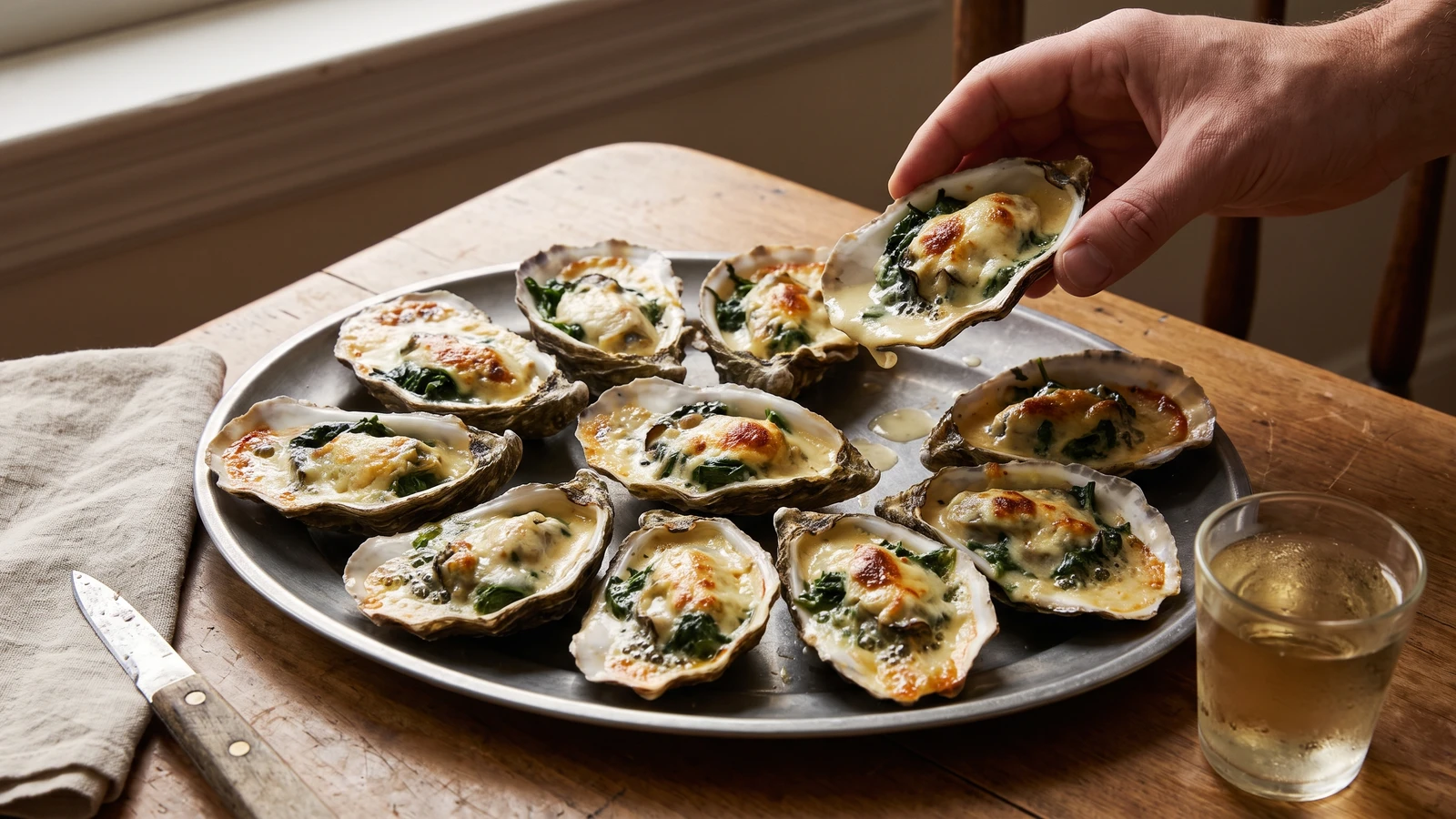
Based on No. 984, Huîtres à la Florentine, from Le Guide Culinaire (1907) by Auguste Escoffier
Twelve oysters, each settled on butter-stewed spinach and masked with Mornay, meet fierce heat just long enough to bronze. The lesson is moisture: dry spinach keeps every shell rich, not watery.
Huîtres à la Florentine (oysters with spinach and Mornay) teaches the discipline of water. The oyster brings liquor, spinach gives up a flood, and Mornay must hold its velvet coat beneath fierce heat. The one true thing is simple: stew the spinach until the pan is dry, or every careful layer above it will loosen.
The grand kitchen behind this terse entry assumed a saucier on staff, a stockpot never off the fire, and a salamander raging above the pass, though the stockpot has no work in this particular shell. At home, make one small saucepan of Mornay and heat the broiler fully before the oysters go beneath it. Twelve oysters replace brigade quantities, and crumpled foil steadies them on an ordinary sheet pan. One cook, one stove, one evening.
The separate sauce station and service tray are brigade scaffolding and can go. Poaching the oysters only to the first curl, stewing the spinach dry in real butter, masking with Mornay, and glazing fast are the dish, so they stay. When it works, each shell holds a plump oyster between deep green spinach and a bubbling ivory-gold cap. Before you touch a pan, remember the spinach: dry means rich, wet means diluted.
Huîtres à la Florentine belongs to the French grand-kitchen canon, especially the Parisian dining room, rather than to the regional cooking of Tuscany. In that kitchen grammar, à la Florentine identifies spinach as the governing garnish, commonly paired with a pale sauce and a quick gratin; the familiar court legend crediting one Florentine queen with bringing spinach to France is better treated cautiously. Applied to oysters, the formula fits neatly inside the shell: butter-stewed spinach below, poached oyster above, Mornay over all, then a fierce glaze.
Quantity
12
Quantity
about 1/2 to 3/4 cup (120 to 180 ml / 120 to 180 g)
reserved from shucking the oysters
Quantity
up to 1/4 cup (60 ml / 60 g)
only if needed to supplement the oyster liquor
Quantity
about 14 packed cups (3.3 L / 450 g)
tough stems removed, washed, thoroughly dried, and finely shredded
Quantity
2 tablespoons (30 ml / 28 g)
Quantity
2 tablespoons (30 ml / 28 g)
Quantity
2 tablespoons (30 ml / 16 g)
Quantity
3/4 cup plus up to 2 tablespoons (180 to 210 ml / 185 to 215 g)
warmed and divided
Quantity
1/4 cup (60 ml / 60 g)
warmed
Quantity
1/2 cup (120 ml / 50 g)
finely grated
Quantity
2 tablespoons (30 ml / 10 g)
finely grated
Quantity
1/4 teaspoon (1.25 ml / 1.5 g), divided, plus more only if needed
Quantity
1/8 teaspoon (0.6 ml / 0.3 g)
Quantity
1 pinch
| Ingredient | Quantity |
|---|---|
| medium live oysters in deep, intact shells | 12 |
| strained oyster liquorreserved from shucking the oysters | about 1/2 to 3/4 cup (120 to 180 ml / 120 to 180 g) |
| water (optional)only if needed to supplement the oyster liquor | up to 1/4 cup (60 ml / 60 g) |
| fresh spinach leavestough stems removed, washed, thoroughly dried, and finely shredded | about 14 packed cups (3.3 L / 450 g) |
| unsalted butter for the spinach | 2 tablespoons (30 ml / 28 g) |
| unsalted butter for the Mornay | 2 tablespoons (30 ml / 28 g) |
| all-purpose flour | 2 tablespoons (30 ml / 16 g) |
| whole milkwarmed and divided | 3/4 cup plus up to 2 tablespoons (180 to 210 ml / 185 to 215 g) |
| heavy creamwarmed | 1/4 cup (60 ml / 60 g) |
| Gruyèrefinely grated | 1/2 cup (120 ml / 50 g) |
| Parmesanfinely grated | 2 tablespoons (30 ml / 10 g) |
| fine salt | 1/4 teaspoon (1.25 ml / 1.5 g), divided, plus more only if needed |
| ground white pepper | 1/8 teaspoon (0.6 ml / 0.3 g) |
| freshly grated nutmeg | 1 pinch |
Set an oven rack 5 to 6 inches (13 to 15 cm) below the broiler and heat it fully. Scrub the closed oysters under cold running water. Protecting your hand with a folded towel or cut-resistant glove, shuck each oyster over a bowl so every drop of liquor is caught. Free the oyster from both muscles, keep it chilled in its liquor, and reserve the twelve deep shell halves. Discard any oyster with a broken shell, an offensive smell, or a shell that remained gaping when tapped before opening. Strain the liquor through a fine sieve to remove grit, then rinse and dry the empty deep shells.
Melt the spinach butter in a wide sauté pan over medium-high heat. Add the shredded spinach in batches, turning each addition until it collapses, then season with half the salt. Continue cooking, stirring and spreading the spinach across the hot surface, until the pan holds no visible liquid and a spoon drawn through it leaves a dry trail. This is the step that decides the dish. If liquid gathers after the spinach rests, return it to the hot pan and cook it away before assembling. Ça se rattrape. Transfer the spinach to a plate so it stops cooking.
Melt the Mornay butter in a small heavy saucepan over medium-low heat. Stir in the flour and cook this roux blanc, a white roux, for 1 to 2 minutes without letting it brown. Add the 3/4 cup (180 ml / 185 g) warm milk gradually, whisking each addition smooth, then whisk in the cream. Bring the sauce to the gentlest simmer and cook for 3 to 4 minutes, stirring, until it thickly coats the back of a spoon. Remove it from the heat before adding the Gruyère, Parmesan, white pepper, nutmeg, and remaining salt. If it becomes grainy or oily, the cheese met too much heat. Take the pan off the stove and whisk in cold milk, 1 teaspoon at a time, until the Mornay comes together again. Taste before adding any more salt, because the oysters and cheeses already carry plenty.
Pour the strained oyster liquor into a small skillet, adding only enough water to make a shallow poaching bath if the oysters yielded very little. Bring it to a bare tremble, never a rolling boil. Slip in the oysters and poach for 20 to 30 seconds, turning once, just until their thin edges begin to curl while the centres remain plump. Lift them out promptly with a slotted spoon. They will finish beneath the broiler, so a full poach here would turn them firm before they ever reach the table.
Crumple strips of foil across a rimmed sheet pan to make twelve stable nests, then settle a deep shell into each one. Divide the spinach among the shells, using about 1 tablespoon in each and keeping it in a compact bed. Lay one poached oyster over every portion. Spoon enough warm Mornay over each oyster to mask it completely, about 1 generous tablespoon, without flooding the shell.
Broil the oysters for 2 to 4 minutes, watching without wandering away, until the Mornay bubbles around the edges and takes mottled golden colour. Rotate the tray if your broiler heats unevenly. If the tops brown before the sauce bubbles, lower the tray by one rack and continue briefly; fierce heat should glaze the sauce, not scorch it while the oyster stays cool. Serve immediately on a stable platter, warning guests that the shells are hot. À table!
1 serving (about 180g)
Culinary guides, cultural storytelling, and the editorial depth that makes cooking meaningful.
Discover Culinary ExplorerChef Juliette
Tiny éperlans, lightly floured and fried until their tails stand crisp, arrive in a generous heap on a napkin with fried parsley and grooved lemon, a weeknight lesson in heat and restraint.

Chef Juliette
Brandade de Morue turns salt cod, warm olive oil, and milk into a pale, silky emulsion: keep everything warm and add the oil slowly, then crown the generous dome with butter-fried bread.

Chef Juliette
Salt cod worked warm with cream, one patient spoonful at a time, until the rough flakes become a glossy Nîmes paste, domed generously and ringed with butter-fried croutons for the table.

Chef Juliette
Wine-poached char packed in its earthenware crock beneath butter gold: a make-ahead first course that turns careful cooling, thorough boning, and one unbroken seal into quiet abundance.