
Chef Juliette
Smelt (Éperlans)
Tiny éperlans, lightly floured and fried until their tails stand crisp, arrive in a generous heap on a napkin with fried parsley and grooved lemon, a weeknight lesson in heat and restraint.
A cooking platform built around craft, culture, and the stories behind what we eat.
Created by Chef Juliette
Based on No. 982, Huîtres à la Mornay, from Le Guide Culinaire (1907) by Auguste Escoffier
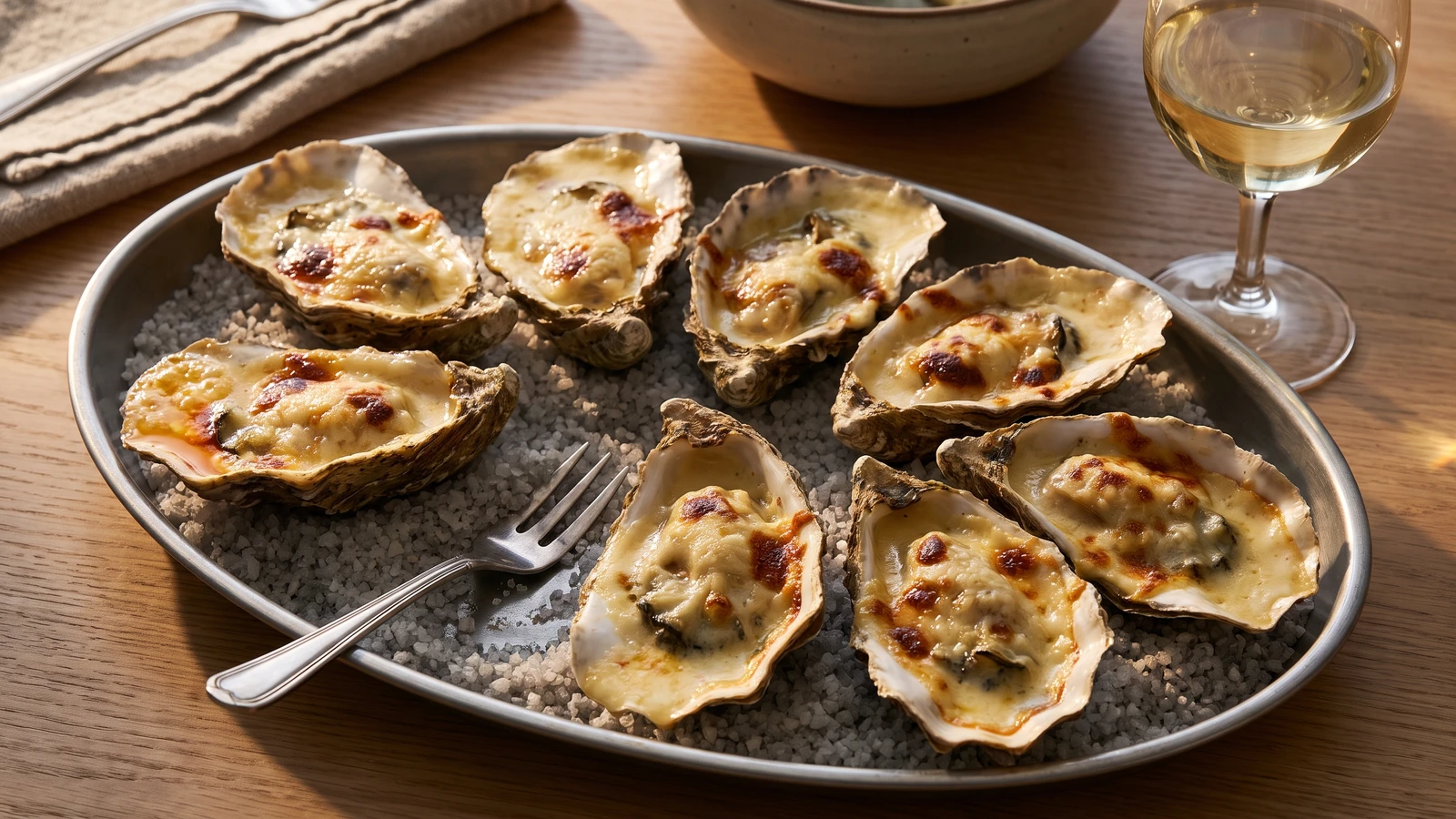
Two oysters to a shell, barely poached beneath silken Sauce Mornay, then Gruyère and butter meet fierce broiler heat. Make the sauce smooth first, and this grand little bite belongs entirely to your table.
Huîtres à la Mornay (oysters glazed with cheese-enriched Béchamel) teaches one hard, useful truth: the sauce must be finished before the oysters feel heat. The shellfish can wait briefly in the cold; once poached, they cannot wait while you chase lumps around a saucepan. Make the Mornay smooth, glossy, and thick enough to cloak a spoon, then everything moves quickly.
The book's kitchen assumed a saucier with finished sauce, stock never off the fire, and a salamander waiting to glaze each order. This entry doesn't need that stock, but it does rely on ready sauce and fierce top heat. At home, make one small saucepan of Mornay and use a fully heated broiler over a salt-cradled tray. Holding gallons of sauce is brigade scaffolding and can go. Brief poaching, two oysters per cleaned deep shell, sauce below and above, grated cheese, melted butter, and a fast glaze are the dish itself, so they stay.
The finished shells should reach the table bubbling at their edges, butter-gold on top and tender within. One cook, one stove, one evening. Before you touch the oyster knife, finish the Mornay.
Huîtres à la Mornay belongs to the Parisian grand-kitchen repertoire, where oysters from France's Atlantic and Channel coasts became a hot hors d'oeuvre through poaching, saucing, and glazing under the salamander. Its identity comes from Sauce Mornay, a cheese-enriched Béchamel, not from Normandy or any single oyster coast, and the method traveled naturally from grand dining rooms to home tables through the broiler. The defining service is immediate: two oysters in a deep shell, their tenderness protected by a sauce browned in moments.
Quantity
16
shells scrubbed
Quantity
1 cup (240 ml / 247 g)
warmed
Quantity
2 tablespoons (30 ml / 28 g)
Quantity
3 tablespoons (45 ml / 23 g)
Quantity
1/3 cup (80 ml / 35 g)
finely grated
Quantity
2 tablespoons (30 ml / 10 g)
finely grated
Quantity
1/8 teaspoon (0.6 ml / 0.8 g)
Quantity
1/8 teaspoon (0.6 ml / 0.3 g)
Quantity
1/3 cup (80 ml / 35 g)
finely grated
Quantity
1 tablespoon (15 ml / 14 g)
melted
Quantity
2 cups (480 ml / 575 g)
for stabilizing the shells
| Ingredient | Quantity |
|---|---|
| live medium cupped oystersshells scrubbed | 16 |
| whole milkwarmed | 1 cup (240 ml / 247 g) |
| unsalted butter | 2 tablespoons (30 ml / 28 g) |
| all-purpose flour | 3 tablespoons (45 ml / 23 g) |
| Gruyère for the Sauce Mornayfinely grated | 1/3 cup (80 ml / 35 g) |
| Parmesan for the Sauce Mornayfinely grated | 2 tablespoons (30 ml / 10 g) |
| fine sea salt | 1/8 teaspoon (0.6 ml / 0.8 g) |
| ground white pepper | 1/8 teaspoon (0.6 ml / 0.3 g) |
| Gruyère for glazingfinely grated | 1/3 cup (80 ml / 35 g) |
| unsalted butter for glazingmelted | 1 tablespoon (15 ml / 14 g) |
| coarse sea saltfor stabilizing the shells | 2 cups (480 ml / 575 g) |
Position an oven rack 5 to 6 inches (13 to 15 cm) below the broiler. Spread the coarse salt in a rimmed, broiler-safe tray, making eight shallow hollows that will hold the shells steady. Scrub the closed oysters under cold running water and keep them cold. Leave the broiler off for now.
Melt the butter in a small heavy saucepan over medium-low heat. Stir in the flour and cook the roux, the butter-and-flour foundation, for 2 minutes without letting it color. Add about one-quarter of the warm milk and whisk until completely smooth, then add the rest in three additions. Bring the sauce to a gentle simmer and whisk for 4 to 5 minutes, until glossy and thick enough to coat the back of a spoon. If lumps appear, pull the pan from the heat and whisk firmly; if a few remain, pass the sauce through a fine sieve. Ça se rattrape.
Remove the Béchamel from the heat. Whisk in the Gruyère and Parmesan until melted, then season cautiously with the fine salt and white pepper. The oysters will bring their own salinity. If the Mornay tightens into a paste or looks oily, stop heating and whisk in a spoonful of the remaining warm milk until it becomes smooth again. Cover the surface directly with parchment to prevent a skin, then turn the broiler to high.
Working over a bowl, open the oysters with a proper oyster knife and save every drop of their liquor. Slide the meat free without cutting it, and do not rinse it. Keep eight sound, deeply cupped bottom shells. Rinse those shells thoroughly to remove grit and fragments, dry them, and strain the oyster liquor through a fine sieve into the smallest skillet or saucepan that will hold the oysters snugly.
Bring the strained oyster liquor only to its first tremble over medium heat. Add the oysters and poach for 30 to 45 seconds, turning once, until their edges just begin to curl while their centers remain plump. Lift them out immediately. Boiling is the enemy here. If they have already firmed more than intended, keep them warm and shorten the final glaze to the few seconds needed to color the sauce.
Nestle the eight cleaned deep shells into the salt bed. Spoon a thin layer of warm Mornay into each shell, set exactly two poached oysters on top, then cover them completely with more sauce. Divide the grated Gruyère evenly over the shells and trickle the melted butter across the cheese. Sauce below, oysters, sauce above: that order protects the shellfish from the broiler and belongs to the dish.
Slide the tray beneath the fully heated broiler and watch without leaving the oven. Glaze for 60 to 90 seconds, rotating the tray if necessary, until the Mornay bubbles at the edges and the cheese takes a quick butter-gold color. Do not wait for a dark crust across every shell; the oysters would pay for it. Carry the tray straight to the table and serve instantly. À table!
1 serving (about 145g)
Culinary guides, cultural storytelling, and the editorial depth that makes cooking meaningful.
Discover Culinary ExplorerChef Juliette
Tiny éperlans, lightly floured and fried until their tails stand crisp, arrive in a generous heap on a napkin with fried parsley and grooved lemon, a weeknight lesson in heat and restraint.

Chef Juliette
Brandade de Morue turns salt cod, warm olive oil, and milk into a pale, silky emulsion: keep everything warm and add the oil slowly, then crown the generous dome with butter-fried bread.

Chef Juliette
Salt cod worked warm with cream, one patient spoonful at a time, until the rough flakes become a glossy Nîmes paste, domed generously and ringed with butter-fried croutons for the table.

Chef Juliette
Wine-poached char packed in its earthenware crock beneath butter gold: a make-ahead first course that turns careful cooling, thorough boning, and one unbroken seal into quiet abundance.