
Chef Juliette
Smelt (Éperlans)
Tiny éperlans, lightly floured and fried until their tails stand crisp, arrive in a generous heap on a napkin with fried parsley and grooved lemon, a weeknight lesson in heat and restraint.
A cooking platform built around craft, culture, and the stories behind what we eat.
Created by Chef Juliette
Based on No. 979, Shrimps and Prawns (Crevettes Grises et Crevettes Roses), from Le Guide Culinaire (1907) by Auguste Escoffier
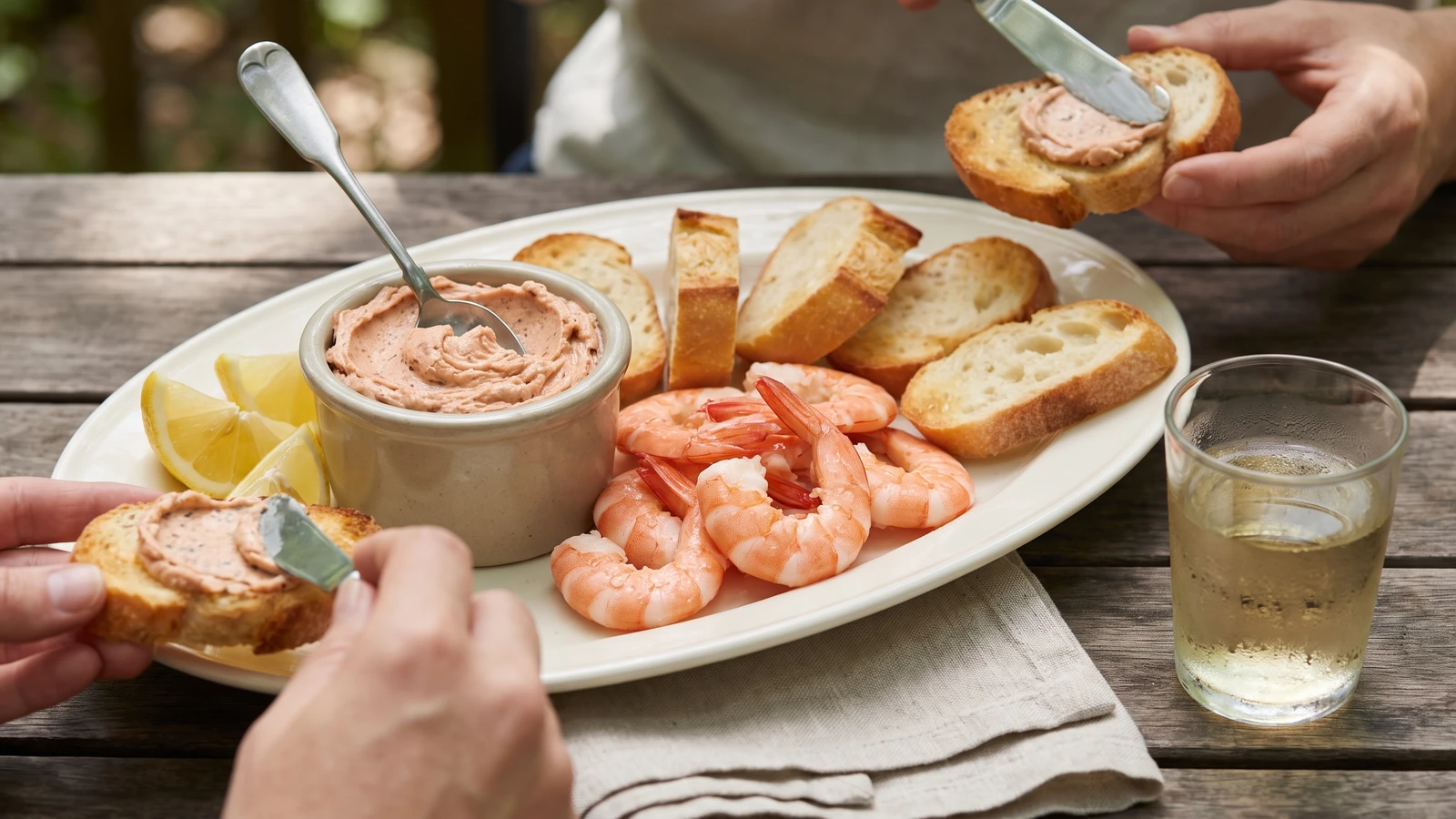
Pink prawns stay sweet and whole, grey shrimps disappear into coral butter, and one cold hors d’œuvre teaches the classical pantry’s best economy: use each shellfish where its character works hardest.
Crevettes grises et crevettes roses teaches a small but fundamental rule: choose shellfish by the work its texture and shell can do. Larger pink prawns give a clean, handsome bite for a cold hors d’œuvre. Tiny grey shrimps surrender their deeper, shell-borne savor to beurre de crevettes grises (grey-shrimp butter). Do not treat them as interchangeable before touching the pan.
The source is a pantry direction rather than a composed formula. Its professional kitchen assumed a garde-manger, the cold-pantry station, with enough hands to send pink prawns into aspics, Mousses, and small cold Soufflé preparations while grey shrimps moved toward garnishes, soups, creams, and butter. For one cook, one stove, one evening, those routes become one coherent hors d’œuvre: gently poached pink prawns, a crock of sieved grey-shrimp butter, and crisp baguette. The multiple preparations and brigade quantities were scaffolding, so they go. The pounding and sieving stay, because they are the dish.
The entry supplies uses rather than proportions, so this home formula adopts the classical working ratio of equal weights grey shrimp and butter. A small processor replaces the mortar, but the tamis, a drum sieve, becomes an ordinary fine-mesh sieve rather than disappearing. Pass the butter through while it is pliable. That single step removes the shell grit and decides whether the finished spread is silk or rubble.
This entry belongs not to one province’s composed dish but to the classical garde-manger, where shellfish were sorted by the work each did best. Along the Channel and North Sea coasts, especially Normandy and Picardy, crevettes grises meant tiny brown shrimp whose shells carry concentrated savor; larger crevettes roses moved from market baskets to Parisian hors d’œuvre platters, aspics, Mousses, and cold Soufflé because their firm flesh held a clean shape. The distinction is not decorative: grey shrimp were pounded into soups, creams, and butter, while pink prawns were shown whole or folded into light preparations.
Quantity
12 ounces (340 g)
Quantity
4 cups (960 ml / 960 g)
Quantity
½ cup (120 ml / 120 g)
Quantity
1 tablespoon (15 ml / 18 g)
Quantity
1
half thinly sliced and half cut into wedges
Quantity
6
Quantity
1
Quantity
6
Quantity
6 ounces (170 g)
thoroughly dried
Quantity
¾ cup (180 ml / 170 g)
pliable but not greasy
Quantity
Up to ⅛ teaspoon (0.6 ml / 0.8 g)
Quantity
1 (about 12 ounces / 340 g)
cut into 20 thin slices
| Ingredient | Quantity |
|---|---|
| raw shell-on pink prawns | 12 ounces (340 g) |
| cold water | 4 cups (960 ml / 960 g) |
| dry white wine | ½ cup (120 ml / 120 g) |
| fine sea salt | 1 tablespoon (15 ml / 18 g) |
| lemonhalf thinly sliced and half cut into wedges | 1 |
| parsley stems | 6 |
| bay leaf | 1 |
| black peppercorns | 6 |
| cooked shell-on grey shrimpsthoroughly dried | 6 ounces (170 g) |
| unsalted butterpliable but not greasy | ¾ cup (180 ml / 170 g) |
| fine sea salt (optional) | Up to ⅛ teaspoon (0.6 ml / 0.8 g) |
| baguettecut into 20 thin slices | 1 (about 12 ounces / 340 g) |
Combine the water, wine, tablespoon of salt, sliced lemon, parsley stems, bay leaf, and peppercorns in a saucepan. Bring to a simmer and let it murmur for 5 minutes, just long enough for the aromatics to perfume the liquid. This is a light cuisson, a seasoned cooking liquor, not a stock that needs hours on the stove.
Lower the heat until the cuisson barely trembles, then add the pink prawns. Stir once and poach for 2 to 4 minutes, depending on size, until the shells are coral and the thickest flesh is opaque and reaches 145°F (63°C). Lift them out immediately and spread them in one layer on a chilled tray. Refrigerate until cold, then peel and devein them. If they overcook and curl into firm little rings, ça se rattrape: slice them lengthwise and serve them on the buttered toasts instead of presenting them whole.
Blot the grey shrimps again; surface water makes the butter weep. Put them, shells and all, into a small food processor and work them to a damp, finely broken paste, stopping twice to scrape down the bowl. Add the softened butter in several pieces and process until the mixture is uniformly coral-grey. If the butter turns shiny or begins to feel oily, stop and chill the bowl for 5 minutes. Do not melt it. You need pliable butter, not liquid fat.
Set a fine-mesh sieve over a bowl and press the shrimp butter through with a flexible scraper, working firmly until only dry shell fragments remain. Scrape every bit of smooth butter from the underside. This is the step that must stay: blending releases the flavor, but sieving removes the grit. If the butter stiffens before it passes, leave it at room temperature for 5 to 10 minutes; if it grows greasy, chill it briefly. Ça se rattrape. Taste and add up to the remaining ⅛ teaspoon salt only if the shrimps need it.
Pack the beurre de crevettes grises into a small crock, cover it, and chill for at least 30 minutes so the flavor settles. Meanwhile, arrange the baguette slices on a baking sheet and toast at 375°F (190°C) for 8 to 10 minutes, turning once, until dry through and gold at the edges. Let them cool completely; warm bread softens the butter and loses its crisp bite.
Take the shrimp butter from the refrigerator 15 minutes before serving. It should yield cleanly to a knife without looking oily. Set the crock beside the chilled pink prawns, lemon wedges, and baguette toasts, letting each guest spread and assemble their own. For a picnic, carry the prawns and butter over ice and uncover them only when the bread is ready. Small work, deep flavor. À table!
1 serving (about 190g)
Culinary guides, cultural storytelling, and the editorial depth that makes cooking meaningful.
Discover Culinary ExplorerChef Juliette
Tiny éperlans, lightly floured and fried until their tails stand crisp, arrive in a generous heap on a napkin with fried parsley and grooved lemon, a weeknight lesson in heat and restraint.

Chef Juliette
Brandade de Morue turns salt cod, warm olive oil, and milk into a pale, silky emulsion: keep everything warm and add the oil slowly, then crown the generous dome with butter-fried bread.

Chef Juliette
Salt cod worked warm with cream, one patient spoonful at a time, until the rough flakes become a glossy Nîmes paste, domed generously and ringed with butter-fried croutons for the table.

Chef Juliette
Wine-poached char packed in its earthenware crock beneath butter gold: a make-ahead first course that turns careful cooling, thorough boning, and one unbroken seal into quiet abundance.