
Chef Juliette
Homard à l’Américaine
Lobster shells blaze red over fierce heat, brandy catches, and tomato-wine liquor reduces to a shining sauce bound with coral and cold butter. The lesson is simple: after the finish, never let it boil.
A cooking platform built around craft, culture, and the stories behind what we eat.
Created by Chef Juliette
Based on No. 972, Soufflé d’Écrevisses à la Florentine, from Le Guide Culinaire (1907) by Auguste Escoffier
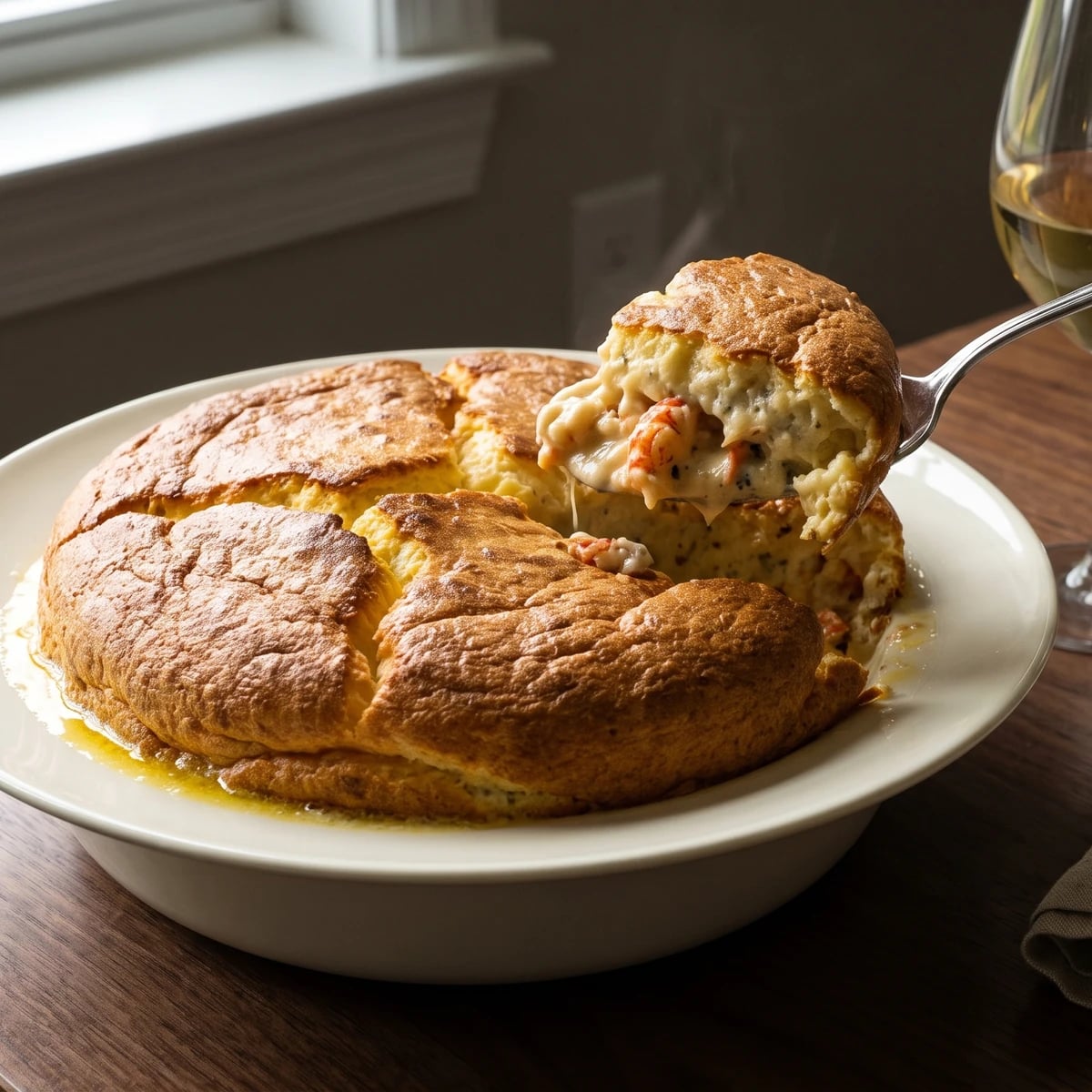
Soufflé d’Écrevisses à la Florentine rises on disciplined folding: Parmesan, crayfish cream, tender tails, and black truffle held in a golden crown that belongs at the table the instant it leaves the oven.
Soufflé d’Écrevisses à la Florentine (crayfish soufflé layered with truffle and tails) teaches the governing fact of every hot soufflé: the rise lives in the beaten whites. The crayfish cream provides savor, Parmesan gives the base strength, and the dark truffle and coral tails appear in generous bands, but none may be allowed to crush that structure. When it is right, the crown stands butter-gold above the dish and the first spoon opens an ivory, shellfish-rich center.
The original formula assumed a saucier on staff, a stock never off the fire behind the service, a silver timbale, and a salamander close by. The stockpot and salamander are brigade scaffolding, not this dish. At home, prepare the Soufflé au Parmesan (No. 2295a) and the Lobster Cream (No. 295), made with crayfish, first; a buttered parchment collar on a one-quart ceramic dish and a thoroughly heated oven supply the honest household equipment. The book’s ratio remains exact, two tablespoons of crayfish cream to one pint of Parmesan soufflé preparation. One pint makes four main-dish portions, while the tails and truffle are measured because there is no brigade cook standing by to judge each layer. That is all that changed, and why.
What must stay is the sequence: combine lightly, layer without pressing, and bake immediately. Fold until the cream is only just dispersed, then stop; perfect smoothness is not the aim. That gentle folding is the step that decides the Soufflé d’Écrevisses.
Soufflé d’Écrevisses à la Florentine belongs to the Parisian grand-kitchen table, where a cheese soufflé, shellfish cream, and costly garnishes could be brought together at the last moment by separate stations. The soufflé traveled readily to bourgeois special-occasion tables because a household oven and a practiced folding hand could reproduce its generous rise without a brigade. Although à la florentine usually signals spinach elsewhere in the canon, this numbered composition contains none; its defining layers are crayfish tails and truffle.
Quantity
1 pint / 2 cups (475 ml / about 475 g) Soufflé au Parmesan (No. 2295a)
Quantity
2 tablespoons (30 ml / about 30 g) Lobster Cream (No. 295), prepared with crayfish rather than lobster
Quantity
2/3 cup (160 ml / 85 g)
thoroughly drained and patted dry
Quantity
1 small (about 20 g)
drained if preserved and sliced paper-thin
Quantity
1 tablespoon (15 ml / 14 g)
softened
| Ingredient | Quantity |
|---|---|
| finished, unbaked Soufflé au Parmesan preparation | 1 pint / 2 cups (475 ml / about 475 g) Soufflé au Parmesan (No. 2295a) |
| crayfish cream | 2 tablespoons (30 ml / about 30 g) Lobster Cream (No. 295), prepared with crayfish rather than lobster |
| cooked crayfish tailsthoroughly drained and patted dry | 2/3 cup (160 ml / 85 g) |
| fresh or jarred whole black truffledrained if preserved and sliced paper-thin | 1 small (about 20 g) |
| unsalted buttersoftened | 1 tablespoon (15 ml / 14 g) |
Set a rack in the lower-middle position, place a heavy baking sheet on it, and heat a conventional oven to 400°F (200°C). Brush the inside of a straight-sided one-quart (950 ml) soufflé dish with the softened butter, working upward from base to rim. Tie a buttered parchment collar around the outside so it rises 2 inches (5 cm) above the rim, with the buttered face turned inward. The old silver timbale has no magic the ceramic dish lacks; straight sides, real butter, and full heat are what matter.
Place the Lobster Cream (No. 295), prepared with crayfish rather than lobster, in a large bowl. Fold a heaped spoonful of the finished, unbaked Soufflé au Parmesan (No. 2295a) into it to lighten the cream, then add the remaining preparation in two additions. Cut down through the center with a broad spatula, sweep along the bottom, and turn the mixture over itself while rotating the bowl. Stop as soon as only faint coral streaks remain. If the mixture turns slack because it was overworked, do not keep stirring. Ça se rattrape: divide it among four buttered 6-ounce (180 ml) ramekins, build the same layers in each, and use the shorter baking time given below. The individual walls will support the weakened structure.
Spoon one-third of the soufflé preparation into the dish without knocking it against the counter. Scatter over half the dry crayfish tails and half the sliced truffle, keeping the heavier garnish about 1/2 inch (1 cm) away from the wall so a clear ring of soufflé can climb. Repeat with another third of the preparation and the remaining tails and truffle, then cover with the final third. Smooth the top lightly and run a clean thumb around the inner rim to leave a shallow channel. Do not press the layers. Their abundance should appear when the spoon goes in, not sit like ballast on the crown.
Set the dish on the heated baking sheet and bake for 20 to 25 minutes. Keep the oven door shut for at least the first 18 minutes; opening it early releases the heat before the whites have set their structure. The Soufflé d’Écrevisses is ready when it stands several inches above the rim, the crown is deep butter-gold, the sides are set, and the center retains only a small, dignified tremble. If the top colors too quickly, reduce the oven to 375°F (190°C) without opening the door. For the ramekin rescue, bake for 13 to 16 minutes.
Remove the parchment collar gently and carry the Soufflé d’Écrevisses straight to the table. Open the center with a large serving spoon, cutting deeply enough to give each person the Parmesan base, crayfish cream, tails, and truffle together. A hot soufflé settles as it is served; that is its nature, not a failure. Warm plates, waiting guests, no delay. À table!
1 serving (about 140g)
Culinary guides, cultural storytelling, and the editorial depth that makes cooking meaningful.
Discover Culinary Explorer
Chef Juliette
Lobster shells blaze red over fierce heat, brandy catches, and tomato-wine liquor reduces to a shining sauce bound with coral and cold butter. The lesson is simple: after the finish, never let it boil.

Chef Juliette
Lobster blushed red in clarified butter, then wrapped in a Bordeaux-built sauce of white wine, brandy, fumet, Espagnole, and tomato, finished with cold butter for a generous table.

Chef Juliette
A whole lobster boiled in vinegar court-bouillon, opened on its linen-lined platter, and sent to table with floury potatoes and melted butter. Timing is the luxury, and twenty minutes decides it.

Chef Juliette
One lobster, one fierce oven, and a Champagne-butter baste: Homard à la Broche teaches the discipline of keeping shellfish glossy, succulent, and generous enough for a celebration table.