Culinary Explorer

A cooking platform built around craft, culture, and the stories behind what we eat.
Discover Culinary Explorer
Langouste à la Russe

Langouste à la Russe

Created by Chef Juliette

Based on No. 965, Langouste à la Russe, from Le Guide Culinaire (1907) by Auguste Escoffier

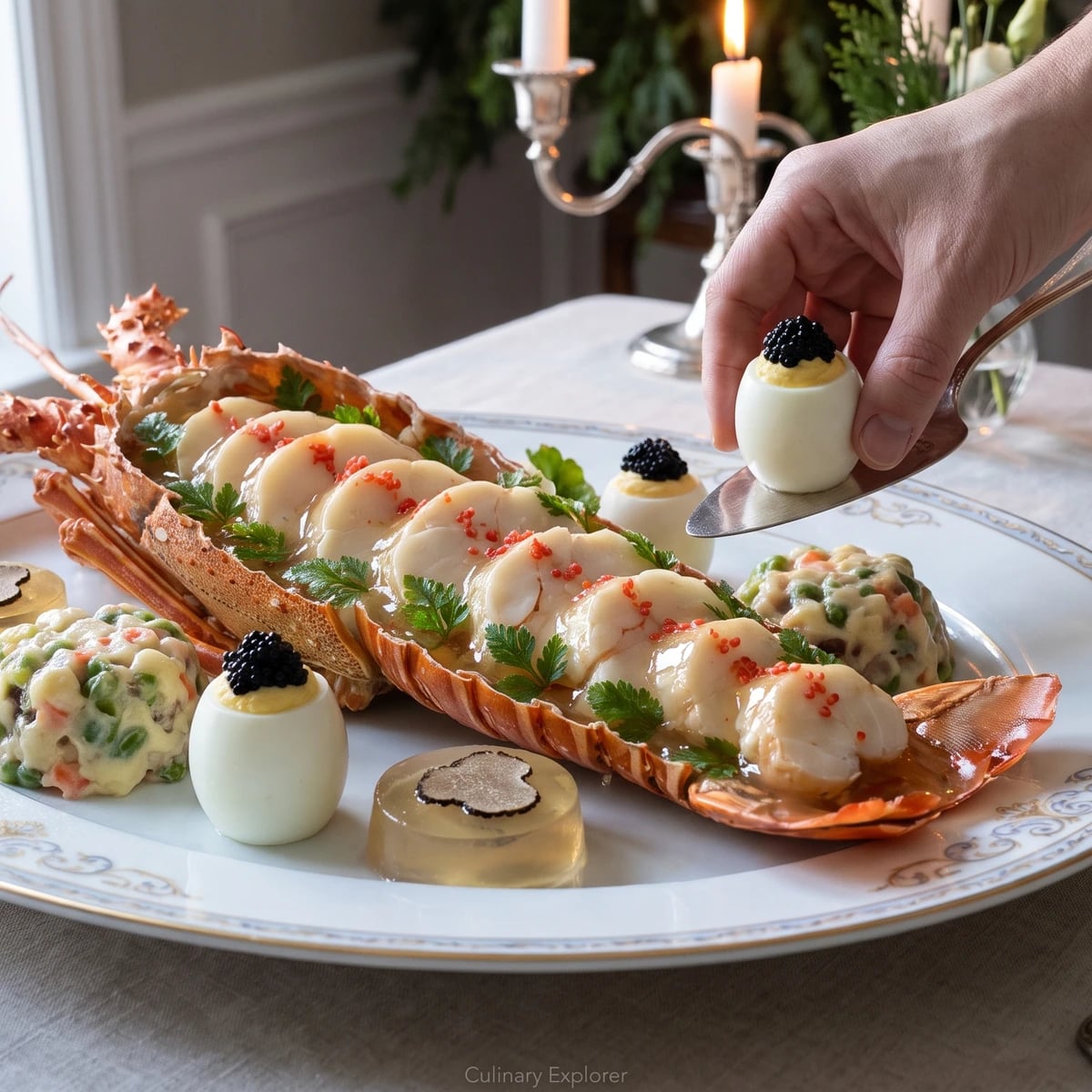
A cold celebration platter of spiny lobster collops lacquered with white chaud-froid and clear aspic, surrounded by moulded salade russe, caviare-filled eggs, truffle, and chervil, scaled with discipline for four.

Main Dishes
French
Celebration
Special Occasion
New Years
1 hr 30 min
Active Time
25 min cook5 hr 30 min total
Yield4 servings

Langouste à la Russe (spiny lobster glazed cold in white sauce and aspic) teaches the discipline of cold coating. Before you touch a pan, know this: the lobster and its tray must be thoroughly cold, while the chaud-froid and aspic must remain fluid enough to settle in thin, even layers. The white sauce supplies flavour and opacity; repeated coats of clear aspic give the collops their glassy sheen.

The original assumed a saucier with white fish chaud-froid and clear aspic ready from stock never off the fire, plus a garde-manger arranging ten dariole moulds and ten caviare-filled eggs. It needed no salamander, because all its finishing work is cold. Your honest equivalent is one complete home-scale Homard à la Russe (No. 961), made with a single langouste, four small moulds, four eggs, a refrigerator, and a chilled oval platter. One cook, one stove, one evening.

A langouste has no claws, so its tail must provide both the graduated collops and the diced meat for the Salade Russe. Reserve the broad, handsome slices first. The towering display cushion and tenfold repetition were brigade scaffolding and may go; the white chaud-froid, coral and chervil decoration, repeated aspic coats, moulded salad, caviare eggs, and clear jelly border are the dish and must stay. The step that decides everything is the glazing, thin coat by thin coat, with patience between them.

Langouste à la Russe belongs to the Parisian grand cold-service repertory, where shellfish was returned to its shell and dressed with chaud-froid, aspic, truffle, and moulded garnishes for a celebration table. Its name points to the Salade Russe and caviare in the garnish, not to a Russian household origin, and the spiny-lobster form is explicitly a species change from Homard à la Russe rather than a separate sauce. The canon also circulated names such as à la Néva and à la Moscovite, but treated them as variable presentations without fixed classical principles.

The technique, the tradition, and the story behind every dish.

Discover Culinary Explorer

Ingredients

Homard à la Russe finished component, prepared with spiny lobster

Quantity

1 complete home-scale preparation of Homard à la Russe (No. 961), scaled to 4 servings and prepared from 1 whole raw spiny lobster, 3 to 3½ lb (1.35 to 1.6 kg), in place of clawed lobster

Use langouste as the crustacean throughout the referenced preparation

Equipment Needed

  • Large pot appropriate to the linked lobster-cooking method
  • Four 4 fl oz (120 ml) dariole moulds or straight-sided ramekins
  • Fine-mesh sieve
  • Wire rack set over a shallow tray
  • 1¼-inch (3 cm) round cutter
  • Large chilled oval platter

Instructions

  1. 1

    Reach for the reference

    Prepare one complete home-scale Homard à la Russe (No. 961), using the linked preparation's cooking, extraction, white fish chaud-froid, Salade Russe, egg garnish, aspic glazing, and dishing instructions as written. Replace only the clawed lobster with one whole langouste. This entry changes the species, not the formula, so add no new flavouring and remove none.

  2. 2

    Scale for four

    Scale the linked preparation to four servings. The original ten dariole moulds and ten hard-boiled eggs become four of each, and the single langouste replaces the banquet-sized lobster quantity; keep the proportions among mayonnaise, chaud-froid, aspic, and Salade Russe unchanged. Use four 4 fl oz (120 ml) moulds or straight-sided ramekins. Reduction in repetition is home-kitchen scaffolding, not a change to the dish.

  3. 3

    Protect the tail

    Follow the referenced cooking and extraction directions, taking particular care to draw the tail meat from its shell in one piece. Cut the broad central meat into enough graduated collops to cover the back of the shell, then dice only the narrow ends and remaining trimmings for the salad. If a collop splits, fit the pieces together on the cold rack and let the first aspic coat bind them; once glazed, the join disappears. Ça se rattrape.

  4. 4

    Glaze by degrees

    At the repeated aspic-coating stage of the cited preparation, keep the decorated chaud-froid-coated collops on a rack over a shallow tray. The collops must be cold and the aspic cool, clear, and slightly syrupy. Apply thin coats, chilling each until set before adding the next, until the surface has an even cold sheen. If the aspic beads and runs away, either the collops are too warm or the jelly is too loose; chill both briefly and try again. If the aspic sets rubbery in the bowl, stand it over barely warm water and stir only until fluid.

  5. 5

    Set the platter

    Dip each filled salad mould in hot water for two seconds, dry its outside, and invert it onto a chilled oval platter. If it refuses to release, warm it for one second more; don't force a knife down the side and scar the surface. Omit the high exhibition cushion and set the cleaned shell directly on the platter, arranging the graduated collops along its back. Alternate the four moulded salads with the four upright caviare-filled eggs, then border the platter with clear jelly roundels topped with truffle. A plain 1¼-inch (3 cm) round cutter honestly replaces the old fancy cutter.

  6. 6

    Chill and serve

    Return the finished platter to the refrigerator for twenty minutes so every element settles, then serve it directly from the cold while the aspic is bright and the caviare tastes fresh. Keep the platter below 40°F (4°C) until serving and don't leave it at the table for more than two hours. Bring it out whole, with a broad server for the salad and collops. À table!

Chef Tips

  • Ask for a whole spiny lobster, not a clawed lobster sold under the same market name. You need a heavy tail with an intact shell because the meat supplies both the collops and salad, while the shell supports the finished presentation.
  • Buy the langouste from a fishmonger who handles it carefully and cook it the day you bring it home. Have the fishmonger dispatch it if you prefer, then carry it home well chilled rather than letting delicate shellfish wait in a warm bag.
  • Use the creamy internal parts in the white chaud-froid only when they are fresh, sweet-smelling, and permitted by local shellfish guidance. If they smell bitter or ammoniacal, discard them and leave the sauce cleanly white.
  • Choose proper caviare in the quantity the linked preparation specifies. Lumpfish roe will provide salt and colour, but its firmer texture changes the soft contrast intended between egg, roe, aspic, and lobster.
  • Pour a very dry Champagne, particularly a blanc de blancs, or a mineral Chablis. Both cut through the mayonnaise and chaud-froid without bullying the sweetness of the langouste.

Advance Preparation

  • The sauce, aspic, and Salade Russe stages within Homard à la Russe (No. 961) may be completed a day ahead and kept separately covered in the refrigerator.
  • Cook, extract, slice, decorate, and glaze the langouste up to 6 hours before serving. Keep the collops covered without touching their glazed surfaces.
  • Mould the salads up to 6 hours ahead, but fill the eggs with caviare and assemble the platter within the final hour so the roe remains distinct and glossy.

Frequently Asked Questions

Nutrition Information

1 serving (about 260g)

Calories
490 calories
Total Fat
32 g
Saturated Fat
5 g
Trans Fat
0 g
Unsaturated Fat
24 g
Cholesterol
125 mg
Sodium
1050 mg
Total Carbohydrates
17 g
Dietary Fiber
3 g
Sugars
3 g
Protein
34 g

Note: Chef personas and recipes are created with AI assistance. Cook with care: follow safe food-handling practices, check doneness with a thermometer when needed, and adapt for allergies and your kitchen.

Where cooking meets culture.

Culinary guides, cultural storytelling, and the editorial depth that makes cooking meaningful.

Discover Culinary Explorer

More from Fish - Lobster (Homard)

Browse the full collection