
Chef Juliette
John Dory (St. Pierre)
John Dory has the delicacy of sole and the firmness of turbot. A light flouring, a quick butter sauté, and nut-brown beurre noisette show exactly why looks never mattered.
A cooking platform built around craft, culture, and the stories behind what we eat.
Created by Chef Juliette
Based on No. 961, Homard à la Russe, from Le Guide Culinaire (1907) by Auguste Escoffier
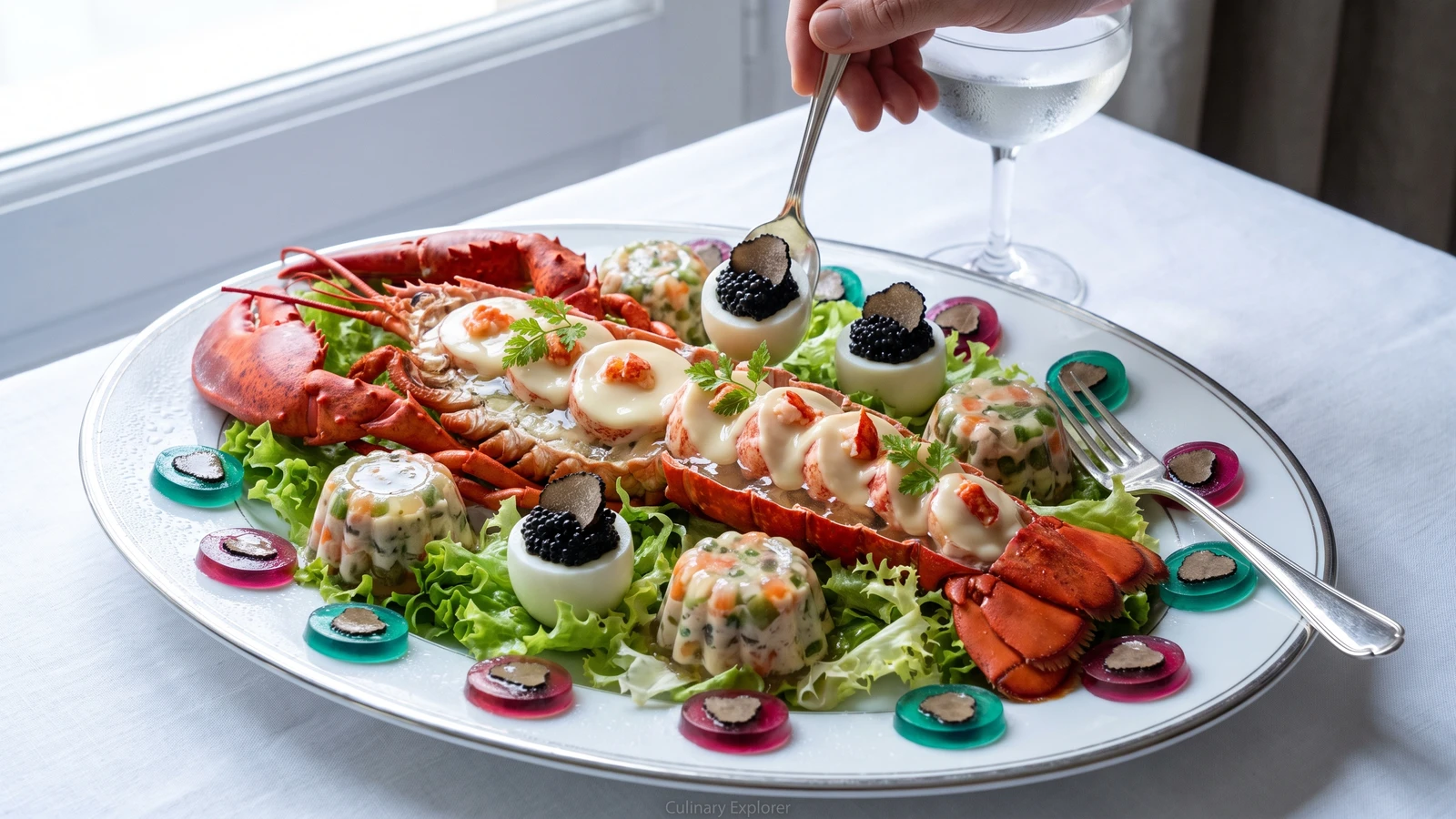
Homard à la Russe turns cold lobster into a lesson in patience: white chaud-froid built on fish velouté, repeated aspic glazing, moulded salade russe, and caviar-crowned eggs arranged with generous ceremony.
Homard à la Russe (cold lobster with Salade Russe and caviar) teaches the discipline of cold glazing. One true thing matters before you touch a pan: every surface must be cold and dry, while each coating remains fluid but never warm. That narrow meeting gives you opaque white chaud-froid, clear aspic, and lobster slices that gleam instead of sliding out of their coats.
The original assumed a saucier on staff, a fish stockpot never off the fire, ten dariole-moulds, and enough cold space for a banquet procession. Here, good unsalted fish stock builds one small white velouté, four 120 ml ramekins replace the little baba moulds, and a low lettuce cushion replaces the sculpted base. The brigade-sized architecture is scaffolding and can go. Repeated glazing, moulded Salade Russe, caviar-filled eggs, and the graduated lobster slices are the dish, so they stay. One cook, one stove, one evening.
The source rubs the lobster's creamy tomalley through the sauce. This home translation omits it because contaminants can concentrate in that organ and cooking does not reliably remove them; the fish velouté is reduced a shade further instead. Cooked coral, when the lobster provides it, remains as the traditional decoration.
Work in thin layers and let each become firm before adding the next. If a coat slips, don't bury it under another. Chill the slice, lift away the loose sauce, and begin again more thinly. Ça se rattrape. This patience is the one step that decides the dish.
Homard à la Russe belongs to the formal Parisian table, where French cooks used the phrase à la russe for garnishes associated with Russian luxury, especially caviar, vegetable salad, and clear jelly. It is not a Russian household lobster dish; its structure is French grand-kitchen work, with chaud-froid sauce and aspic turning cooked seafood into a cold celebration centerpiece. From banquet rooms it passed to ambitious home tables, where the number of moulds may shrink but the glossy procession remains.
Quantity
1, about 2½ pounds (1.1 kg)
Quantity
3 quarts (2.8 litres / 2.8 kg)
Quantity
1 cup (240 ml / 240 g)
Quantity
¼ cup plus 2 teaspoons (70 ml / 84 g)
divided
Quantity
1 (about 150 g)
quartered
Quantity
2 (about 200 g)
1 sliced and 1 cut into 6 mm dice
Quantity
1
Quantity
1 cup (240 ml / 240 g)
Quantity
2 tablespoons (30 ml / 28 g)
Quantity
2 tablespoons (30 ml / 18 g)
Quantity
½ cup (120 ml / 120 g)
Quantity
1⅔ cups (400 ml / 400 g) from Another Method of Preparing Aspics de Filets de Soles (No. 916)
Quantity
2 teaspoons (10 ml / 10 g)
Quantity
¼ teaspoon (1.25 ml / 0.5 g)
Quantity
2 (about 180 g)
peeled and cut into 6 mm dice
Quantity
½ cup (120 ml / 60 g)
cut into 6 mm pieces
Quantity
½ cup (120 ml / 70 g)
Quantity
⅓ cup (80 ml / 50 g)
cut into 6 mm dice
Quantity
½ cup (120 ml / 115 g)
Quantity
4
Quantity
3 tablespoons (45 ml / 50 g)
Quantity
1 (about 15 g)
thinly sliced
Quantity
16
Quantity
2 teaspoons (10 ml / 8 g)
rubbed through a fine sieve, if present
Quantity
1 small head (about 200 g)
leaves washed and thoroughly dried
Quantity
4 Barquettes (No. 314)
| Ingredient | Quantity |
|---|---|
| live lobster | 1, about 2½ pounds (1.1 kg) |
| water | 3 quarts (2.8 litres / 2.8 kg) |
| dry white wine | 1 cup (240 ml / 240 g) |
| fine sea saltdivided | ¼ cup plus 2 teaspoons (70 ml / 84 g) |
| yellow onionquartered | 1 (about 150 g) |
| medium carrots1 sliced and 1 cut into 6 mm dice | 2 (about 200 g) |
| bouquet garni | 1 |
| unsalted fish stock | 1 cup (240 ml / 240 g) |
| unsalted butter | 2 tablespoons (30 ml / 28 g) |
| plain flour | 2 tablespoons (30 ml / 18 g) |
| heavy cream | ½ cup (120 ml / 120 g) |
| very clear fish aspic, prepared and kept fluid for glazing and moulding | 1⅔ cups (400 ml / 400 g) from Another Method of Preparing Aspics de Filets de Soles (No. 916) |
| fresh lemon juice | 2 teaspoons (10 ml / 10 g) |
| ground white pepper | ¼ teaspoon (1.25 ml / 0.5 g) |
| small waxy potatoespeeled and cut into 6 mm dice | 2 (about 180 g) |
| green beanscut into 6 mm pieces | ½ cup (120 ml / 60 g) |
| frozen peas | ½ cup (120 ml / 70 g) |
| cornichonscut into 6 mm dice | ⅓ cup (80 ml / 50 g) |
| mayonnaise made with pasteurized egg | ½ cup (120 ml / 115 g) |
| large eggs | 4 |
| sturgeon caviar | 3 tablespoons (45 ml / 50 g) |
| small black trufflethinly sliced | 1 (about 15 g) |
| small chervil leaves | 16 |
| cooked lobster coral (optional)rubbed through a fine sieve, if present | 2 teaspoons (10 ml / 8 g) |
| Boston lettuceleaves washed and thoroughly dried | 1 small head (about 200 g) |
| prepared small barquettes for alternate service (optional) | 4 Barquettes (No. 314) |
Chill two trays, a wire rack, and the serving platter. Liquefy the very clear fish aspic from Another Method of Preparing Aspics de Filets de Soles (No. 916) over a gentle water bath until it flows like light syrup, keeping it below 32°C. Pour 100 ml into a small flat dish to form a layer about 4 mm thick and refrigerate it for the roundels. Keep the remainder fluid over barely warm water. If it begins to set around the bowl, warm it for a few seconds and stir; never boil it.
Put the water, wine, ¼ cup of the salt, onion, sliced carrot, and bouquet garni in a stockpot. Boil for 15 minutes to make a court-bouillon, an aromatic poaching liquor. Quiet the lobster in the freezer for 20 minutes, dispatch it swiftly through the head with a heavy knife, and lower it into the boiling liquor. Cover until the liquid returns to a simmer, then cook gently for 15 to 17 minutes, until the thickest part of the tail reaches 63°C and the meat is opaque. Drain for 10 minutes, chill briefly over ice without soaking it, then refrigerate for 30 minutes.
Detach the tail and claws without crushing the carapace, because the shell returns to the platter. Cut through the thin underside of the tail shell and ease the meat out whole. Crack the claws carefully and remove their meat with the knuckles. Slice the tail crosswise into eight even medallions about 8 mm thick; dice the claw and knuckle meat into 6 mm pieces for the Salade Russe. Reserve cooked coral if present, discard the tomalley, and keep every portion cold and covered.
Melt the butter over gentle heat, stir in the flour, and cook this white roux for 2 minutes without letting it colour. Whisk in the fish stock a little at a time, then simmer for 6 minutes until the velouté is smooth and coats the back of a spoon. Add the cream and reduce gently until pale ivory and full-bodied. Off the heat, whisk in 60 ml of fluid aspic, the lemon juice, white pepper, and a small pinch of the remaining salt. Pass the chaud-froid through a fine sieve, then stir it over ice until cool but still fluid. If it becomes lumpy or too firm, warm the bowl for a few seconds and whisk in a teaspoon of fish stock.
Dry the chilled lobster medallions thoroughly and arrange them on the cold rack. Spoon over a thin coat of chaud-froid and refrigerate for 5 to 7 minutes, until firm. Repeat twice, building an even white covering without burying the shape of the lobster. Place a speck of sieved coral and two chervil leaves on each slice, then brush with a thin layer of fluid aspic. Chill and repeat the aspic coating two more times for a clear sheen. If a coat slips, the slice or sauce was too warm. Lift away the loose layer, chill both, and begin again thinly. Ça se rattrape.
Cook the diced potatoes and carrot separately in salted water until tender but still sharply shaped, about 6 to 8 minutes. Blanch the green beans for 3 minutes and the peas for 1 minute. Drain every vegetable well, spread them on a towel-lined tray, and chill completely; trapped water loosens the mayonnaise and prevents the moulds from setting. Fold the vegetables with the cornichons, diced lobster, mayonnaise, and 45 ml of fluid aspic. Taste cold and correct the salt. The mixture should hold a mound from the spoon.
Set four dariole-moulds, small baba moulds or 120 ml straight-sided ramekins, over ice. Spoon a little aspic into each and rotate until the inside wears a thin, even coating, following the mould-clothing method in Another Method of Preparing Aspics de Filets de Soles (No. 916). Let it set, fix one truffle slice to the bottom with a drop of aspic, and add another thin coat. Pack in the Salade Russe without air pockets, level the tops, and seal each with a spoonful of aspic. Refrigerate for at least 2 hours. For the source's optional alternate service, fill four prepared Barquettes (No. 314) shortly before serving instead of moulding the salad.
While the salads set, lower the eggs into simmering water and cook for 10 minutes. Chill, peel, and cut each horizontally one-third of its height above the rounded base. Trim the slightest sliver from the bottom so each cup stands upright, then remove the yolk carefully. Keep the egg cups covered and cold. Cut the set sheet of aspic into 2.5 cm roundels with a plain or fluted cutter and place a small piece of truffle on each. Fill the eggs with caviar in small pyramids no more than 30 minutes before serving.
Arrange the dry lettuce leaves as a low cushion on the chilled platter and reassemble the lobster shell on top. Graduate the glazed tail medallions from large to small along its back. Dip each dariole-mould in hot water for 2 seconds, dry the outside, and invert it beside the lobster; if one clings, give it one more second in the water rather than pulling at the salad. Alternate the four moulded salads with the four upright caviar eggs. Border the platter with the clear aspic roundels and their truffle pieces. Keep the platter cold until it goes to the table, then serve within 30 minutes. À table!
1 serving (about 490g)
Culinary guides, cultural storytelling, and the editorial depth that makes cooking meaningful.
Discover Culinary ExplorerChef Juliette
John Dory has the delicacy of sole and the firmness of turbot. A light flouring, a quick butter sauté, and nut-brown beurre noisette show exactly why looks never mattered.

Chef Juliette
Fresh haddock proves its delicacy in the meunière pan: a fine flour crust, moist pearly flakes, and beurre noisette sharpened with lemon and parsley, ready from one skillet in half an hour.

Chef Juliette
Éperlans à l’Anglaise turns small fish into a lesson in disciplined coating: boned smelts under a close, crisp crumb, pan-fried in clarified butter and finished with bright, half-melted maître d’hôtel butter.

Chef Juliette
Tiny smelts, shallot, mushrooms, white wine, gratin sauce, and fine bread raspings meet a fierce oven, where the fish must turn tender in the same breath the buttered crust bronzes.