
Chef Juliette
Smelt (Éperlans)
Tiny éperlans, lightly floured and fried until their tails stand crisp, arrive in a generous heap on a napkin with fried parsley and grooved lemon, a weeknight lesson in heat and restraint.
A cooking platform built around craft, culture, and the stories behind what we eat.
Created by Chef Juliette
Based on No. 955, Côtelettes de Homard Arkangel, from Le Guide Culinaire (1907) by Auguste Escoffier
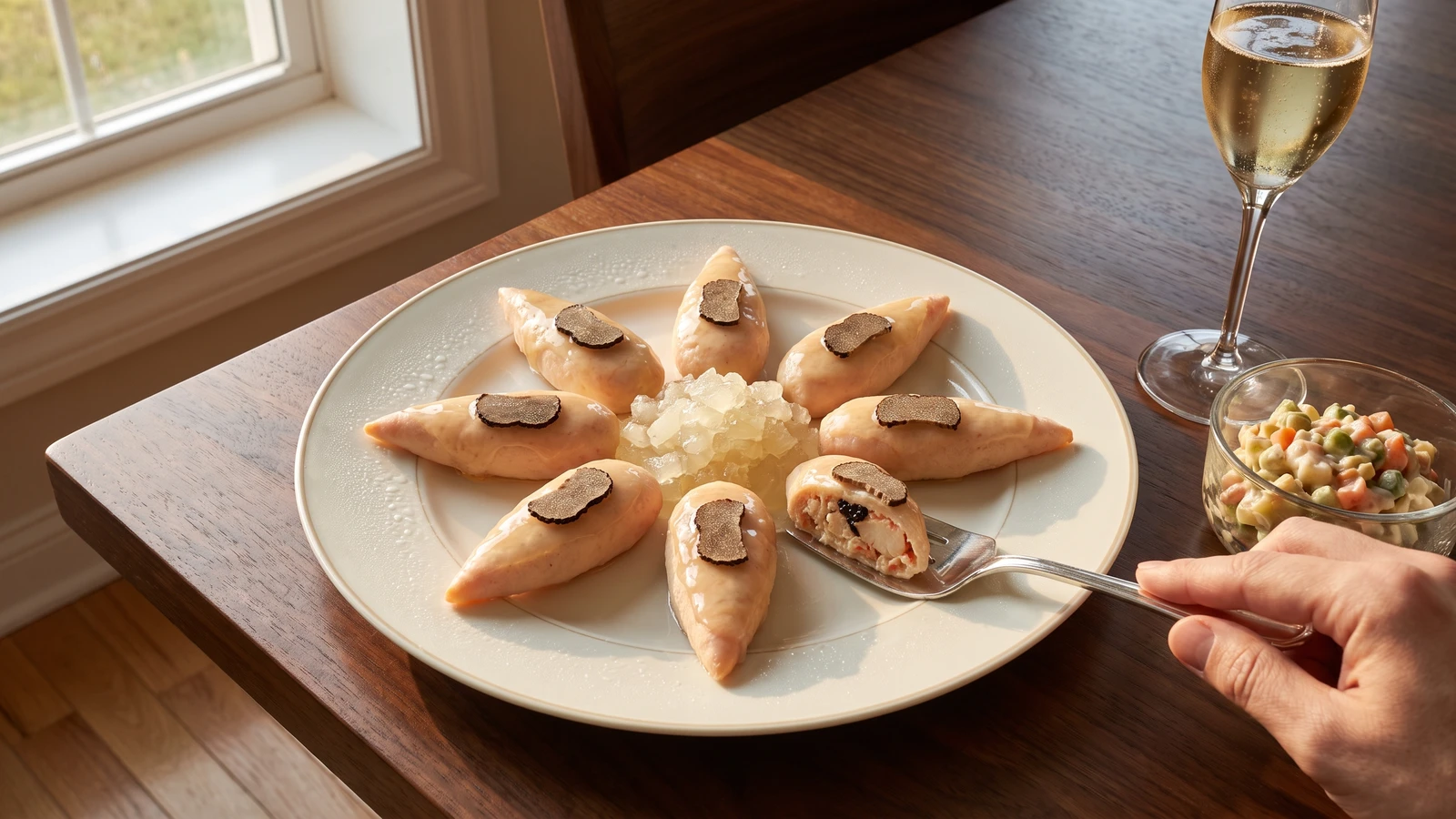
Cold lobster, caviare, and mousse set in the shape of cutlets, veiled with lobster chaud-froid, marked with black truffle, and glazed in aspic: a lesson in temperature, texture, and exact proportion.
Côtelettes de Homard Arkangel (cold moulded lobster cutlets) teach the discipline of the cold mousses: temperature is structure. The one true thing to know before touching a pan is that every element must be properly cold, while the coating must remain fluid enough to flow and thick enough to cling. Lobster and caviare form the salpicon, a finely diced mixture, held with an equal weight of Mousse de Homard (No. 956); the set shapes then wear chaud-froid, a chilled velouté coating, followed by clear aspic.
The original assumed a saucier on staff, a fish stockpot never off the fire, prepared jelly waiting in the cold room, and ranks of metal cutlet moulds. At home, one small saucepan builds the sauce, powdered gelatin gives clean and predictable setting, and shallow silicone moulds or a lined tray make the cutlet shapes. The permanent stockpot and multiple moulds were brigade scaffolding and can go. The proportions cannot: lobster and caviare remain equal by weight, and their combined weight is matched by the mousse. One cook, one stove, one evening.
When the côtelettes are right, their coating is smooth and ivory-pink, the black truffle shows beneath a glass-clear glaze, and the first cut reveals distinct pieces of lobster and caviare held in a tender mousse. Chill the moulded salpicon thoroughly, then cool the chaud-froid until it falls from a spoon in a slow, broad ribbon. That coating point decides the dish.
Arkangel is the name's form for Arkhangelsk, the White Sea port, but the preparation belongs to the Parisian grand cold table rather than to Russian regional cooking. Its lavish measure of caviare, black truffle, aspic, and separately served Russian salad shows how the French cold-kitchen repertoire adopted Russian names and ingredients while retaining a thoroughly French structure of salpicon, mousse, chaud-froid, and jelly. The côtelettes are not fried chops at all; the word describes their cutlet-shaped mould, a visual conceit preserved by generations of cold-buffet cooks.
Quantity
1 lobster (about 1¼ lb / 570 g whole), yielding ½ cup (120 mL / 80 g) meat
meat cut into small even dice; shell and any coral reserved
Quantity
⅓ cup (80 mL / 80 g)
Quantity
⅔ cup (160 mL / 160 g) Mousse de Homard (No. 956)
Quantity
1 teaspoon (5 mL / 4 g)
for the moulds
Quantity
3 tablespoons (45 mL / 42 g)
divided
Quantity
1 tablespoon (15 mL / 8 g)
Quantity
2 cups (480 mL / 480 g)
divided
Quantity
¼ cup (60 mL / 60 g)
Quantity
1 tablespoon (15 mL / 9 g)
divided
Quantity
3 tablespoons (45 mL / 45 g)
divided
Quantity
Up to ⅛ teaspoon (0.6 mL / 0.8 g)
Quantity
1⁄16 teaspoon (0.3 mL / 0.15 g)
Quantity
1 small truffle (about 15 g)
cut into 8 paper-thin grooved slices
Quantity
2 cups (480 mL / 400 g)
chilled and served separately
| Ingredient | Quantity |
|---|---|
| cooked lobstermeat cut into small even dice; shell and any coral reserved | 1 lobster (about 1¼ lb / 570 g whole), yielding ½ cup (120 mL / 80 g) meat |
| chilled sturgeon caviare | ⅓ cup (80 mL / 80 g) |
| chilled Mousse de Homard | ⅔ cup (160 mL / 160 g) Mousse de Homard (No. 956) |
| neutral oilfor the moulds | 1 teaspoon (5 mL / 4 g) |
| unsalted butterdivided | 3 tablespoons (45 mL / 42 g) |
| plain flour | 1 tablespoon (15 mL / 8 g) |
| clear, pale, unsalted fish stockdivided | 2 cups (480 mL / 480 g) |
| heavy cream | ¼ cup (60 mL / 60 g) |
| unflavoured powdered gelatindivided | 1 tablespoon (15 mL / 9 g) |
| cold waterdivided | 3 tablespoons (45 mL / 45 g) |
| fine sea salt | Up to ⅛ teaspoon (0.6 mL / 0.8 g) |
| finely ground white pepper | 1⁄16 teaspoon (0.3 mL / 0.15 g) |
| preserved black trufflecut into 8 paper-thin grooved slices | 1 small truffle (about 15 g) |
| prepared Russian saladchilled and served separately | 2 cups (480 mL / 400 g) |
Cut the reserved lobster shell into small pieces with kitchen shears. Melt 2 tablespoons of the butter over the lowest heat, add the shell and any coral, and cook gently for 8 minutes, stirring, until the butter turns rosy and smells distinctly of lobster. Keep it below browning; if the foam races, pull the pan off the heat until it settles. Strain through a fine sieve, pressing lightly, and reserve 1 tablespoon of this lobster butter for finishing the sauce.
Pat the lobster dice dry and weigh them against the caviare: each must be exactly 80 g. Fold them together gently to make the salpicon, keeping the caviare intact. Add the 160 g of chilled Mousse de Homard (No. 956), exactly equal to the combined weight of lobster and caviare, and fold just until evenly distributed. Brush eight shallow cutlet or oval moulds with an even film of oil, leaving no pools, then pack in the mixture without air pockets and level the tops. Cover and chill for at least 2 hours, until completely firm.
Sprinkle 2 teaspoons of the gelatin over 2 tablespoons of the cold water and leave it for 5 minutes. Warm 1¼ cups of the fish stock until hot but not boiling, remove it from the heat, and stir in the swollen gelatin until perfectly clear. Strain it. Pour ¾ cup into a shallow dish for the chopped white jelly and ½ cup into a small bowl for glazing. Chill both until firmly set, about 2 hours.
Bloom the remaining 1 teaspoon gelatin in the remaining 1 tablespoon cold water. Melt the remaining 1 tablespoon plain butter in a small saucepan, stir in the flour, and cook gently for 2 minutes without colouring. Add the remaining ¾ cup fish stock in several additions, whisking each one smooth before the next, then simmer gently for 5 minutes until the sauce nappes, or coats, the back of a spoon. Stir in the cream and cook for 2 minutes more. Off the heat, dissolve in the bloomed gelatin, then whisk in the reserved lobster butter as the final addition. Season cautiously with white pepper and only enough salt to make the sauce distinct once cold, remembering that the caviare is already well salted. Strain into a bowl and cool, stirring often, until it falls from the spoon in a slow, opaque ribbon. If it runs like milk, chill it briefly; if it begins setting in the bowl, warm it for a few seconds over barely warm water. Ça se rattrape.
Set a wire rack over a rimmed tray. Unmould the thoroughly chilled côtelettes and place them on the rack with space between them. Spoon the thickened chaud-froid over each one from the centre outward, letting it flow down the sides in one smooth layer. Cover any bare spot immediately with another spoonful, but don't keep working the surface once it begins to set. Chill for 20 to 30 minutes, until the coating is firm and dry enough to touch lightly.
Lay one fine grooved truffle slice on each coated côtelettes. Melt the reserved bowl of aspic over barely warm water, then cool it until liquid but beginning to gain body. Brush a thin, even coat over the cutlets and truffle. The aspic should cling without forming puddles; if it runs straight off, cool it a little longer, and if it sets on the brush, warm it by a few degrees. Chill the glazed côtelettes for at least 30 minutes.
Chop the aspic from the shallow dish into fine, irregular crystals. Arrange the eight côtelettes in a circle on a chilled round platter, with their tapered ends pointing outward, and mound the chopped white jelly in the centre. Carry the Russian salad to the table in a separate bowl, as the original service requires. Keep everything properly cold until the moment of serving. À table!
1 serving (about 285g)
Culinary guides, cultural storytelling, and the editorial depth that makes cooking meaningful.
Discover Culinary ExplorerChef Juliette
Tiny éperlans, lightly floured and fried until their tails stand crisp, arrive in a generous heap on a napkin with fried parsley and grooved lemon, a weeknight lesson in heat and restraint.

Chef Juliette
Brandade de Morue turns salt cod, warm olive oil, and milk into a pale, silky emulsion: keep everything warm and add the oil slowly, then crown the generous dome with butter-fried bread.

Chef Juliette
Salt cod worked warm with cream, one patient spoonful at a time, until the rough flakes become a glossy Nîmes paste, domed generously and ringed with butter-fried croutons for the table.

Chef Juliette
Wine-poached char packed in its earthenware crock beneath butter gold: a make-ahead first course that turns careful cooling, thorough boning, and one unbroken seal into quiet abundance.