
Chef Juliette
John Dory (St. Pierre)
John Dory has the delicacy of sole and the firmness of turbot. A light flouring, a quick butter sauté, and nut-brown beurre noisette show exactly why looks never mattered.
A cooking platform built around craft, culture, and the stories behind what we eat.
Created by Chef Juliette
Based on No. 953, Cold Lobster with Various Sauces, from Le Guide Culinaire (1907) by Auguste Escoffier
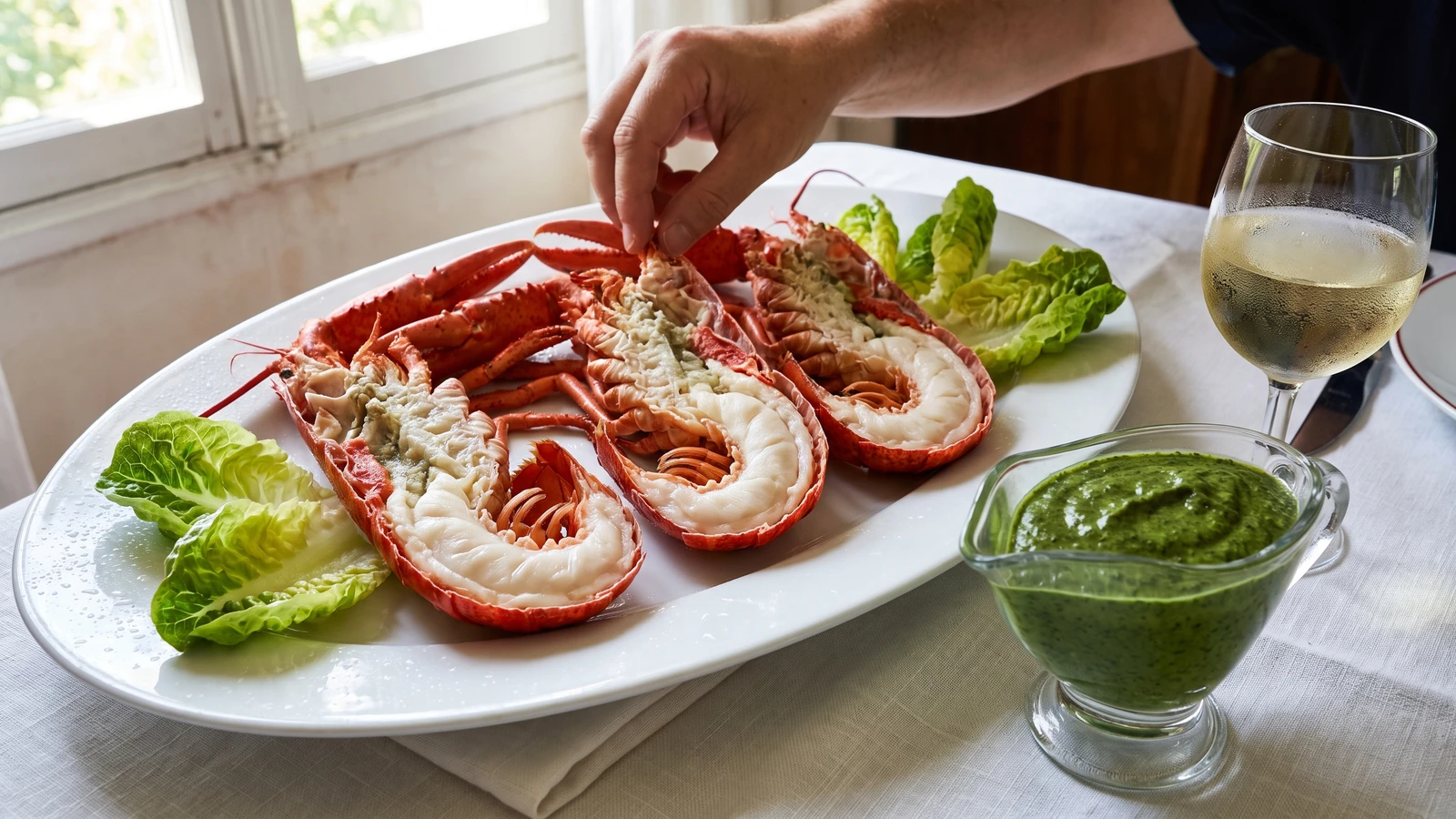
Homard poached in aromatic court-bouillon, cooled in that same liquor, then split over linen with claw meat and crisp lettuce, while a vivid mayonnaise derivative waits separately.
Homard froid aux sauces diverses (cold lobster with various sauces) teaches one true thing: cool shellfish promptly in the liquor that cooked it, and the meat stays succulent instead of tightening and drying. The court-bouillon seasons gently through the shell, while the cold mayonnaise derivative brings richness at the table without covering the lobster's sweetness.
The original recipe assumed a great pot of court-bouillon already at hand and a saucier on staff with several mayonnaise derivatives waiting. Your kitchen needs one stockpot, an ice-water bath, two lobsters, and one cup of one finished sauce. We reduce the brigade quantity and the elaborate buffet wreath because they are scaffolding; cooking in court-bouillon, cooling in that same liquor, and serving the sauce separately are the dish, so those stay exactly where they belong. One cook, one stove, one evening.
The finished platter is generous and wonderfully direct: coral-red shells, pearly meat, opened claws, crisp lettuce, and a cold sauce bright with either tomato and capsicum or green herbs. The one step that decides everything is the cooling, with the lobster submerged while the court-bouillon moves quickly from hot to thoroughly cold.
Homard froid belongs to the formal cold table of Paris, supplied with lobster from the Atlantic ports of Brittany and Normandy. Coastal poaching became a codified presentation: the lobster cooled in its liquor, split in its shell, and a mayonnaise derivative sent separately so the sweet meat remained distinct. The napkin was practical before it was ceremonial, catching the last court-bouillon draining from the shell and keeping the serving platter dry.
Quantity
2, each 1¼ to 1½ lb (570 to 680 g)
Quantity
6 qt (5.7 L / 5.7 kg)
Quantity
2 cups (475 ml / 470 g)
Quantity
½ cup (120 ml / 120 g)
Quantity
⅓ cup (80 ml / 96 g)
Quantity
2 medium (about 2 cups / 300 g)
quartered
Quantity
2 medium (about 1½ cups / 225 g)
thickly sliced
Quantity
2 ribs (about 1 cup / 120 g)
thickly sliced
Quantity
1
made with 6 parsley stems, 2 thyme sprigs, and 1 bay leaf
Quantity
1 tsp (5 ml / 3 g)
lightly crushed
Quantity
2 loosely packed cups (475 ml / 60 g) parsley or 4 lettuce hearts (about 12 oz / 340 g)
washed and dried thoroughly
Quantity
About 10 qt (9.5 L / 4.5 kg)
| Ingredient | Quantity |
|---|---|
| live hard-shell lobsters | 2, each 1¼ to 1½ lb (570 to 680 g) |
| cold water | 6 qt (5.7 L / 5.7 kg) |
| dry white wine | 2 cups (475 ml / 470 g) |
| white wine vinegar | ½ cup (120 ml / 120 g) |
| fine sea salt | ⅓ cup (80 ml / 96 g) |
| yellow onionsquartered | 2 medium (about 2 cups / 300 g) |
| carrotsthickly sliced | 2 medium (about 1½ cups / 225 g) |
| celerythickly sliced | 2 ribs (about 1 cup / 120 g) |
| bouquet garnimade with 6 parsley stems, 2 thyme sprigs, and 1 bay leaf | 1 |
| black peppercornslightly crushed | 1 tsp (5 ml / 3 g) |
| finished mayonnaise derivative, choose one | 1 cup (240 ml / about 240 g) Andalouse Sauce (No. 122) or Vincent Sauce (No. 132) |
| curly-leaf parsley sprigs or small lettuce hearts, choose one (optional)washed and dried thoroughly | 2 loosely packed cups (475 ml / 60 g) parsley or 4 lettuce hearts (about 12 oz / 340 g) |
| ice for the cooling bath | About 10 qt (9.5 L / 4.5 kg) |
Combine the water, wine, vinegar, salt, onions, carrots, celery, bouquet garni, and peppercorns in a 12-quart stockpot. Bring to a full boil, then simmer uncovered for 20 minutes so the vegetables and herbs season the liquor. Taste a cooled spoonful. It should be distinctly saline and aromatic, because the lobster meets it through a shell, but it must not taste harshly sour.
Keep the lobsters cold until the court-bouillon boils. Working one at a time on a nonslip board, place a lobster belly down, set the point of a heavy chef's knife on the cross immediately behind the eyes, press decisively downward, then cut forward through the head. Lower both lobsters headfirst into the boiling court-bouillon at once. Cover only until the liquid returns to a lively simmer, then uncover and cook for 10 to 12 minutes. The shells will turn coral-red, but colour alone is not the test: the flesh should be pearly and opaque, and the thickest tail meat should reach 145°F (63°C).
Turn off the heat immediately and keep the lobsters submerged, using a small heatproof plate if they float. Set the stockpot in a sink or deep basin packed with ice and cold water, without adding ice to the court-bouillon itself. Refresh the outer bath as it warms and stir the liquor gently every few minutes until it falls below 40°F (4°C), which should take 60 to 90 minutes. If the large pot cools too slowly, transfer each lobster and enough strained court-bouillon to cover it into two smaller heatproof vessels nested in fresh ice. Ça se rattrape. What matters is that the lobster remains in its seasoned liquor without lingering warm enough to overcook.
Chill a large oval platter while the lobsters cool. Wash the parsley or lettuce hearts and dry them completely, since wet greenery dilutes the presentation and leaves puddles on the napkin. Line the cold platter with a freshly laundered, unscented white linen napkin just before assembly. Bring either the finished Andalouse Sauce (No. 122) or the finished Vincent Sauce (No. 132) from the cold about 10 minutes before serving. If the chosen sauce has tightened, whisk in a teaspoon of cold court-bouillon; if the emulsion looks separated, begin with a teaspoon of cold water in a clean bowl and whisk the sauce into it one spoonful at a time. Ça se rattrape.
Lift the lobsters from the cold court-bouillon and let them drain for 10 minutes, then blot the shells. Twist off the claws at their first joints, crack them without crushing the shells, and withdraw the claw meat as nearly whole as possible. Split each lobster lengthwise through the centre with a heavy knife or sturdy kitchen shears. Remove the dark intestinal vein, the feathery gills, and the hard stomach sac just behind the head, the part called the queen in the source. Wipe away any fragments with a cloth dipped in cold court-bouillon rather than rinsing the meat under the tap. If a claw breaks into pieces, tuck them neatly back into the opened shell. Never apologize at your own table.
Set the four lobster halves cut side up on the linen-lined platter. Place the opened claws and their meat on either side, then surround the lobster with curly-leaf parsley or the quartered lettuce hearts, keeping the arrangement generous and unfussy. Send the chosen mayonnaise derivative to the table separately in a cold bowl or sauceboat, allowing each guest a half lobster and a generous spoonful of sauce. Serve cool rather than numb from the refrigerator. À table!
1 serving (about 140g)
Culinary guides, cultural storytelling, and the editorial depth that makes cooking meaningful.
Discover Culinary ExplorerChef Juliette
John Dory has the delicacy of sole and the firmness of turbot. A light flouring, a quick butter sauté, and nut-brown beurre noisette show exactly why looks never mattered.

Chef Juliette
Fresh haddock proves its delicacy in the meunière pan: a fine flour crust, moist pearly flakes, and beurre noisette sharpened with lemon and parsley, ready from one skillet in half an hour.

Chef Juliette
Éperlans à l’Anglaise turns small fish into a lesson in disciplined coating: boned smelts under a close, crisp crumb, pan-fried in clarified butter and finished with bright, half-melted maître d’hôtel butter.

Chef Juliette
Tiny smelts, shallot, mushrooms, white wine, gratin sauce, and fine bread raspings meet a fierce oven, where the fish must turn tender in the same breath the buttered crust bronzes.