Culinary Explorer

A cooking platform built around craft, culture, and the stories behind what we eat.
Discover Culinary Explorer
Vincent Sauce

Vincent Sauce

Created by Chef Juliette

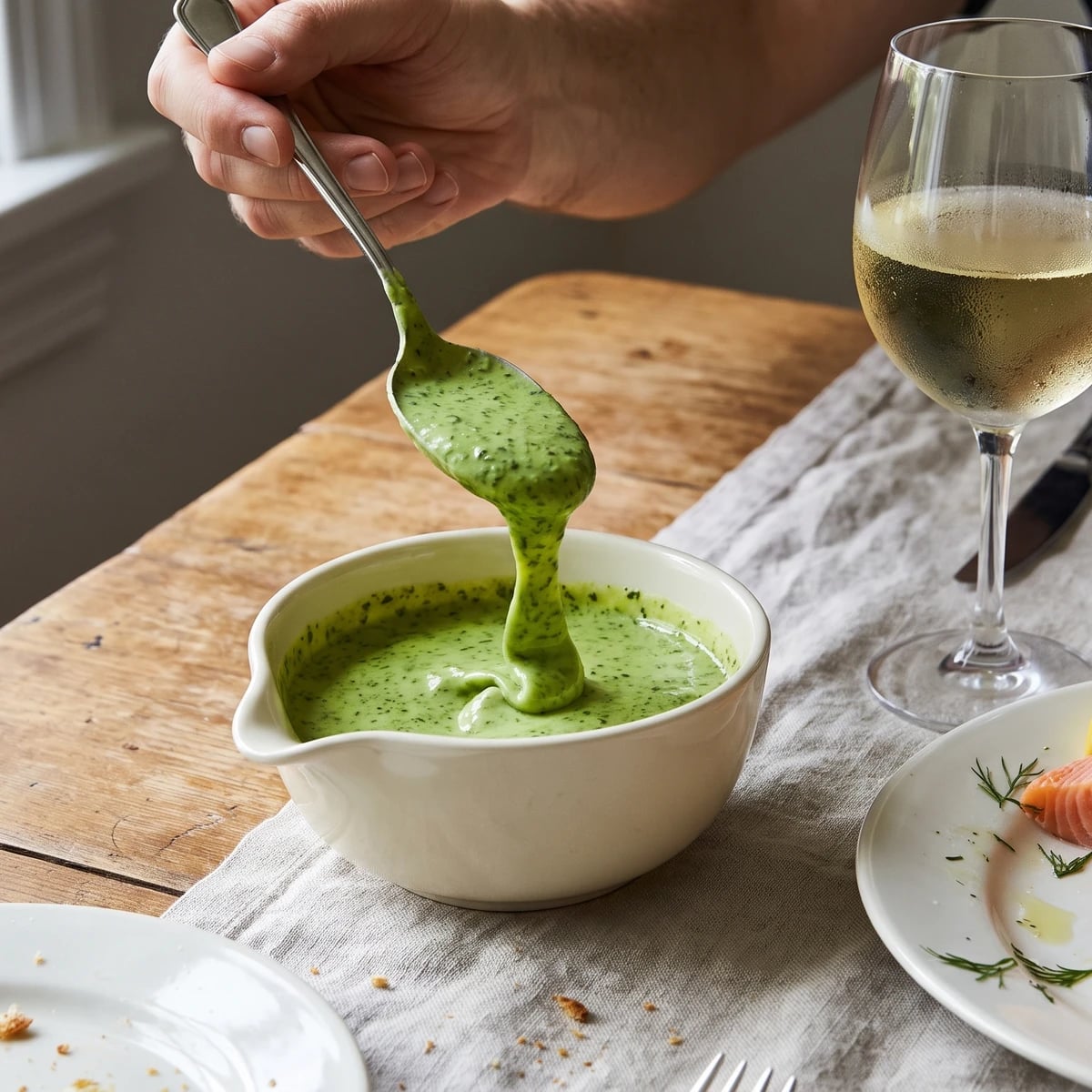
Sauce Vincent turns eight briefly blanched herbs, hard-boiled yolks, and stiff Mayonnaise into a cool green emulsion. Two minutes in boiling water preserves its color, and not a second longer.

Sauces & Condiments
French
Dinner Party
Special Occasion
30 min
Active Time
5 min cook1 hr 5 min total
YieldAbout 2 cups (475 ml), 12 to 16 sauce servings

Sauce Vincent (a cold herb-green mayonnaise sauce) teaches one discipline: blanchir, to boil briefly and chill at once. Here, color is timing. Eight herbs enter salted boiling water for two minutes only, then cold water stops the cooking while their green is still vivid. Hard-boiled yolks give the sauce a velvet body, and Worcestershire brings a quiet savory depth without announcing itself.

The source formula assumed a saucier, a copper bowl, a mortar, and separate sieve and tammy cloth, with enough sauce needed for service. One cook needs no such procession. The formula here is halved ingredient for ingredient, making a generous dinner-party bowl; a stainless-steel pot replaces the copper, a small processor replaces the long pounding, and two passes through one fine-mesh sieve reproduce the old double refinement. The separate equipment was brigade scaffolding. The exact two-minute blanch, the hard-boiled yolks, and the very stiff Mayonnaise are the dish itself, so they stay.

The source's fresh pimpernel is salad burnet, the cucumber-scented herb called pimprenelle in French; the name changed, the ingredient did not. Have the cold-water bath beside the stove before the herbs touch the pot. Those two minutes decide the sauce.

Sauce Vincent belongs to the Parisian grande cuisine repertory of sauces froides, cold sauces, rather than to the cooking of a single French region. Its unusually broad mixture of herbs traveled from the saucier's worktable to bourgeois dining rooms as an accompaniment for cold poached fish, shellfish, and meats. Worcestershire is not a modern addition but part of the established formula, a reminder that the classical canon readily absorbed a seasoning when it served the sauce.

The technique, the tradition, and the story behind every dish.

Discover Culinary Explorer

Ingredients

flat-leaf parsley leaves and tender sprigs

Quantity

½ cup loosely packed (120 ml / 14 g)

fresh chervil leaves and tender sprigs

Quantity

1 cup loosely packed (240 ml / 14 g)

fresh tarragon leaves

Quantity

⅔ cup loosely packed (160 ml / 14 g)

fresh chives

Quantity

½ cup (120 ml / 14 g)

snipped

fresh sorrel leaves

Quantity

1 cup loosely packed (240 ml / 14 g)

fresh salad burnet leaves (pimprenelle, called fresh pimpernel in the source)

Quantity

1 cup loosely packed (240 ml / 14 g)

cultivated watercress leaves and tender stems

Quantity

2 cups loosely packed (480 ml / 28 g)

fresh spinach leaves

Quantity

2 cups loosely packed (480 ml / 28 g)

water for blanching

Quantity

8 cups (1.9 L / 1.9 kg)

fine sea salt

Quantity

1 tablespoon (15 ml / 18 g)

ice water

Quantity

8 cups (1.9 L / 1.9 kg)

large egg yolks

Quantity

4

hard-boiled

very stiff Mayonnaise

Quantity

1 cup plus 3 tablespoons (285 ml / 270 g)

Worcestershire sauce

Quantity

1 teaspoon (5 ml / 5 g)

Equipment Needed

  • 4-quart (3.8-liter) nonreactive saucepan
  • Large bowl for the ice-water bath
  • Fine-mesh sieve and flexible scraper
  • Small food processor or large mortar and pestle
  • Clean kitchen towel
  • Chilled mixing bowl

Instructions

  1. 1

    Wash and stage

    Wash every herb in several changes of cold water, lifting the leaves out rather than pouring the water away over them, so the grit remains at the bottom of the bowl. Remove woody stems but keep tender sprigs. Set the ice water beside the stove, then bring the blanching water and salt to a full rolling boil in a large nonreactive saucepan. Everything must be ready before the herbs enter.

    Weigh the prepared herbs if you can. Chervil and chives occupy very different volumes at the same weight, and the book's equal-ounce proportions are best protected by the scale.
  2. 2

    Blanchir for two minutes

    Add all eight herbs quickly, pressing them beneath the water, and start the timer as the last leaves enter. Keep the heat high and blanchir for exactly two minutes. Drain immediately and plunge the herbs into the ice water, stirring until cold. If you're delayed by a few seconds, chill them at once and refresh the water; ça se rattrape before the retained heat does further damage. Once the leaves have turned fully olive, their bright color cannot be restored.

  3. 3

    Drain completely

    Lift the cold herbs into a sieve and leave them to drain for five minutes. Gather them in a clean kitchen towel and squeeze firmly until no more water runs out. Open the bundle, loosen the herbs, then squeeze once more. This dryness matters: trapped water slackens the finished Mayonnaise and dilutes the concentrated herb flavor.

  4. 4

    Pound and sieve

    Put the drained herbs and hard-boiled yolks in a small food processor. Pulse, scrape the bowl, and pulse again until they form the finest green paste the machine can manage, stopping before its motor warms the mixture. Press the paste through a fine-mesh sieve with a flexible scraper, collect it, and pass it through the clean sieve once more. If the paste resists, process or pound it longer; don't loosen it with water. The second pass gives Vincent its smooth, close texture.

  5. 5

    Fold the emulsion

    Place the herb-and-yolk purée in a chilled bowl. Reserve 3 tablespoons of the stiff Mayonnaise, then fold the rest into the purée in three additions until the color is even. Fold in the Worcestershire sauce and the reserved Mayonnaise. Don't return the mixture to the processor, because warmth and hard mechanical mixing relax its body. If the sauce nevertheless turns loose, place the reserved Mayonnaise in a clean cold bowl and work the loose sauce into it one spoonful at a time. Ça se rattrape.

  6. 6

    Rest and serve

    Cover the surface directly and chill the Vincent for thirty minutes, which lets the herbs settle through the emulsion. Stir once before serving; it should hold a deep spoon track while remaining supple enough to fall from the spoon. Serve cool with cold poached salmon or trout, shellfish, or cold sliced meat, and return it to the refrigerator promptly after the meal. À table!

Chef Tips

  • Fresh pimpernel in the source means salad burnet, Sanguisorba minor, also called pimprenelle. It is not scarlet pimpernel, the ornamental field plant, which must never enter the kitchen. Look for salad burnet through an herb grower or a well-stocked nursery.
  • Use cultivated watercress, not watercress gathered from a stream. Wild watercress can carry parasites even when the water looks perfectly clear; careful washing does not make foraged plants safe.
  • The Mayonnaise must be very stiff before the herb purée enters. Full-fat Mayonnaise holds the sauce; a reduced-fat substitute turns it slack and watery. If making your own for vulnerable guests, use pasteurized yolks.
  • Don't replace the fresh herbs with dried ones. This sauce depends on fresh leaf color, moisture, and perfume, and dried tarragon or chervil makes an entirely different condiment.
  • Keep Vincent covered and refrigerated below 4°C. It is brightest on the day it is made and remains good for two days, though the green gradually softens. It does not freeze well.

Advance Preparation

  • Hard-boil the eggs and prepare the stiff Mayonnaise up to one day ahead. Keep both covered and refrigerated, then separate the yolks shortly before making the sauce.
  • The herbs can be washed several hours ahead, dried thoroughly, and held in the refrigerator between barely damp towels. Weigh them after removing woody stems.
  • Vincent may be completed up to twenty-four hours before serving. Press reusable wrap or parchment directly against its surface to limit oxidation, then stir gently before bringing it to the table.

Frequently Asked Questions

Nutrition Information

1 serving (about 34g)

Calories
150 calories
Total Fat
16 g
Saturated Fat
3 g
Trans Fat
0 g
Unsaturated Fat
13 g
Cholesterol
60 mg
Sodium
160 mg
Total Carbohydrates
1 g
Dietary Fiber
0 g
Sugars
0 g
Protein
1 g

Note: Chef personas and recipes are created with AI assistance. Cook with care: follow safe food-handling practices, check doneness with a thermometer when needed, and adapt for allergies and your kitchen.

Where cooking meets culture.

Culinary guides, cultural storytelling, and the editorial depth that makes cooking meaningful.

Discover Culinary Explorer

More from Cold Sauces and Compound Butters

Browse the full collection