
Chef Juliette
Homard à l’Américaine
Lobster shells blaze red over fierce heat, brandy catches, and tomato-wine liquor reduces to a shining sauce bound with coral and cold butter. The lesson is simple: after the finish, never let it boil.
A cooking platform built around craft, culture, and the stories behind what we eat.
Created by Chef Juliette
Based on No. 947, Homard à la Mornay, otherwise au Gratin, from Le Guide Culinaire (1907) by Auguste Escoffier
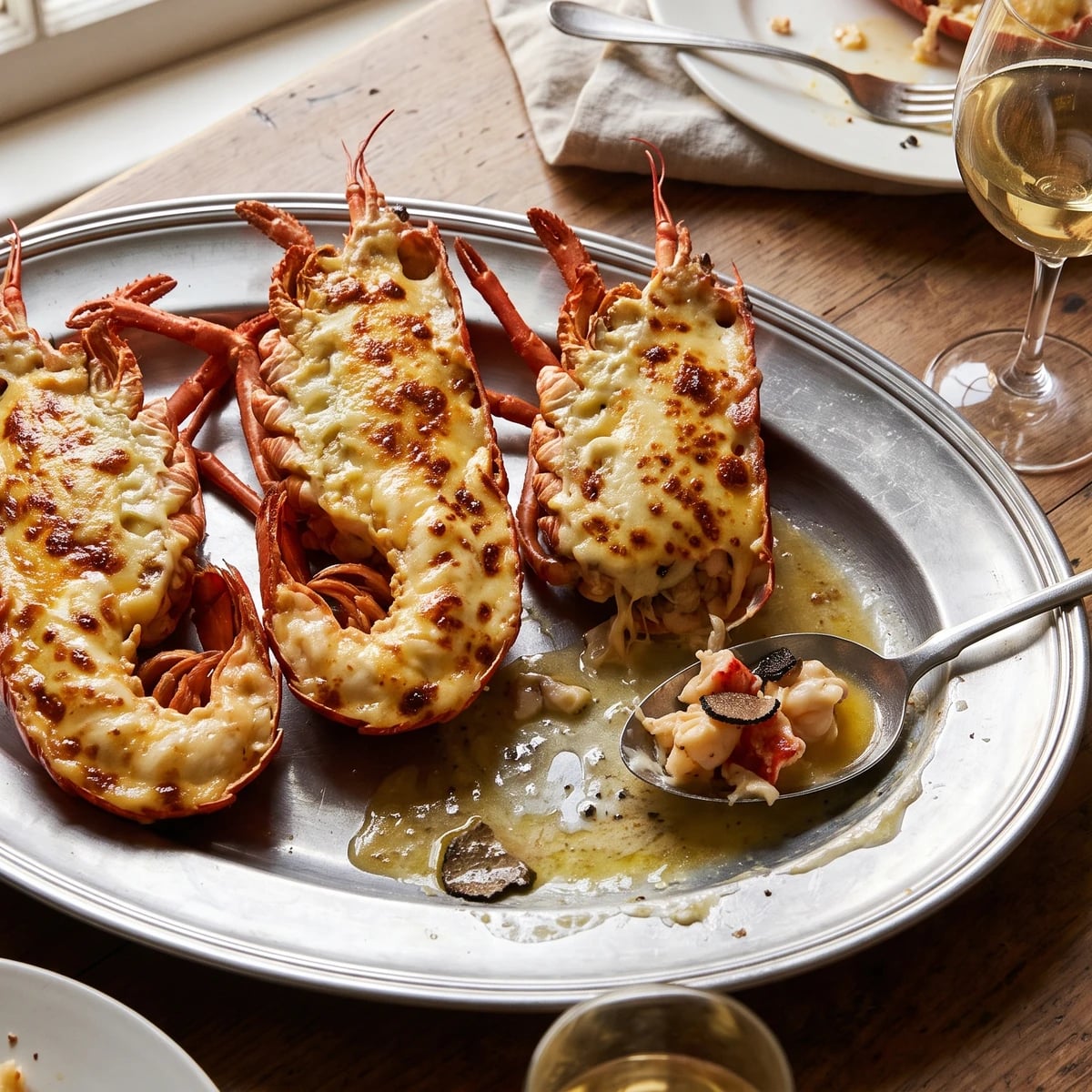
Hot lobster, mushroom and truffle salpicon, and cheese-rich Mornay return to the shell, then meet fierce heat just long enough to bronze. The broiler glazes the dish, it does not cook it twice.
Homard à la Mornay, otherwise au Gratin (lobster with Mornay, glazed under fierce heat) teaches the true meaning of gratiner, to glaze and brown quickly. Everything beneath the crust must already be cooked, sauced, and hot before it approaches the broiler. That is the one true thing to know before touching a pan: the fierce heat colors the dish, it must never be asked to reheat it.
The original assumed a saucier on staff, a stock never off the fire for the parent preparations, several pans holding each element hot, and a salamander ready at service. Your kitchen gets one small saucepan of Mornay, the precise shell arrangement of Homard Cardinal (No. 943), and a broiler heated as fiercely as it will go. Separate holding pans and brigade portions are scaffolding, so they go. The mushroom and truffle salpicon, the filled carapaces, the real butter and cheese, and the rapid glaze are the dish, so they stay. One cook, one stove, one evening.
At the table, the shells should be coral-red beneath an ivory sauce bronzed to butter-gold, with lobster and truffle visible where the spoon breaks the crust. Have the filled shells hot and the broiler fully heated before you coat them. That final alignment matters more than any flourish.
Homard à la Mornay belongs to the grand Parisian dining-room repertoire, where lobster meat was returned to its carapace, richly sauced, and rapidly glazed so the shell became both vessel and presentation. It is a named variation of Homard Cardinal (No. 943): the Cardinal arrangement survives, while cheese-enriched Mornay replaces the red, lobster-rich Cardinal sauce. “Au gratin” here does not mean prolonged baking; it means a brief salamander glaze that colors the sauce and cheese before the lobster toughens.
Quantity
1 four-serving preparation Homard Cardinal (No. 943), based on 2 live 1¼-pound lobsters (1.1 kg total)
carried through the filled-shell stage, with Mornay replacing Cardinal sauce at every call
Quantity
3 tablespoons (45 ml / 42 g)
cut into small pieces
Quantity
3 tablespoons (45 ml / 24 g)
Quantity
1¾ cups (420 ml / 432 g)
divided
Quantity
½ cup (120 ml / 120 g)
divided
Quantity
⅔ cup (160 ml / 70 g)
finely grated and divided
Quantity
⅓ cup (80 ml / 30 g)
finely grated and divided
Quantity
½ teaspoon (2.5 ml / 3 g)
Quantity
⅛ teaspoon (0.6 ml / 0.3 g)
Quantity
1 small pinch
Quantity
1 tablespoon (15 ml / 14 g)
melted
| Ingredient | Quantity |
|---|---|
| Homard Cardinalcarried through the filled-shell stage, with Mornay replacing Cardinal sauce at every call | 1 four-serving preparation Homard Cardinal (No. 943), based on 2 live 1¼-pound lobsters (1.1 kg total) |
| unsalted buttercut into small pieces | 3 tablespoons (45 ml / 42 g) |
| all-purpose flour | 3 tablespoons (45 ml / 24 g) |
| whole milkdivided | 1¾ cups (420 ml / 432 g) |
| heavy creamdivided | ½ cup (120 ml / 120 g) |
| Gruyèrefinely grated and divided | ⅔ cup (160 ml / 70 g) |
| Parmesanfinely grated and divided | ⅓ cup (80 ml / 30 g) |
| fine sea salt | ½ teaspoon (2.5 ml / 3 g) |
| ground white pepper | ⅛ teaspoon (0.6 ml / 0.3 g) |
| freshly grated nutmeg | 1 small pinch |
| unsalted buttermelted | 1 tablespoon (15 ml / 14 g) |
Reserve ¼ cup (60 ml) of the milk and 2 tablespoons (30 ml) of the cream. Warm the remaining milk and cream until tiny bubbles gather at the edge, without letting it boil. Make a roux blanc (white roux): melt the 3 tablespoons of butter over medium-low heat, stir in the flour, and cook for 2 minutes while stirring constantly. Keep it pale. The flour should smell faintly of warm biscuits but take no brown color.
Whisk the warm dairy into the roux in four additions, making each one completely smooth before adding the next. Bring the sauce to the barest simmer and cook for 8 to 10 minutes, whisking often, until no raw flour taste remains. Remove it from the heat and whisk in three quarters of both cheeses, then season with the salt, white pepper, and nutmeg. The Mornay should napper, meaning it coats the back of a spoon in an even ivory film. If it is lumpy, pass it through a fine sieve. Ça se rattrape. If the cheese releases oily beads, take the pan off the heat and whisk in the reserved cold cream a teaspoon at a time; once smooth, do not boil it again.
Prepare Homard Cardinal (No. 943) exactly through the filled-shell stage, following its court-bouillon cooking, shell work, salpicon proportions, claw filling, and arrangement. At every call for Cardinal sauce, use the warm Mornay instead: use only enough to keep the sliced tail meat supple and bind the salpicon, preserving the greater part for coating. The filling should support the lobster slices, not swim beneath them. As the shells are being filled, set an oven rack 4 to 5 inches (10 to 13 cm) below the broiler and heat the broiler at its highest setting for a full 10 minutes.
Hold the remaining Mornay over a saucepan of barely trembling water while the lobster is assembled, stirring occasionally and keeping the sauce between 140 and 150°F (60 and 65°C). If it tightens while waiting, warm the reserved milk and whisk it in one spoonful at a time. Do not thin the sauce until it runs; it must cling to the curved shells beneath the broiler.
Set the filled half-carapaces on a large metal gratin platter, wedging them upright with the filled claws as directed in Homard Cardinal (No. 943). Reserve 2 tablespoons of Mornay in the saucepan, then coat the lobster slices and claws generously with the rest. Mix the reserved Gruyère and Parmesan, scatter them evenly over the sauce, and trickle the melted butter across the cheese. Gratinate 4 to 5 inches (10 to 13 cm) beneath the broiler for 2 to 4 minutes, watching without interruption, until the surface is butter-gold with deeper brown freckles and the edges bubble. If it remains pale after 2 minutes, move it closer and rotate the platter rather than leaving the lobster under moderate heat. Fierce and fast is the method.
Pull the platter the instant the gratin is bronzed. If butter begins separating around an edge, stop the cooking at once. Ça se rattrape: blot only the loose fat at the rim, whisk the reserved Mornay smooth, and spoon it over any broken patch without returning the platter to the broiler. Carry it directly to the table and serve one half-shell per person while the crust is still crisp at its darkest points and the lobster beneath remains tender. À table!
1 serving (about 220g)
Culinary guides, cultural storytelling, and the editorial depth that makes cooking meaningful.
Discover Culinary Explorer
Chef Juliette
Lobster shells blaze red over fierce heat, brandy catches, and tomato-wine liquor reduces to a shining sauce bound with coral and cold butter. The lesson is simple: after the finish, never let it boil.

Chef Juliette
Lobster blushed red in clarified butter, then wrapped in a Bordeaux-built sauce of white wine, brandy, fumet, Espagnole, and tomato, finished with cold butter for a generous table.

Chef Juliette
A whole lobster boiled in vinegar court-bouillon, opened on its linen-lined platter, and sent to table with floury potatoes and melted butter. Timing is the luxury, and twenty minutes decides it.

Chef Juliette
One lobster, one fierce oven, and a Champagne-butter baste: Homard à la Broche teaches the discipline of keeping shellfish glossy, succulent, and generous enough for a celebration table.