
Chef Juliette
John Dory (St. Pierre)
John Dory has the delicacy of sole and the firmness of turbot. A light flouring, a quick butter sauté, and nut-brown beurre noisette show exactly why looks never mattered.
A cooking platform built around craft, culture, and the stories behind what we eat.
Created by Chef Juliette
Based on No. 943, Homard Cardinal, from Le Guide Culinaire (1907) by Auguste Escoffier
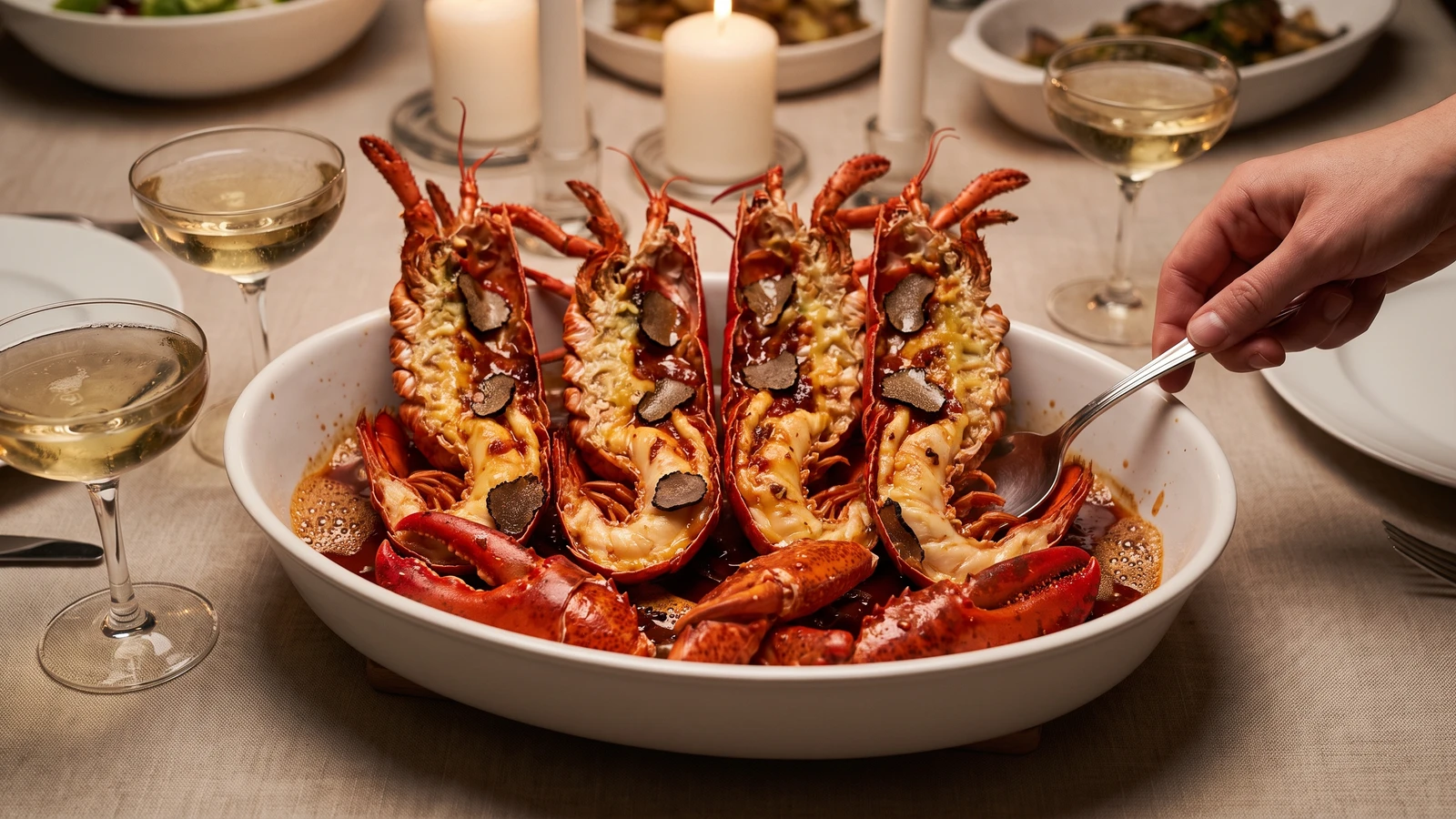
Poached lobster, truffled salpicon, and a cardinal-red sauce return to the shell under a fierce glaze, a composed French centerpiece whose success depends on heat, order, and speed.
Homard Cardinal (lobster with truffled salpicon and cardinal-red sauce) teaches a lesson in ordered heat: every part must be hot before the glaze begins, because the fierce final heat is there to color and gloss, never to cook the lobster again. That is the one true thing to know before touching a pan.
The original recipe assumed a saucier on staff, a stockpot never off the fire, several warm holding pans, and a salamander waiting above the pass. At home, the sauces and lobster are brought to readiness first, one warm water bath replaces the holding station, and a home broiler supplies the fierce overhead heat. The separate station pans are brigade scaffolding and may go; the weighted salpicon, reconstruction in the shell, generous coating of Sauce Cardinal, and rapid glaze are the dish and must stay. Two lobsters replace the original single specimen because this is scaled for four diners, while every stated ratio remains intact. One cook, one stove, one evening.
The finished Homard Cardinal should arrive scarlet and gleaming, its tail slices visible beneath the sauce and its claws holding the shell halves upright. The decisive step is the last one: assemble everything hot, then glaze for moments rather than minutes.
Homard Cardinal belongs not to Brittany or Normandy but to the Parisian grand-kitchen canon, where lobster was dismantled, sauced, reconstructed in its carapace, and sent beneath the salamander as a composed service dish. Its name refers to the cardinal red of the sauce and shell, traditionally intensified through lobster essence and coral rather than borrowed from any coastal province. The salpicon joins economy to ceremony, turning every usable morsel from the claws and carapace into the rich foundation beneath the tail.
Quantity
2 whole Homard Bouilli à la Hollandaise (No. 941), each prepared from 1 lobster (2 lb / 900 g) and kept hot
separate potato and melted-butter accompaniments omitted
Quantity
2 cups (475 ml / about 500 g)
kept hot
Quantity
up to 1/2 cup (120 ml / about 125 g)
kept hot
Quantity
an equal weight to the claw meat and permitted creamy parts, about 1 1/4 cups (300 ml / 200 g)
well drained and finely diced
Quantity
half the weight of the claw meat and permitted creamy parts, about 2/3 cup (160 ml / 100 g)
finely diced
Quantity
1/4 cup loosely packed (60 ml / 40 g)
cut into fine slices
Quantity
1/3 cup (80 ml / 30 g)
finely grated
Quantity
2 tablespoons (30 ml / 28 g)
melted
| Ingredient | Quantity |
|---|---|
| cooked lobster preparationseparate potato and melted-butter accompaniments omitted | 2 whole Homard Bouilli à la Hollandaise (No. 941), each prepared from 1 lobster (2 lb / 900 g) and kept hot |
| Sauce Cardinalkept hot | 2 cups (475 ml / about 500 g) |
| lobster saucekept hot | up to 1/2 cup (120 ml / about 125 g) |
| cooked button mushroomswell drained and finely diced | an equal weight to the claw meat and permitted creamy parts, about 1 1/4 cups (300 ml / 200 g) |
| black truffle for the salpiconfinely diced | half the weight of the claw meat and permitted creamy parts, about 2/3 cup (160 ml / 100 g) |
| black truffle for layeringcut into fine slices | 1/4 cup loosely packed (60 ml / 40 g) |
| Gruyèrefinely grated | 1/3 cup (80 ml / 30 g) |
| unsalted buttermelted | 2 tablespoons (30 ml / 28 g) |
Prepare the two Homard Bouilli à la Hollandaise (No. 941) according to its own entry, timing them to remain hot for assembly. Bring the Sauce Cardinal and lobster sauce to serving heat over gentle water baths, never a boil. Set an oven rack about 6 inches (15 cm) beneath the broiler, place a large broiler-safe oval dish nearby, and heat the broiler to its fiercest setting.
As soon as each Homard Bouilli à la Hollandaise (No. 941) is cooked, cut it cleanly in half lengthwise. Remove each tail in one piece and slice it crosswise into even medallions about 1/2 inch (1.25 cm) thick. Disconnect the claws, open their inner sides with sturdy shears, and withdraw the meat without breaking the claw shells. Keep all four half-carapaces and the four opened claws intact.
Spread about 3/4 cup (180 ml / 190 g) of the hot Sauce Cardinal in a shallow warm pan and lay in the tail slices, turning them once so every surface receives a thin coating. Cover and hold the pan over barely warm water, off direct heat. If the sauce tightens around the lobster, loosen it with a spoonful of hot water; the slices should remain lacquered, not buried in paste.
Dice the claw meat and any creamy parts from the carapaces that are safe to use under local seafood guidance, then weigh them together. Add exactly the same weight of diced cooked mushrooms and half that weight of diced truffle. This is the salpicon, a finely diced mixture cohered with sauce. Fold in the hot lobster sauce a tablespoon at a time, using only enough to bind the dice into a moist mixture that holds on a spoon. If it becomes loose, ça se rattrape: drain away the excess sauce through a fine sieve, return the solids to the pan, and bind them with a little less sauce.
Set the four half-carapaces in the broiler-safe dish. Spread the salpicon evenly across their bottoms, reserving 1/4 cup (60 ml / about 60 g) for the emptied claws. Pack that reserve into the four claw shells. Arrange the coated tail medallions over the salpicon, alternating them with the fine truffle slices so the tail still reads as a continuous lobster.
Stand the shell halves at a slight upright angle, using the filled claws as wedges, just as the original service requires. Spoon the remaining hot Sauce Cardinal over the exposed tail slices and filled claws in an even veil. Sprinkle with the grated Gruyère, then trickle the melted butter across the surface. We don't apologize for butter; here it helps the fierce heat produce the fast, glossy glaze the dish needs.
Slide the dish beneath the fully heated broiler and watch without turning away. Glaze for 1 to 3 minutes, only until the cheese takes small golden freckles, the sauce bubbles at the edges, and the butter shines across the surface. If the sauce begins to look oily or dull, remove it at once. Ça se rattrape: blot away any separated fat, veil the spot with a spoonful of reserved hot Sauce Cardinal, and return it beneath the broiler for no more than 15 seconds.
Carry the Homard Cardinal directly to the table in its oval dish. Give each diner one filled half-shell and one claw, making certain the truffled salpicon beneath the tail comes with it. This dish waits for nobody, and happily nobody waits once it appears. À table!
1 serving (about 345g)
Culinary guides, cultural storytelling, and the editorial depth that makes cooking meaningful.
Discover Culinary ExplorerChef Juliette
John Dory has the delicacy of sole and the firmness of turbot. A light flouring, a quick butter sauté, and nut-brown beurre noisette show exactly why looks never mattered.

Chef Juliette
Fresh haddock proves its delicacy in the meunière pan: a fine flour crust, moist pearly flakes, and beurre noisette sharpened with lemon and parsley, ready from one skillet in half an hour.

Chef Juliette
Éperlans à l’Anglaise turns small fish into a lesson in disciplined coating: boned smelts under a close, crisp crumb, pan-fried in clarified butter and finished with bright, half-melted maître d’hôtel butter.

Chef Juliette
Tiny smelts, shallot, mushrooms, white wine, gratin sauce, and fine bread raspings meet a fierce oven, where the fish must turn tender in the same breath the buttered crust bronzes.