
Chef Juliette
John Dory (St. Pierre)
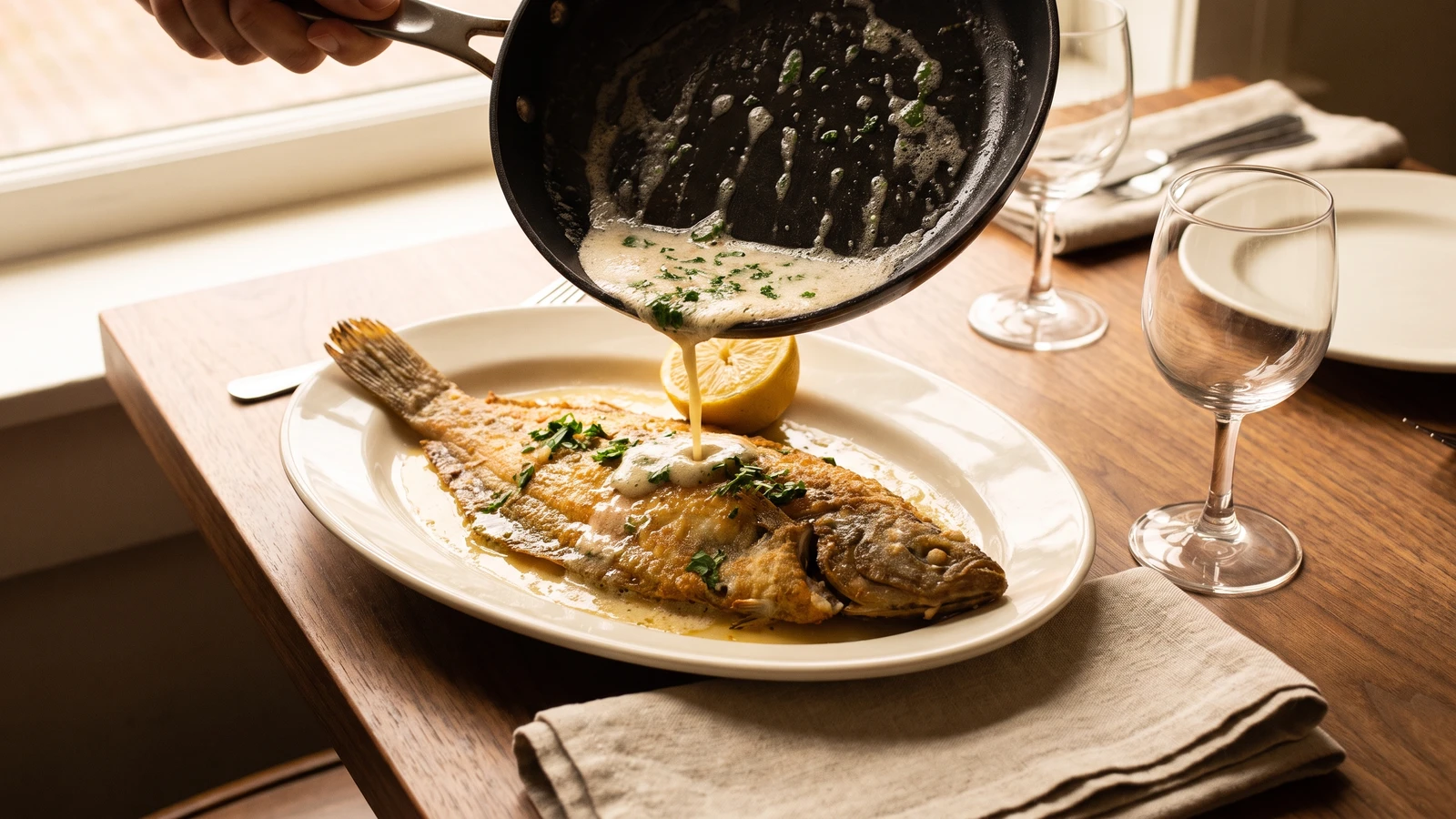
John Dory has the delicacy of sole and the firmness of turbot. A light flouring, a quick butter sauté, and nut-brown beurre noisette show exactly why looks never mattered.
A cooking platform built around craft, culture, and the stories behind what we eat.
Created by Chef Juliette
Based on No. 842, Sole à la Meunière, from Le Guide Culinaire (1907) by Auguste Escoffier
Whole sole in a veil of flour, gilded in hot butter and finished with lemon, scalded parsley, and foaming beurre noisette: meunière proves that mastery is dry fish, a hot pan, and service without delay.
Sole à la meunière (sole in browned butter) teaches one true thing before you touch the pan: the fish must be dry and the butter properly hot. Damp sole steams, heavy flour turns to paste, and timid heat leaves the coating pallid. Dry fish, a veil of flour, decisive heat. Cooking well is not cooking fancy.
The original book sends this dish to The Cooking of Fish à la Meunière (No. 778) and assumes each sole can travel from frying pan to dining room at once. It calls for no saucier, no stock never off the fire, and no salamander. Those pieces of brigade scaffolding never belonged here. Its one professional luxury was immediate service, so the home equivalent is two skillets working side by side, a warmed platter, and four small soles cooked in two quick batches. Clarifying the frying butter keeps its milk solids from blackening across those batches; the flour, lemon, scalded parsley, fresh finishing butter, and their sequence remain exactly as the book gives them. One cook, one stove, one evening.
When it lands correctly, the sole is butter-gold at the edges, tender against the bone, and covered by pale hazelnut butter that froths as it strikes the lemon-damp parsley. The step that matters most comes last: brown the finishing butter only after every sole is dressed on the hot platter, then pour and serve without delay.
Sole à la meunière belongs to the Channel table, where true sole comes ashore along Normandy and the northern French coast before traveling to the markets and dining rooms of Paris. Meunière means "in the miller's-wife manner," a reference to the thin flour coating that lets the fish take a gilded crust in butter. The finish is not a separate sauce waiting in a pot: lemon, parsley, and freshly browning butter meet on the fish at the final moment, which is why the dish passes so naturally between the classical kitchen and the home table.
Quantity
4 fish (8 to 10 oz / 225 to 285 g each)
heads and dark skin removed, white skin scaled, fins trimmed
Quantity
3/4 cup (180 ml / 170 g)
clarified
Quantity
1/2 cup (120 ml / 113 g)
cut into pieces, with 1 tablespoon held cold
Quantity
3/4 cup (180 ml / 90 g)
Quantity
2 teaspoons (10 ml / 12 g)
divided
Quantity
1/2 teaspoon (2.5 ml / 1 g)
divided
Quantity
3 lemons (about 14 oz / 400 g total)
1 juiced to yield 1 tablespoon (15 ml / 15 g), 2 trimmed and halved
Quantity
1/2 cup loosely packed (120 ml / 20 g)
coarsely chopped and scalded
| Ingredient | Quantity |
|---|---|
| small whole Dover solesheads and dark skin removed, white skin scaled, fins trimmed | 4 fish (8 to 10 oz / 225 to 285 g each) |
| unsalted butter for fryingclarified | 3/4 cup (180 ml / 170 g) |
| cold unsalted butter for finishingcut into pieces, with 1 tablespoon held cold | 1/2 cup (120 ml / 113 g) |
| all-purpose flour | 3/4 cup (180 ml / 90 g) |
| fine sea saltdivided | 2 teaspoons (10 ml / 12 g) |
| freshly ground black pepperdivided | 1/2 teaspoon (2.5 ml / 1 g) |
| medium lemons1 juiced to yield 1 tablespoon (15 ml / 15 g), 2 trimmed and halved | 3 lemons (about 14 oz / 400 g total) |
| flat-leaf parsley leavescoarsely chopped and scalded | 1/2 cup loosely packed (120 ml / 20 g) |
Heat the oven to 200°F (95°C) and warm an ovenproof platter inside. Put the coarsely chopped parsley in a fine sieve, pour boiling water over it, then drain and pat it thoroughly. This is persil concassé, coarsely chopped parsley, prepared as the source directs; leave no clinging water that could make the hot butter spit wildly. Juice one lemon, trim and halve the other two, and have the side dishes and diners ready. Meunière waits for no one.
Melt the 3/4 cup frying butter gently in a small saucepan without stirring. Skim away the surface foam, then pour the clear golden fat into a heatproof cup, leaving the milky sediment behind; you should have about 1/2 cup (120 ml / 130 g) clarified butter. The book allows ordinary butter for very small fish and calls for clarified butter as size increases. Clarifying it here is the practical allowance for two successive home batches: the pans can stay properly hot without burned milk solids spoiling the later soles. The fresh whole butter for the final froth remains untouched.
Pat each sole completely dry outside and inside the cavity, then season both sides with most of the salt and pepper. Spread the flour in a wide shallow dish. Dredge only the first two soles, pressing them into the flour and shaking off every loose patch until nothing remains but a veil. Flour the fish immediately before frying, never earlier; if it waits, moisture rises through the coating and makes glue.
Set two 12-inch (30 cm) heavy skillets over medium-high heat and divide half the clarified butter between them. When the fat shimmers and a pinch of flour sizzles immediately, lower one sole into each pan with its smooth former dark-skin side down, staggering the second by thirty seconds so you can turn calmly. This is the central rule of The Cooking of Fish à la Meunière (No. 778): very hot butter, lightly floured fish, colour on one side, then one careful turn. Cook without nudging for 3 to 4 minutes, until the underside is evenly golden, then turn with a wide fish spatula and cook for another 2 to 3 minutes. The flesh should look opaque beside the backbone and lift from it with little resistance. If the butter darkens before the crust releases, lift the pan from the heat for twenty seconds, add a spoonful of cool clarified butter, and lower the burner. Ça se rattrape. If the coating clings when you try to turn, give it another twenty seconds rather than scraping; a properly formed crust releases itself.
Transfer the first pair to the warm platter and hold them uncovered in the turned-off oven for no more than eight minutes. Using tongs and folded paper towel, wipe any black flour specks from the skillets, then add the remaining clarified butter. Flour and fry the remaining soles in the same way. Transfer them to the platter with the first pair, arranging all four in a single layer. Discard the flour that touched the raw fish.
Sprinkle the soles with the lemon juice, using only enough to brighten them rather than soak the crust. Season lightly with the remaining salt and pepper, then scatter the scalded parsley over the fish. Place a trimmed lemon half beside each sole. This order belongs to the dish: lemon first, seasoning and parsley next, hot finishing butter last.
Wipe one skillet clean and return it to medium-high heat. Keep 1 tablespoon of the finishing butter cold and add the rest to the pan. Let it melt and foam, swirling gently, until the milk solids show the first pale hazelnut freckles and the aroma turns nutty. This is beurre noisette, butter browned to the colour and scent of hazelnuts. Pull the pan from the heat and swirl in the reserved cold tablespoon to arrest the browning, then pour it immediately over the parsley-covered soles. The contact makes the butter froth across the fish, exactly as it should. If the butter races toward dark brown, take it off the heat and add the reserved cold piece at once; ça se rattrape before the milk solids turn black. Black flecks and an acrid smell mean burned butter, and burned butter must be remade. Bring the platter straight to the table while the froth still lives. À table!
1 serving (about 180g)
Culinary guides, cultural storytelling, and the editorial depth that makes cooking meaningful.
Discover Culinary ExplorerChef Juliette
John Dory has the delicacy of sole and the firmness of turbot. A light flouring, a quick butter sauté, and nut-brown beurre noisette show exactly why looks never mattered.

Chef Juliette
Fresh haddock proves its delicacy in the meunière pan: a fine flour crust, moist pearly flakes, and beurre noisette sharpened with lemon and parsley, ready from one skillet in half an hour.

Chef Juliette
Éperlans à l’Anglaise turns small fish into a lesson in disciplined coating: boned smelts under a close, crisp crumb, pan-fried in clarified butter and finished with bright, half-melted maître d’hôtel butter.

Chef Juliette
Tiny smelts, shallot, mushrooms, white wine, gratin sauce, and fine bread raspings meet a fierce oven, where the fish must turn tender in the same breath the buttered crust bronzes.