
Chef Juliette
Sole Alice
A whole-poached sole teaches the discipline of gentle heat: tender fillets, oysters barely set, and a white fumet sauce bound with biscotte crumbs and mounted with cold butter just before it reaches the table.
A cooking platform built around craft, culture, and the stories behind what we eat.
Created by Chef Juliette
Based on No. 833, Sole au Gratin, from Le Guide Culinaire (1907) by Auguste Escoffier
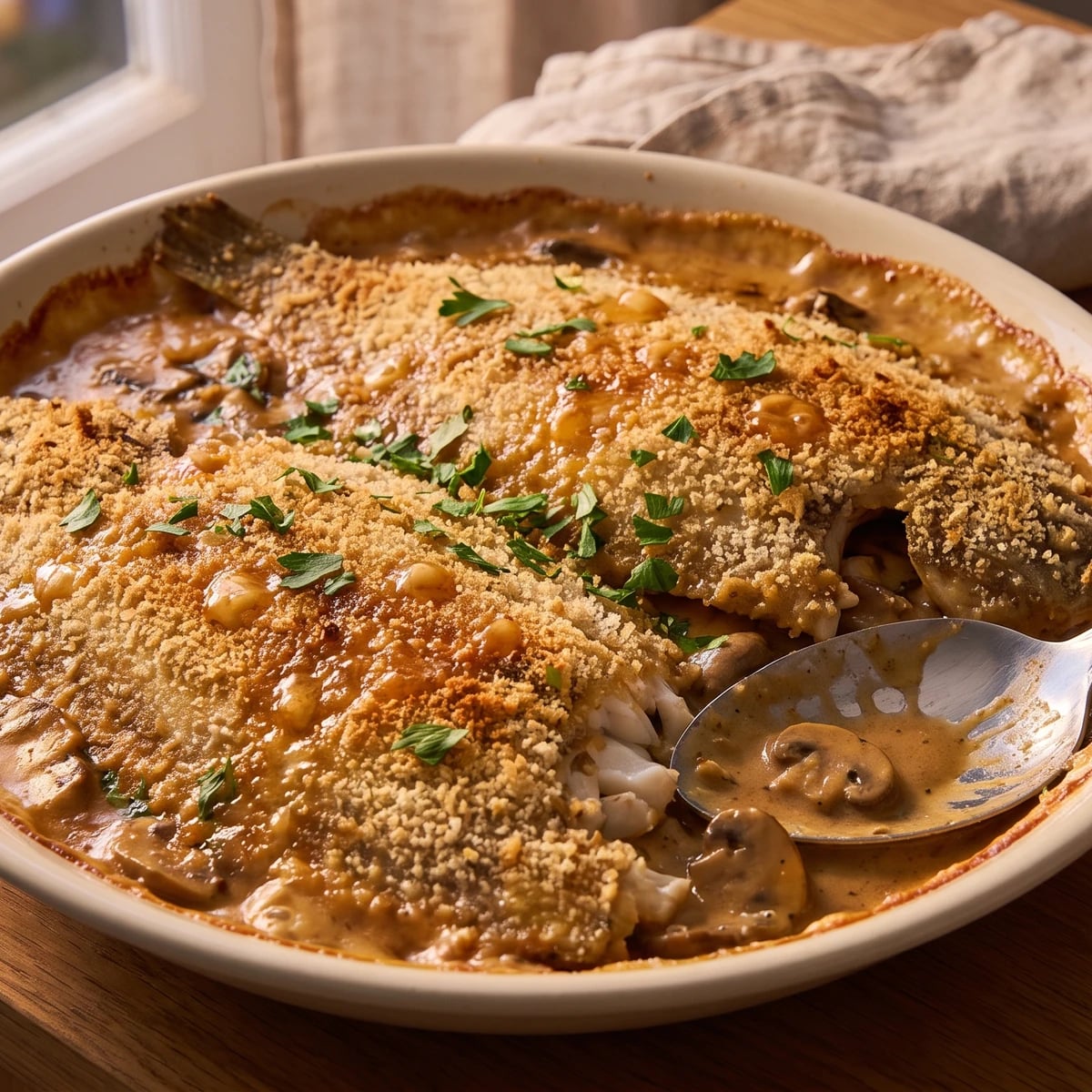
A complete gratin in the proper sense: whole sole, mushrooms, wine, sauce, crumbs, and butter meeting fierce heat so the fish cooks as the sauce tightens and the crust bronzes.
Sole au gratin (whole sole baked under a mushroom gratin crust) teaches the complete gratin: fish, sauce, and crust must reach the finish together. That is the one true thing to know before you touch a pan. Too little heat and the sole poaches while the crumbs remain pale; too much and the sauce catches before the flesh leaves the bone. Mind the heat.
The original kitchen had a saucier handing over finished sauce, stock never off the fire, a salamander above, and rows of individual gratin dishes ready for service. At home, you begin with the finished linked sauce, divide four portion soles between two shallow dishes, and use a thoroughly heated oven followed, only if needed, by a brief broil. The separate sauce station and service-by-service assembly are brigade scaffolding, so they go. The butter slipped beneath the upper fillets, the raw and cooked mushrooms, wine, sauce, raspings, and synchronized gratin are the dish, so they stay. One cook, one stove, one evening.
When it is right, the flesh stays moist against the bone, the mushroom-rich sauce clings rather than floods, and the buttered crumbs form a close bronze crust with bubbling edges. The step that decides everything is measuring the sauce before it covers the fish: enough to reduce around the sole, never enough to drown it.
Sole au gratin belongs to the classical Paris kitchen, which paired prized flatfish from Channel and Atlantic fisheries with the gratin method and sent it to bourgeois dining rooms in the same baking dish. Its complete gratin is a timed operation, not simply a browned topping: the fish cooks, the sauce reduces, and buttered raspings form the crust together. Cheese is not the definition of gratin here, and the canonical sole needs none.
Quantity
4 fish, each 10 to 12 oz (280 to 340 g)
cleaned, trimmed, both skins removed, heads removed, and central bones left intact
Quantity
14 tablespoons (210 ml / 200 g)
divided, with 3 tablespoons melted for finishing
Quantity
1/4 cup (60 ml / 40 g)
finely chopped
Quantity
1/4 cup (60 ml / 15 g)
finely chopped and divided
warmed
Quantity
16 mushrooms (about 5 oz / 140 g)
stems trimmed
Quantity
1 1/3 cups (320 ml / 115 g)
thinly sliced
Quantity
1/2 cup (120 ml / 120 g)
Quantity
1/2 cup (120 ml / 55 g)
Quantity
1 tablespoon (15 ml / 15 g)
Quantity
1 teaspoon (5 ml / 6 g)
| Ingredient | Quantity |
|---|---|
| whole solecleaned, trimmed, both skins removed, heads removed, and central bones left intact | 4 fish, each 10 to 12 oz (280 to 340 g) |
| unsalted butterdivided, with 3 tablespoons melted for finishing | 14 tablespoons (210 ml / 200 g) |
| shallotsfinely chopped | 1/4 cup (60 ml / 40 g) |
| flat-leaf parsleyfinely chopped and divided | 1/4 cup (60 ml / 15 g) |
| finished Gratin saucewarmed | 2 cups (480 ml / 500 g) Gratin sauce for Gratins (No. 268) and Complete Gratin (No. 269) |
| small button mushroomsstems trimmed | 16 mushrooms (about 5 oz / 140 g) |
| raw button mushroomsthinly sliced | 1 1/3 cups (320 ml / 115 g) |
| dry white wine | 1/2 cup (120 ml / 120 g) |
| fine dry breadcrumbs or bread raspings | 1/2 cup (120 ml / 55 g) |
| fresh lemon juice | 1 tablespoon (15 ml / 15 g) |
| fine sea salt | 1 teaspoon (5 ml / 6 g) |
Set a rack in the upper third of the oven and heat it to 475°F (245°C), allowing at least twenty minutes for the oven and rack to become thoroughly hot. Butter two shallow gratin dishes with 2 tablespoons of the butter. Melt another tablespoon in a skillet, add the 16 whole mushrooms, and cook over medium-high heat for 4 to 5 minutes, until just tender and glazed and any released moisture has evaporated. Warm the finished Gratin sauce used for Gratins (No. 268) and Complete Gratin (No. 269) over gentle heat until it flows from a spoon, but do not boil it.
Dry each sole thoroughly and place it with its upper, formerly dark-skinned side facing up. Run a flexible knife along the central line until it touches bone, then slide the blade outward between the bone and each of the two upper fillets. Loosen each fillet only partway, leaving its outer edge and tail end attached. Slip 1 tablespoon of softened butter beneath each upper fillet, using 8 tablespoons altogether, then season the fish lightly inside and out. The partial cut lets butter baste the flesh without allowing the sole to collapse; do not turn the fillets into loose pieces.
Divide the shallots and 2 tablespoons of the parsley between the buttered dishes. Spread 1/2 cup (120 ml) of the warm Gratin sauce associated with Gratins (No. 268) and Complete Gratin (No. 269) across the dish bottoms, using 2 tablespoons beneath each fish. Lay two soles in each dish. Place four cooked whole mushrooms alongside every sole, then distribute the sliced raw mushrooms around them. Pour 2 tablespoons of white wine around each fish, keeping it near the sauce rather than washing it over the flesh.
Cover each sole evenly with 6 tablespoons of the remaining Gratin sauce for Gratins (No. 268) and Complete Gratin (No. 269). The sauce must be nappant, thick enough to coat a spoon while still flowing. If it runs like broth, reduce it alone before it touches the fish; extra crumbs will not correct a watery foundation. Sprinkle each sole with 2 tablespoons of the fine raspings, then drizzle the remaining 3 tablespoons of melted butter evenly over the crumbs. Butter, not cheese, is what binds and bronzes this crust.
Bake the dishes side by side for 12 to 16 minutes, checking at 10. The sole is ready when its thickest flesh reaches 145°F (63°C), looks opaque beside the central bone, and separates cleanly when nudged with a knife. At that same moment, the sauce should be bubbling and reduced at the edges, while the crumbs are deep butter-gold. If the crust browns before the fish is cooked, cover only the darkening surface loosely with foil and move the dishes one rack lower. If the fish is ready but the crust is pale, place it beneath a fully heated broiler for 30 to 60 seconds, watching without looking away. If thin sauce still pools after the fish is done, draw it carefully from the edge into a small saucepan, reduce it briskly, and return it around the sole without wetting the crust. Ça se rattrape.
Take the gratins from the oven and immediately scatter over the remaining parsley. Dot each sole with a few drops of lemon juice, enough to sharpen the butter and mushrooms without making the sauce taste lemony. Carry the dishes straight to the table while their edges still bubble and the crust holds firm. À table!
1 serving (about 370g)
Culinary guides, cultural storytelling, and the editorial depth that makes cooking meaningful.
Discover Culinary Explorer
Chef Juliette
A whole-poached sole teaches the discipline of gentle heat: tender fillets, oysters barely set, and a white fumet sauce bound with biscotte crumbs and mounted with cold butter just before it reaches the table.

Chef Juliette
Sole poached at a tremble in fumet, napped with ivory Mornay, scattered with Gruyère and Parmesan, then glazed gold under the broiler: one quiet lesson in sauce, restraint, and heat.

Chef Juliette
Sole Mornay des Provençaux teaches the decisive French gratin: poach the fish gently, reduce its fumet honestly, nap it with sauce vin blanc, then glaze the cheese before the sole can overcook.

Chef Juliette
Champagne-poached sole under glossy velouté, with crisp julienne of sole at each side: a celebration dish that teaches reduction, mounting with butter, and timing the garnish at the last possible moment.