
Chef Juliette
John Dory (St. Pierre)
John Dory has the delicacy of sole and the firmness of turbot. A light flouring, a quick butter sauté, and nut-brown beurre noisette show exactly why looks never mattered.
A cooking platform built around craft, culture, and the stories behind what we eat.
Created by Chef Juliette
Based on No. 806, Saumon Froid, ou Darne de Saumon Froid à la Norvégienne, from Le Guide Culinaire (1907) by Auguste Escoffier
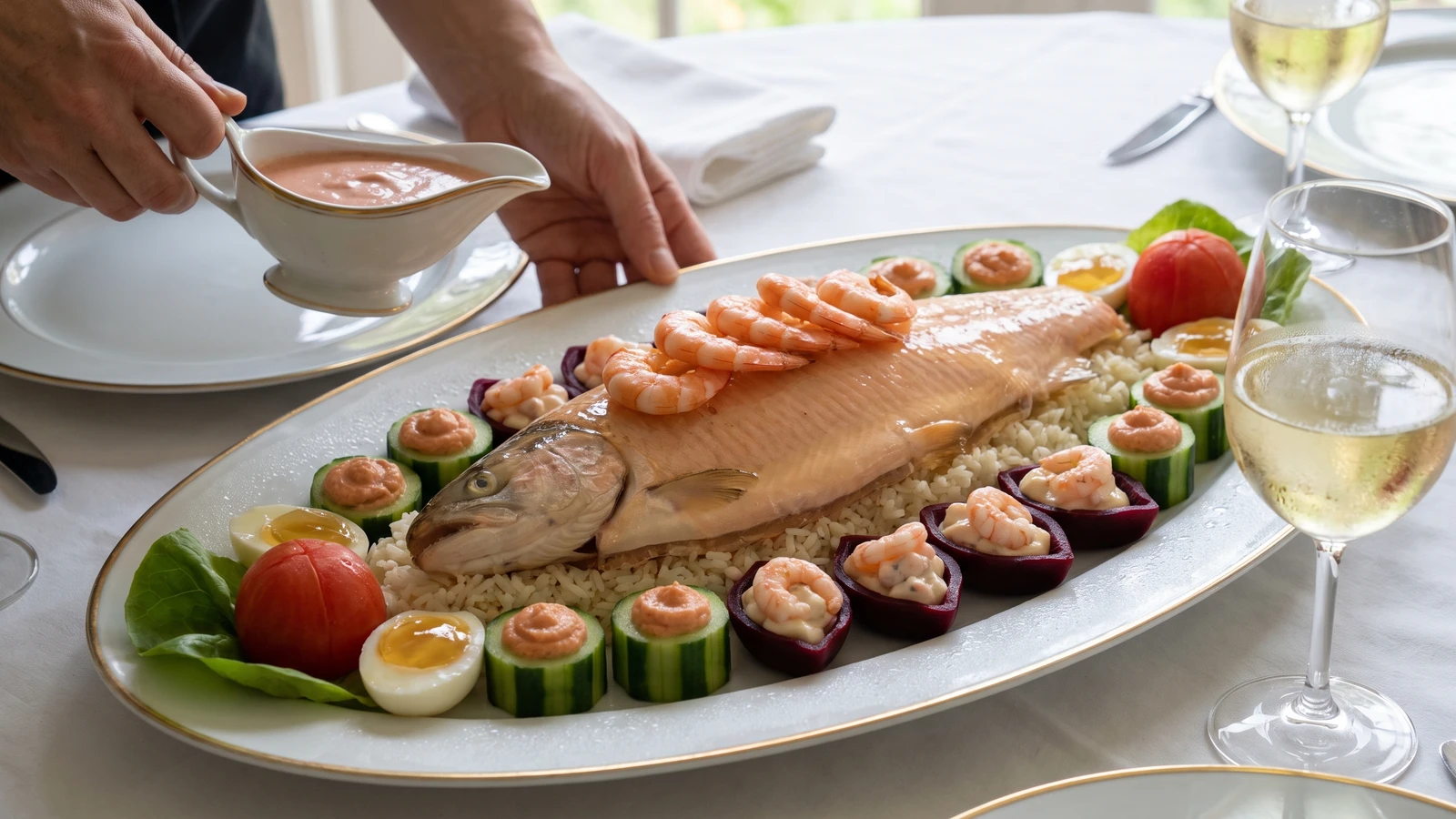
Cold salmon under a lucid aspic veil, raised on rice and crowned with prawns, while cucumber timbales, glazed eggs, tomatoes, and beetroot barquettes make the platter a proper celebration.
Saumon Froid, ou Darne de Saumon Froid à la Norvégienne (cold glazed salmon, or a thick cross-cut salmon steak, Norwegian-style) teaches cold construction. Every element must be thoroughly chilled, while the aspic must be fluid enough to veil the food and cool enough to set where it lands. Temperature is structure here. Know that before you touch a pan.
The original assumed a garde-manger shaping garnishes, a saucier on staff, a stockpot never off the fire, and trays of perfectly clear fish aspic waiting in the cold room. At home, one measured batch of white fish aspic, a refrigerator-cold oval platter, a pastry brush, and several shallow trays do the same work. The crystal vessel sunk into a block of clean ice is brigade scaffolding and can go. The transparent glaze, rice cushion, prawns, cucumber timbales, aspic eggs, beetroot barquettes, and Russe sauce served apart are the dish, and they stay. One cook, one stove, one evening of careful assembly.
The salmon arrives pale coral beneath its clear veil, lifted proudly above a bright ring of garnishes rather than buried beneath them. The step that decides everything is the glazing: aspic applied too warm slides off and loosens the decoration, while aspic allowed to set in the bowl lands in lumps. Cool it until it clings like light syrup, then work in thin coats. If one coat misbehaves, ça se rattrape, and the next coat makes it whole.
This composed salmon belongs to the Parisian buffet froid of grand French service, where whole fish were glazed, raised on edible socles, and surrounded by garnishes displaying the cold kitchen's command of shape and clarity. À la Norvégienne does not make it a Norwegian household dish; within the French canon, the title signaled smoked salmon and northern seafood arranged through French technique. As the presentation traveled to private celebration tables, the ice plinth receded, but the transparent glaze, formal garnish ring, and sauce served apart remained its grammar.
Quantity
1 piece, about 2 lb (900 g), prepared through the glazing stage of Saumon Froid, ou Darne de Saumon Froid en Belle-vue (No. 804)
poached, skinned, decorated, glazed, and chilled
Quantity
2¼ cups (540 ml / 540 g)
melted and cooled until fluid, divided
Quantity
1 cup (240 ml / 200 g)
Quantity
2 cups (480 ml / 480 g)
Quantity
2 teaspoons (10 ml / 12 g), plus more for blanching water
divided
Quantity
12
body shells removed and tail fans left intact
Quantity
1 large, about 12 oz (340 g)
Quantity
½ cup (120 ml / 120 g) Cooked Marinade for Venison (No. 168)
chilled, for the cucumber
Quantity
5 oz (140 g)
finely sliced
Quantity
¼ cup (60 ml / 57 g)
softened
Quantity
3 tablespoons (45 ml / 45 g)
well chilled
Quantity
⅛ teaspoon (0.6 ml / 0.3 g)
Quantity
2
hard-boiled, chilled, and peeled
Quantity
4
Quantity
½ cup loosely packed (120 ml / 15 g), plus 4 short stem tips
leaves and stems separated
Quantity
3 tablespoons (45 ml / 42 g)
softened
Quantity
1 medium, about 5 oz (150 g)
cut into small dice
Quantity
⅓ cup (80 ml / 80 g) Cooked Marinade for Venison (No. 168)
chilled, for the beetroot
Quantity
¾ cup (180 ml / 115 g)
thoroughly drained
Quantity
2
Quantity
2 teaspoons (10 ml / 10 g)
Quantity
1 tablespoon (15 ml / 15 g)
Quantity
1 cup (240 ml / 220 g)
Quantity
1 tablespoon (15 ml / 15 g)
Quantity
2 tablespoons (30 ml / 25 g)
finely grated
| Ingredient | Quantity |
|---|---|
| chilled center-cut salmon piecepoached, skinned, decorated, glazed, and chilled | 1 piece, about 2 lb (900 g), prepared through the glazing stage of Saumon Froid, ou Darne de Saumon Froid en Belle-vue (No. 804) |
| very clear white fish aspic jellymelted and cooled until fluid, divided | 2¼ cups (540 ml / 540 g) |
| short-grain white rice | 1 cup (240 ml / 200 g) |
| water | 2 cups (480 ml / 480 g) |
| fine sea saltdivided | 2 teaspoons (10 ml / 12 g), plus more for blanching water |
| fine cooked prawnsbody shells removed and tail fans left intact | 12 |
| English cucumber | 1 large, about 12 oz (340 g) |
| Cooked Marinade for Venisonchilled, for the cucumber | ½ cup (120 ml / 120 g) Cooked Marinade for Venison (No. 168) |
| smoked salmonfinely sliced | 5 oz (140 g) |
| unsalted butter for smoked-salmon puréesoftened | ¼ cup (60 ml / 57 g) |
| heavy creamwell chilled | 3 tablespoons (45 ml / 45 g) |
| ground white pepper | ⅛ teaspoon (0.6 ml / 0.3 g) |
| large eggshard-boiled, chilled, and peeled | 2 |
| small firm tomatoes | 4 |
| flat-leaf parsleyleaves and stems separated | ½ cup loosely packed (120 ml / 15 g), plus 4 short stem tips |
| unsalted butter for beurre vertsoftened | 3 tablespoons (45 ml / 42 g) |
| Barquettesfully baked and cooled | 4 small Barquettes (No. 314) |
| cooked beetrootcut into small dice | 1 medium, about 5 oz (150 g) |
| Cooked Marinade for Venisonchilled, for the beetroot | ⅓ cup (80 ml / 80 g) Cooked Marinade for Venison (No. 168) |
| cooked small shrimp tailsthoroughly drained | ¾ cup (180 ml / 115 g) |
| pasteurized large egg yolks | 2 |
| Dijon mustard | 2 teaspoons (10 ml / 10 g) |
| white wine vinegar | 1 tablespoon (15 ml / 15 g) |
| neutral oil | 1 cup (240 ml / 220 g) |
| fresh lemon juice | 1 tablespoon (15 ml / 15 g) |
| prepared horseradishfinely grated | 2 tablespoons (30 ml / 25 g) |
Chill a 46 cm oval serving platter until it feels thoroughly cold. Melt the aspic over the lowest heat only until liquid, never boiling it, then cool it over an ice bath until it flows like light oil. Pour 1¼ cups (300 ml / 300 g) onto the platter, tilting to make an even layer about 3 mm deep, and refrigerate until firm, about 30 minutes. If the aspic begins setting before the platter is coated, scrape it back into the pan and melt it gently. Ça se rattrape. A hurried, lumpy base does not improve beneath decoration.
Put the rice, water, and ½ teaspoon (2.5 ml / 3 g) of the salt in a small saucepan. Bring to a boil, cover, and cook over low heat until the rice is very tender and the water has been absorbed, about 18 minutes. Rest it covered for 10 minutes, then spread it on a shallow tray to cool quickly. While barely warm, pack it firmly into a narrow oval about 30 cm long and slightly smaller than the salmon, using a parchment collar or small loaf tin as a guide. Chill until solid, then slide it carefully onto the set aspic. If the rice cracks, mix in 2 tablespoons (30 ml / 30 g) of fluid aspic, press it together again, and chill. The cushion is support, not sculpture for its own sake.
Cut four neat cylinders from the cucumber, each about 5 cm tall. Peel them, hollow out the seeded centers without cutting through the bases, and parboil them in well-salted water for 90 seconds. Chill immediately in ice water, drain, and cover with the chilled Cooked Marinade for Venison (No. 168) for 15 minutes. Drain upside down and blot every surface dry. Longer marinating softens the walls. If a timbale splits, trim it into a lower ring and pipe the filling generously; the silhouette changes, but the garnish remains sound.
Process the smoked salmon and softened butter until perfectly smooth, scraping the bowl often. Add the cold cream a spoonful at a time, then season with the white pepper. Press the purée through a fine sieve if any fibers remain. Transfer it to a piping bag fitted with a plain tip and pipe a full dome into each cucumber timbale. If the purée turns loose or greasy, set the bowl over ice and work it firmly with a spatula until the butter catches again. Ça se rattrape. Refrigerate the filled timbales.
Whisk the pasteurized yolks with the Dijon mustard, vinegar, and ¼ teaspoon (1.25 ml / 1.5 g) of salt. Add the oil drop by drop until the emulsion takes, then pour it in a fine steady thread while whisking constantly. Stir in the lemon juice. Reserve ¼ cup (60 ml / 55 g) of this plain mayonnaise for the shrimp tails, then fold the horseradish into the remainder to make the Russe sauce. If the mayonnaise breaks, put 1 teaspoon (5 ml / 5 g) of cold water in a clean bowl and whisk in the broken sauce a teaspoon at a time. Keep both portions covered and cold.
Halve the hard-boiled eggs lengthwise and blot the cut surfaces dry. Brush them with a thin coat of fluid aspic, chill until set, then repeat until they wear a clear, even gloss. Score the tomatoes, lower them into boiling water for 10 seconds, chill, and peel them without tearing the flesh. Set each inside the corner of a clean towel and press with a gentle twisting motion to restore its round shape. For the beurre vert (green herb butter), blanch the parsley leaves for 10 seconds, chill, squeeze very dry, and pound them into the softened butter. Pass it through a fine sieve, pipe one small leaf onto each tomato, and insert a parsley stem tip beside it.
Marinate the diced beetroot in the chilled Cooked Marinade for Venison (No. 168) for 15 minutes, then drain and blot it thoroughly. Fill the baked Barquettes (No. 314) with the beetroot. Fold the shrimp tails through the reserved plain mayonnaise just firmly enough to cohere them, then mound them over the beetroot. Assemble these no more than 20 minutes before they meet the platter, or the pastry will lose its crisp edges.
Lift the chilled salmon prepared through the glazing stage of Saumon Froid, ou Darne de Saumon Froid en Belle-vue (No. 804) onto the rice cushion, centering it so the rice supports the fish without showing broadly around it. If the final aspic veil has dulled, brush on one more very thin coat and chill for 5 minutes. Arrange the prawns in a close row along the salmon, using tiny drops of fluid aspic beneath them to hold them in place.
Arrange the cucumber timbales, glazed egg halves, tomatoes with beurre vert, and filled beetroot barquettes in a repeating ring around the rice cushion. Keep the garnishes close enough to read as one generous composition, but leave a narrow border of clear aspic visible at the edge. Brush away any stray mayonnaise or beetroot marinade before it marks the jelly. This is precision in the service of appetite, not plating theater.
Refrigerate the completed platter for 20 to 30 minutes so every aspic joint sets. Bring it out about 10 minutes before serving, with the Russe sauce in a chilled sauceboat beside it. Carve the salmon across the grain and give each plate some rice, a prawn, and a share of the garnish ring. Keep the platter cold and do not leave it at room temperature for more than 2 hours. À table!
1 serving (about 960g)
Culinary guides, cultural storytelling, and the editorial depth that makes cooking meaningful.
Discover Culinary ExplorerChef Juliette
John Dory has the delicacy of sole and the firmness of turbot. A light flouring, a quick butter sauté, and nut-brown beurre noisette show exactly why looks never mattered.

Chef Juliette
Fresh haddock proves its delicacy in the meunière pan: a fine flour crust, moist pearly flakes, and beurre noisette sharpened with lemon and parsley, ready from one skillet in half an hour.

Chef Juliette
Éperlans à l’Anglaise turns small fish into a lesson in disciplined coating: boned smelts under a close, crisp crumb, pan-fried in clarified butter and finished with bright, half-melted maître d’hôtel butter.

Chef Juliette
Tiny smelts, shallot, mushrooms, white wine, gratin sauce, and fine bread raspings meet a fierce oven, where the fish must turn tender in the same breath the buttered crust bronzes.