
Chef Juliette
John Dory (St. Pierre)
John Dory has the delicacy of sole and the firmness of turbot. A light flouring, a quick butter sauté, and nut-brown beurre noisette show exactly why looks never mattered.
A cooking platform built around craft, culture, and the stories behind what we eat.
Created by Chef Juliette
Based on No. 804, Saumon Froid, ou Darne de Saumon Froid en Belle-vue, from Le Guide Culinaire (1907) by Auguste Escoffier
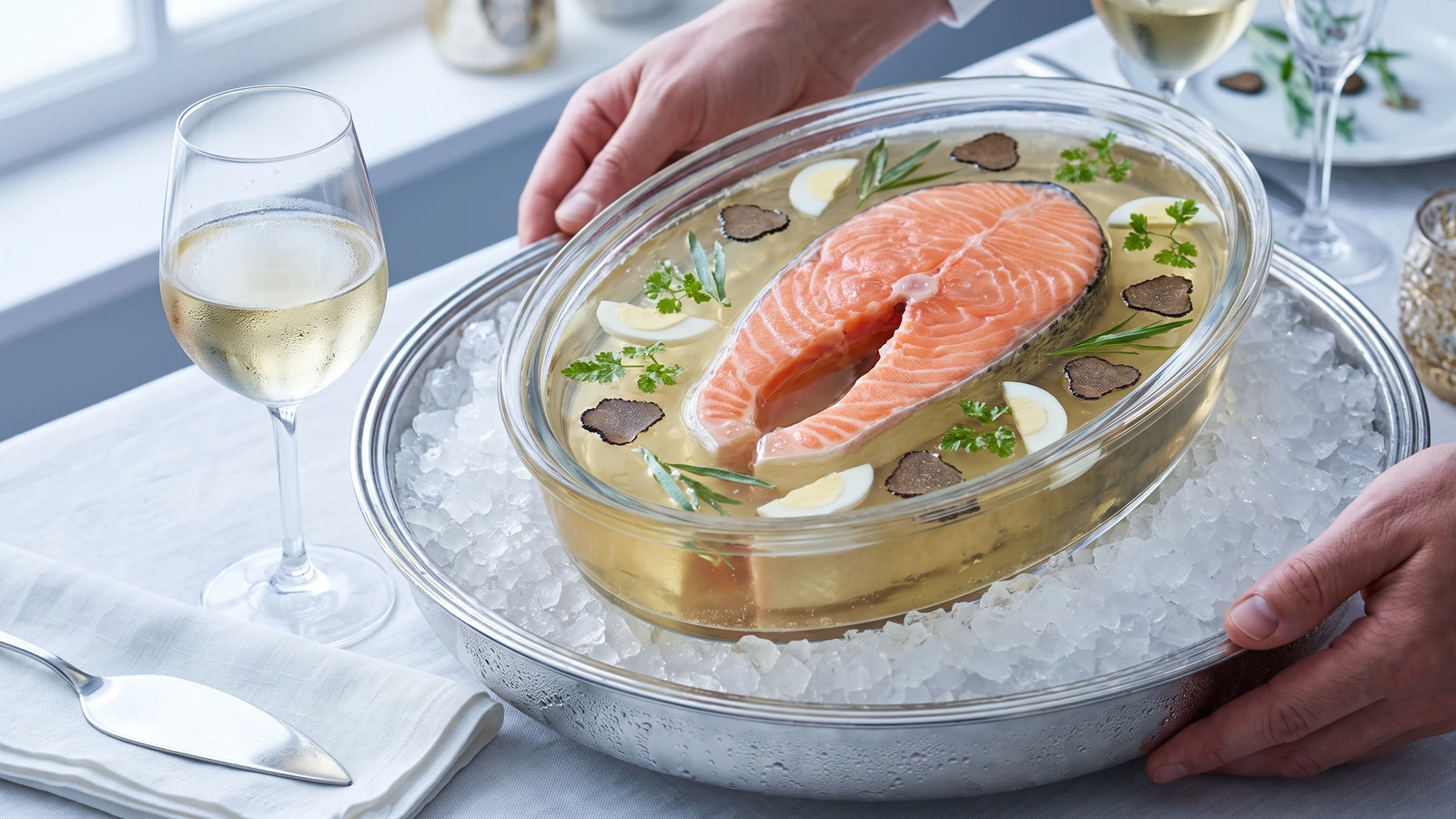
An upright salmon darne, gently poached, decorated with truffle, egg white, chervil, and tarragon, then veiled in brilliant fish aspic: a cold presentation that teaches clarity, patience, and confident generosity.
Saumon Froid, ou Darne de Saumon Froid en Belle-vue (cold salmon or salmon darne under clear aspic) teaches one exacting principle: a cold presentation is built in layers. The salmon must be succulent, the decoration must stay precisely where you placed it, and the aspic must form a transparent veil rather than a thick rubber coat. None of this is difficult, but every stage must be properly cold before the next begins.
The original recipe began with a cooked salmon piece, a saucier holding brilliant fish aspic made from stock never off the fire, a fish-shaped crystal receptacle, and enough hands to glaze the salmon while someone else carved a block of ice. At home, you have a two-pound center-cut darne, clear fish stock strengthened with gelatin, a close-fitting oval glass dish, and crushed ice, which the source itself gives as the sensible alternative. The carved block and fitted crystal fish are brigade scaffolding. The repeated aspic coats are the dish, so those stay. One cook, one stove, one evening of work, then the refrigerator keeps watch.
Choose the serving dish before buying the salmon, because a close fit uses less aspic and helps the darne stand upright on its belly edge. The moment that decides everything comes during glazing: the aspic must be cool and lightly syrupy, fluid enough to spoon yet thick enough to cling. Too warm and it runs away; too cold and it lands in lumps. Ça se rattrape, and the method tells you how.
Belle-vue belongs to the Parisian repertoire of formal cold fish and the grand buffet, where cooks displayed whole fish beneath transparent aspic both for brilliance and for protection from the air. The name describes a presentation, not a sauce or regional seasoning: the food must remain clearly visible through its jelly. A darne is not a fillet but a thick cross-cut section through a large round fish, prized here because its two fillets and central bone make a handsome, self-supporting centerpiece.
Quantity
1 darne, 3½ to 4 inches (8 to 10 cm) thick, about 2 pounds (900 g)
skin on and scaled
Quantity
10 cups (2.4 L / 2.4 kg)
divided
Quantity
1½ cups (360 ml / 360 g)
divided
Quantity
1
thinly sliced
Quantity
1
thinly sliced
Quantity
4
Quantity
1
Quantity
1 teaspoon (5 ml / 2 g)
Quantity
1½ tablespoons (22 ml / 27 g)
Quantity
4 cups (950 ml / 950 g)
Quantity
½ cup (120 ml / 120 g)
Quantity
3 tablespoons (45 ml / 27 g)
Quantity
3
divided, 2 for clarification and 1 for decoration
Quantity
1 teaspoon (5 ml / 6 g), or as needed
Quantity
1 small truffle, about ½ ounce (15 g)
drained and thinly sliced
Quantity
12
Quantity
12
Quantity
12 cups (2.8 L / about 1.8 kg)
for presentation
| Ingredient | Quantity |
|---|---|
| center-cut salmon darneskin on and scaled | 1 darne, 3½ to 4 inches (8 to 10 cm) thick, about 2 pounds (900 g) |
| cold waterdivided | 10 cups (2.4 L / 2.4 kg) |
| dry white winedivided | 1½ cups (360 ml / 360 g) |
| medium onionthinly sliced | 1 |
| medium carrotthinly sliced | 1 |
| flat-leaf parsley stems | 4 |
| bay leaf | 1 |
| black peppercorns | 1 teaspoon (5 ml / 2 g) |
| fine sea salt for the poaching liquor | 1½ tablespoons (22 ml / 27 g) |
| clear, unsalted fish stock | 4 cups (950 ml / 950 g) |
| cold water for blooming the gelatin | ½ cup (120 ml / 120 g) |
| unflavored powdered gelatin | 3 tablespoons (45 ml / 27 g) |
| large egg whitesdivided, 2 for clarification and 1 for decoration | 3 |
| fine sea salt for the aspic (optional) | 1 teaspoon (5 ml / 6 g), or as needed |
| whole preserved black truffledrained and thinly sliced | 1 small truffle, about ½ ounce (15 g) |
| small chervil leaves | 12 |
| small tarragon leaves | 12 |
| crushed icefor presentation | 12 cups (2.8 L / about 1.8 kg) |
Combine the fish stock with ½ cup (120 ml) of the wine in a saucepan and let the mixture become completely cold. Whisk 2 egg whites only until loosened, not foamy, and stir them into the cold stock. Heat very slowly, stirring across the bottom until the whites gather and begin rising into a raft. Stop stirring, open a small vent in the raft with a spoon, and hold the liquid at the barest simmer for 15 minutes. Ladle it gently through a fine sieve lined with damp cheesecloth, without pressing the raft. Pressing forces the captured particles straight back into the aspic.
Sprinkle the gelatin evenly over the ½ cup (120 ml) cold blooming water and leave it for 10 minutes, until every grain is swollen. Stir the bloomed gelatin into the hot clarified stock off the heat, then taste and add up to 1 teaspoon of salt. Cold dulls seasoning, so the liquid should taste slightly more vivid than you want at the table. Spoon a tablespoon onto a chilled saucer and refrigerate it for 5 minutes; it should set firmly but melt cleanly on the tongue. Cool the remaining aspic until it is fluid and lightly syrupy. If it sets in the bowl, warm it gently over lukewarm water. If it runs like water, chill it for another 5 minutes. Ça se rattrape.
Put 8 cups (1.9 L) of the remaining water and 1 cup (240 ml) of the remaining wine into a wide pan with the onion, carrot, parsley stems, bay leaf, peppercorns, and poaching salt. Simmer gently for 15 minutes, then lower the temperature to 175°F (80°C). The pan should hold the darne without bending it, with the liquid covering the fish by about 1 inch (2.5 cm). A wide sauté pan or small roasting pan is the honest home equivalent of a fish kettle.
Lower the salmon into the liquor and hold the temperature between 167°F and 176°F (75°C and 80°C). The surface may tremble, but it must never boil. Poach for 25 to 35 minutes, depending on thickness, until a thermometer inserted into the thickest fillet reads 140°F (60°C). Lift the fish carefully onto a rack, rest it for 5 minutes, and confirm that carryover heat brings the center to 145°F (63°C). Boiling would contract the flesh, force out its moisture, and leave the chilled salmon dry.
Let the darne drain and cool for 20 minutes, then refrigerate it uncovered until thoroughly cold, about 1½ hours. Support each fillet with one hand while lifting away the skin with the tip of a small knife. Remove the thin gray layer immediately beneath the skin without cutting into the coral flesh, but leave the central bone and the connection at the belly intact because they hold the darne upright. Set it on its belly edge on a cold tray and blot every surface dry. Aspic will not cling to wet fish.
Bring the remaining 2 cups (475 ml) water just below a simmer in a small saucepan. Slide in the remaining egg white and poach it gently until evenly opaque, about 3 minutes. Lift it out, cool it in cold water, and blot it dry. Cut small diamonds, crescents, or narrow leaves from its smoothest parts. Arrange the white egg, black truffle, chervil, and tarragon across both fillets in a simple repeating pattern, leaving enough coral salmon visible for the decoration to breathe.
Spoon a few drops of lightly syrupy aspic over each piece of decoration, using only enough to fasten it to the salmon. Refrigerate the darne for 5 minutes, until the garnish no longer shifts when the tray is moved. If the herbs curl or the truffle slides, the aspic is too warm; chill it briefly and fix the loose pieces again. Do not chase them around with your fingers. A drop of properly cooled aspic does the work.
Spoon a very thin coat of aspic over the entire darne and refrigerate it for 4 to 6 minutes, just until set. Repeat with 5 to 7 thin coats, turning the tray as needed so both decorated fillets, the cut face, and the upper edge receive an even veil. One heavy pour will trap bubbles, drag away the garnish, and set in thick ridges. Repeated thin coats are not brigade ceremony. They are the dish. If a coat lands in lumps, warm the aspic gently until fluid again; if a bare patch remains, cover it with the next coat.
Transfer the glazed darne to the close-fitting clear glass dish and stand it upright on its belly edge. Pour the remaining cool, fluid aspic slowly around the fish, not directly over the decoration. If the darne begins to lean, support it between two chilled spoons, add only ½ inch (1 cm) of aspic, and refrigerate until that anchor sets before filling the dish to the brim. Chill for at least 2 hours, until the jelly is completely firm and transparent.
Spread the crushed ice in a broad tray and nest the glass dish securely into it just before serving. Wipe the rim so the aspic remains brilliant and the cold glass shows only fine beads of condensation. Cut through the jelly with a sharp knife, then lift portions from each fillet away from the central bone with a fish slice. The salmon is generous, the aspic trembles, and nothing needs disguising. À table!
1 serving (about 440g)
Culinary guides, cultural storytelling, and the editorial depth that makes cooking meaningful.
Discover Culinary ExplorerChef Juliette
John Dory has the delicacy of sole and the firmness of turbot. A light flouring, a quick butter sauté, and nut-brown beurre noisette show exactly why looks never mattered.

Chef Juliette
Fresh haddock proves its delicacy in the meunière pan: a fine flour crust, moist pearly flakes, and beurre noisette sharpened with lemon and parsley, ready from one skillet in half an hour.

Chef Juliette
Éperlans à l’Anglaise turns small fish into a lesson in disciplined coating: boned smelts under a close, crisp crumb, pan-fried in clarified butter and finished with bright, half-melted maître d’hôtel butter.

Chef Juliette
Tiny smelts, shallot, mushrooms, white wine, gratin sauce, and fine bread raspings meet a fierce oven, where the fish must turn tender in the same breath the buttered crust bronzes.