
Chef Juliette
John Dory (St. Pierre)
John Dory has the delicacy of sole and the firmness of turbot. A light flouring, a quick butter sauté, and nut-brown beurre noisette show exactly why looks never mattered.
A cooking platform built around craft, culture, and the stories behind what we eat.
Created by Chef Juliette
Based on No. 800, Cold Salmon, from Le Guide Culinaire (1907) by Auguste Escoffier
Saumon froid teaches the discipline of gentle poaching: keep the fish whole, cool it in its own liquor, preserve its silver skin, and serve with Montpellier Butter (No. 153).
Saumon froid (cold salmon) teaches one uncompromising thing: fish served cold stays succulent when it is poached whole and allowed to cool in the liquor that cooked it. Individual portions may look tidier, but their cut faces surrender moisture; the whole fish, still in its silver skin, protects the flesh. That is the dish.
The book assumed a long fish kettle, five quarts of Court-bouillon with Vinegar (No. 163), and a garde-manger, the cold-kitchen cook. Montpellier Butter (No. 153), an herb-rich cold butter sauce, Barquettes (No. 314), little boat-shaped croustades, and cucumber Cassolette cases could all be waiting at hand. Your honest equivalents are a snug metal pan that fits both the fish and the refrigerator, a foil sling, and a sink full of ice. The regiment of aspics and stuffed garnishes is brigade scaffolding and can go; poaching the fish whole and cooling it in the same liquor must stay. One cook, one stove, one evening.
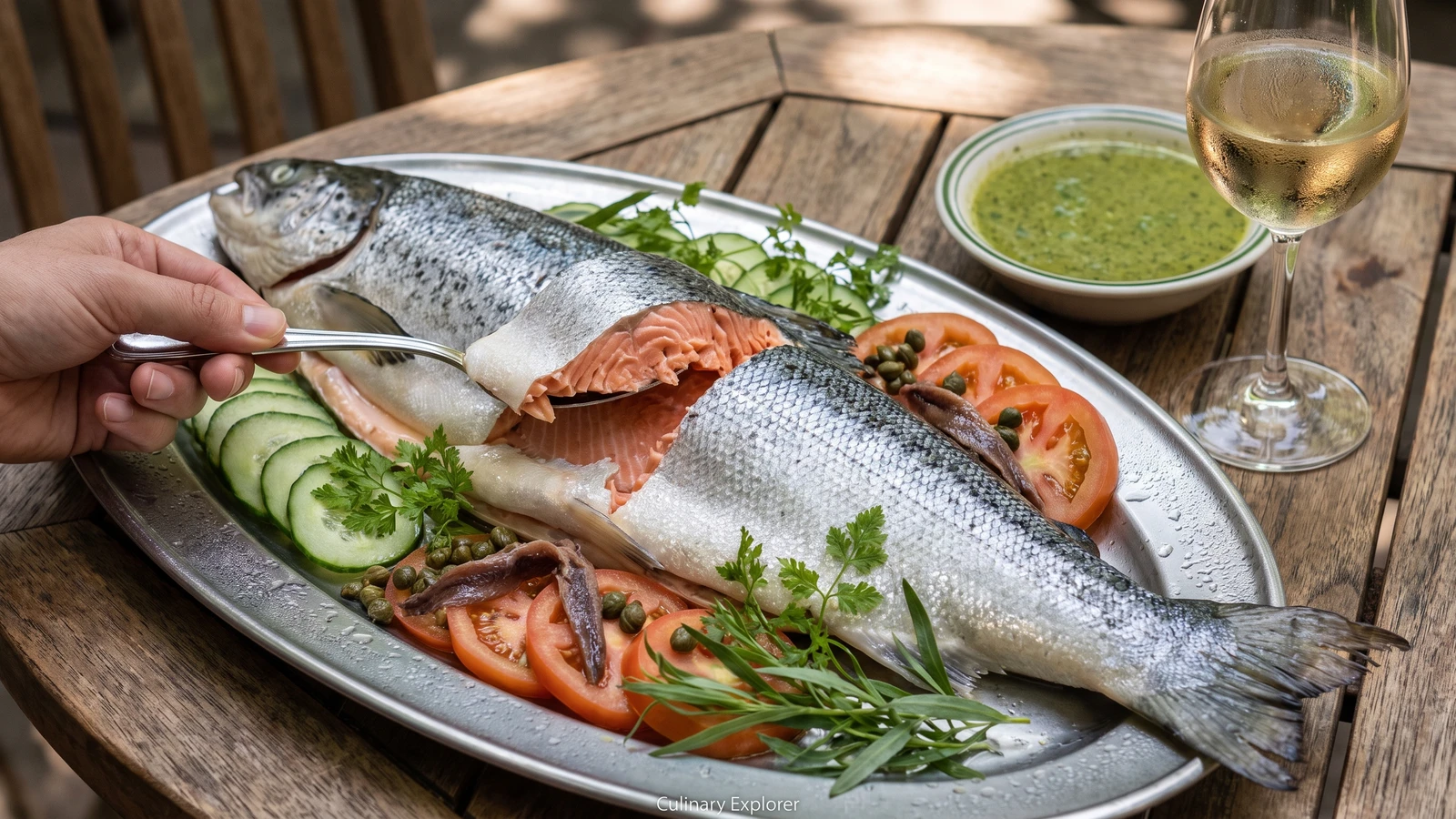
Bring the saumon froid to the table properly cold, its coral flesh moist beneath bright silver skin, with cucumber, capers, anchovy, herbs, and the green sauce beside it. No piped colored butter and no decoration for its own sake. The step that decides everything is the cooling: leave the salmon submerged, then pull the heat out quickly with an ice bath so moisture and safety travel together.
Saumon froid belongs to the Parisian cold-buffet repertoire, from which it traveled to bourgeois celebration tables and shaded outdoor lunches across France. Grand kitchens surrounded the whole fish with aspics, stuffed eggs, Barquettes (No. 314), and cucumber or beetroot Cassolette garnishes, yet their own rule prized the moist flesh protected by silver skin above the tidier appearance of separate portions. The revealing debate concerned decoration: bared fillets accepted ornament more easily, but gourmets preferred the natural vestment and Montpellier Butter (No. 153), not colored butter piped over a cold fish.
Quantity
1 whole fish, 3½ to 4 lb (1.6 to 1.8 kg)
scaled, gutted, and cleaned with head, tail, and skin intact
Quantity
About 4 quarts (3.8 L / 3.9 kg) Court-bouillon with Vinegar (No. 163)
thoroughly chilled and divided
Quantity
1 medium cucumber, about 10 oz (285 g)
chilled
Quantity
2 small tomatoes, about 8 oz (225 g)
Quantity
2 tablespoons (30 ml / 18 g)
drained
Quantity
6 fillets, about 1¼ oz (35 g)
drained and gently rinsed
Quantity
¼ cup (60 ml / 12 g)
loosely packed
Quantity
2 tablespoons (30 ml / 5 g)
Quantity
4 prepared Barquettes (No. 314)
filled at serving with cucumber, capers, and anchovy
| Ingredient | Quantity |
|---|---|
| small whole salmonscaled, gutted, and cleaned with head, tail, and skin intact | 1 whole fish, 3½ to 4 lb (1.6 to 1.8 kg) |
| prepared Court-bouillon with Vinegarthoroughly chilled and divided | About 4 quarts (3.8 L / 3.9 kg) Court-bouillon with Vinegar (No. 163) |
| prepared Montpellier Butterchilled | ¾ cup (180 ml / 170 g) Montpellier Butter (No. 153) |
| cucumberchilled | 1 medium cucumber, about 10 oz (285 g) |
| ripe tomatoes (optional) | 2 small tomatoes, about 8 oz (225 g) |
| capersdrained | 2 tablespoons (30 ml / 18 g) |
| anchovy filletsdrained and gently rinsed | 6 fillets, about 1¼ oz (35 g) |
| chervil leavesloosely packed | ¼ cup (60 ml / 12 g) |
| small tarragon leaves | 2 tablespoons (30 ml / 5 g) |
| prepared Barquettes (optional)filled at serving with cucumber, capers, and anchovy | 4 prepared Barquettes (No. 314) |
Before heating anything, confirm that the salmon lies flat in a long stovetop-safe metal roasting pan or fish poacher and that the same vessel fits in the refrigerator. Clear the shelf now. Fold a wide sheet of heavy foil or clean cheesecloth into a sling long enough to extend beyond both ends of the fish; this will let you lift the cooked salmon without breaking it. Prepare a sink or large tub with ice nearby, but do not fill it with water yet.
Lay the salmon on its side over the sling, curving the tail gently only if necessary. Pour in enough thoroughly chilled Court-bouillon with Vinegar (No. 163) to cover the fish by about ½ inch (1 cm), reserving 1 cup (240 ml / 245 g) of the cold liquid. Let the belly cavity fill so no pocket of air keeps the fish afloat. Keeping the salmon whole is not presentation fuss; the uncut skin slows moisture loss from the flesh.
Set the pan across two low burners and warm it slowly, rotating the vessel occasionally if one end heats faster. Hold the liquid between 175 and 185°F (79 and 85°C), where it trembles and shows only an occasional lazy bubble. Never let it boil. Begin checking the salmon once the liquid reaches poaching temperature, inserting an instant-read thermometer into the thickest flesh just behind the head without touching the backbone. Turn off the heat at 140°F (60°C), then leave the fish submerged for 5 to 8 minutes and confirm that it reaches 145°F (63°C). If the liquid begins to boil, pull the pan off the burners immediately and add some reserved cold Court-bouillon with Vinegar (No. 163). Ça se rattrape: bring the temperature down, then continue over gentler heat.
Take the pan directly to the prepared sink and surround it with ice water, keeping the outer water nearly level with the poaching liquor. Leave the salmon submerged. Stir the water outside the pan every 10 minutes and replace melted ice until the liquor falls to 70°F (21°C) or colder, which must happen within 2 hours. Cover the pan and refrigerate the fish in its liquor until both reach 40°F (4°C) or colder, usually another 3 hours and always within the next 4 hours. Do not leave this large fish cooling on the counter; the ice bath is the home kitchen's cold room.
Use the sling to lift the fully chilled salmon onto a rack set over a rimmed tray, then let it drain in the refrigerator for 10 minutes. Transfer it carefully to a chilled long platter and blot away surface moisture with a soft towel, pressing rather than rubbing. Keep the skin. If a patch catches on the sling, wet the cloth with a spoonful of cold poaching liquor and ease it free; if a small tear remains, ça se rattrape, place that side downward or shelter the spot with a few cucumber slices.
Cut two-thirds of the cucumber into thin rounds or half-moons and dice the remainder finely. Slice the tomatoes, if using. Arrange the cucumber and tomato close around the salmon rather than over its silver skin, then add the capers, anchovy fillets, chervil, and tarragon in loose, edible groups. If using the prepared Barquettes (No. 314), fill them just before serving with the diced cucumber, a few capers, and finely chopped anchovy, then place one near each portion. Stop while the fish still looks like fish.
Take the Montpellier Butter (No. 153) from the refrigerator about 10 minutes before serving and work it briefly with a wooden spoon until cool, smooth, and easy to spoon. Present it in a chilled bowl beside the salmon rather than piping it over the skin. If beads of oil appear at the edge, chill the bowl for 5 minutes and beat the sauce smooth again. We don't apologize for butter, but we do serve it at the temperature where it behaves.
Bring the saumon froid from the refrigerator no more than 20 minutes before eating. With a fish knife or narrow slicing knife, cut the upper fillet into four broad portions down to the backbone and lift each away with a fish slice. Remove the backbone in one piece, then divide the lower fillet. Give every plate cucumber, capers, anchovy, herbs, and a generous spoonful of sauce alongside the moist coral flesh. À table!
1 serving (about 400g)
Culinary guides, cultural storytelling, and the editorial depth that makes cooking meaningful.
Discover Culinary ExplorerChef Juliette
John Dory has the delicacy of sole and the firmness of turbot. A light flouring, a quick butter sauté, and nut-brown beurre noisette show exactly why looks never mattered.

Chef Juliette
Fresh haddock proves its delicacy in the meunière pan: a fine flour crust, moist pearly flakes, and beurre noisette sharpened with lemon and parsley, ready from one skillet in half an hour.

Chef Juliette
Éperlans à l’Anglaise turns small fish into a lesson in disciplined coating: boned smelts under a close, crisp crumb, pan-fried in clarified butter and finished with bright, half-melted maître d’hôtel butter.

Chef Juliette
Tiny smelts, shallot, mushrooms, white wine, gratin sauce, and fine bread raspings meet a fierce oven, where the fish must turn tender in the same breath the buttered crust bronzes.