
Chef Juliette
John Dory (St. Pierre)
John Dory has the delicacy of sole and the firmness of turbot. A light flouring, a quick butter sauté, and nut-brown beurre noisette show exactly why looks never mattered.
A cooking platform built around craft, culture, and the stories behind what we eat.
Created by Chef Juliette
Based on No. 777, The Frying of Fish, from Le Guide Culinaire (1907) by Auguste Escoffier
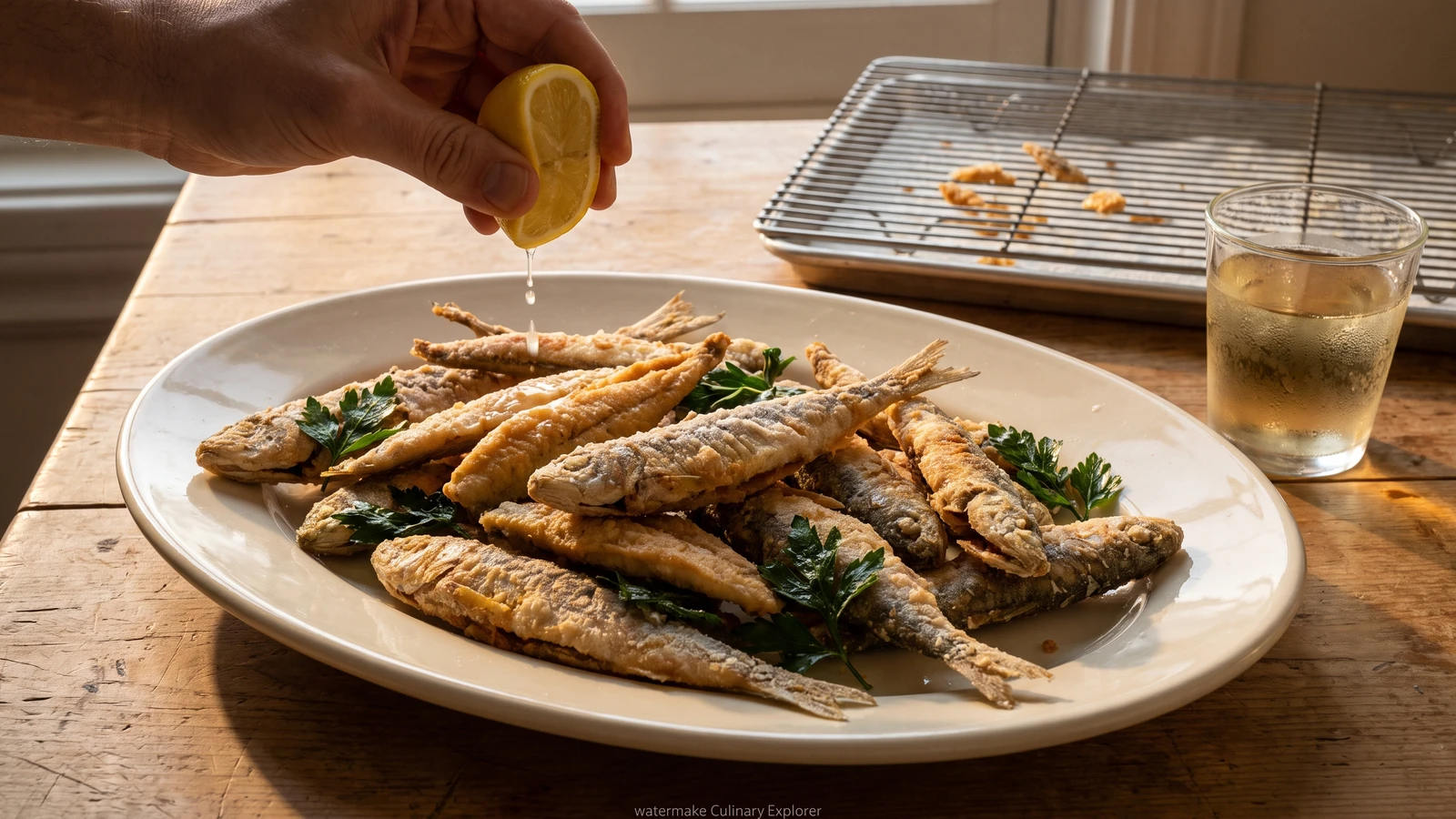
Small fish and thin fillets, salted milk, flour, and very hot fat: friture teaches the exact instant when a crisp bronze crust sets before delicate flesh has time to dry.
Friture de poissons (deep-fried small fish) teaches one law: the crust must set before the flesh has time to dry. That requires small fish or thin fillets, a light coat rather than armor, and fat already very hot when the fish enters. Begin with a thick steak and the outside will exhaust itself before heat reaches the center. Begin with cool fat and the flour will drink it.
The classical kitchen assumed a deep copper frying kettle, a generous supply of filtered fat held ready through service, and a drainer dressed with special papers. For four people, one cook needs a heavy straight-sided pot filled no more than halfway, a thermometer, and a wire rack. Capacity and presentation have changed because you are feeding a table, not a dining room. The napkin, special paper, and decorative crisscrossing were brigade scaffolding and may go. Salted milk, flour, and very hot fat are the dish, so they stay. One cook, one stove, one evening.
Done properly, the fish arrives bronze and crisp at its fine edges, moist beneath the crust, with dark green fried parsley and lemon ready to cut through the richness. The step that decides everything is temperature: let the oil return to 375°F (190°C) before every batch.
Friture de poissons has no single provincial owner: fish markets along the Saône and Rhône around Lyon, Channel ports in Normandy, and Mediterranean ports in Provence each sent their smallest local catch to hot fat, with the species changing while the method remained distinct and precise. The classical kitchen codified that household practice into salted milk, flour, fried parsley, and trimmed lemon, while reserving panés à l’anglaise for a fuller egg-and-crumb coat. Napkins, draining stands, and crisscrossed crumbs belonged to formal service; the essential method traveled unchanged between bistros and home tables.
Quantity
1½ pounds (680 g)
scaled and gutted if whole, pin-boned if filleted, no thicker than ½ inch (1.25 cm)
Quantity
1½ cups (360 ml / 370 g)
Quantity
2 teaspoons (10 ml / 12 g)
divided
Quantity
1¼ cups (300 ml / 155 g)
Quantity
2 quarts (1.9 L / about 1.75 kg), for Fryings (No. 262)
Quantity
2 loosely packed cups (480 ml / 50 g)
washed and completely dried
Quantity
2
halved crosswise, seeded and trimmed
Quantity
1 batch Anglaise (for Egg-and-bread-crumbing) (No. 174)
Quantity
2 cups (480 ml / 160 g)
| Ingredient | Quantity |
|---|---|
| small cleaned fish, such as smelts or small whiting, or thin skinless filletsscaled and gutted if whole, pin-boned if filleted, no thicker than ½ inch (1.25 cm) | 1½ pounds (680 g) |
| whole milk | 1½ cups (360 ml / 370 g) |
| fine sea saltdivided | 2 teaspoons (10 ml / 12 g) |
| plain flour | 1¼ cups (300 ml / 155 g) |
| refined sunflower or peanut oil | 2 quarts (1.9 L / about 1.75 kg), for Fryings (No. 262) |
| flat-leaf parsley sprigswashed and completely dried | 2 loosely packed cups (480 ml / 50 g) |
| lemonshalved crosswise, seeded and trimmed | 2 |
| Anglaise (for Egg-and-bread-crumbing) (optional) | 1 batch Anglaise (for Egg-and-bread-crumbing) (No. 174) |
| fine fresh white breadcrumbs (optional) | 2 cups (480 ml / 160 g) |
Check every piece before heating the oil. Thin fillets and genuinely small whole fish need no gashing. If a small whole fish is noticeably thick through the shoulder, score both sides toward the bone in a close crosshatch so heat can enter; for a small flatfish cooked whole, partly loosen the two underside fillets along the backbone instead. A large fish or thick steak does not belong in this preparation. Set a wire rack over a rimmed tray and warm the oven to 200°F (95°C) for holding the briefest possible time.
For the standard friture, dissolve 1 teaspoon (5 ml / 6 g) salt in the cold milk and steep the fish for 15 minutes in the refrigerator. Lift it out and let the excess milk drain for 2 minutes, but do not rub the surface dry; the slight tack is what holds the flour. Whitebait is the classical exception and goes directly into flour without milk. For panés à l’anglaise (breaded in the English manner), omit the milk. Dust the dry fish lightly with flour, coat it completely in the finished Anglaise (for Egg-and-bread-crumbing) (No. 174), then roll it in the fresh white breadcrumbs and press the coating gently with the flat of a knife. The old crisscross marking was decorative brigade work and can go; firm adhesion cannot.
Use the safe deep-fat arrangement set out in Fryings (No. 262): pour the oil into a bone-dry, heavy, straight-sided pot, making certain the pot is no more than half full. Clip on the thermometer, keep a fitted lid within reach, and heat the oil gradually to 350°F (175°C). The empty space above the oil contains the surge when food enters, so it is protection, not wasted capacity. Never leave the pot unattended, never move it while hot, and never bring water near the oil.
Make certain the parsley is completely dry. Lower a small handful into the 350°F (175°C) oil with a wire skimmer and fry for 10 to 15 seconds, until the leaves turn darker green and crisp. It will spit sharply at first, so keep your face and hands back. If the splattering becomes fierce, lower the heat and wait without reaching across the pot. Lift the parsley to the rack, season it with a pinch of the remaining salt, skim away loose leaves, then raise the oil to 375°F (190°C).
Put the flour in a wide shallow dish. For the milk-steeped fish, dredge only enough pieces for one batch and shake off every loose veil of flour; a thin, even coat crisps, while clotted flour turns pasty. Lower the fish away from you into the 375°F (190°C) oil without crowding the pot. Keep the oil between 355°F and 375°F (180°C and 190°C), turning the fish once, until the coating is firm and bronze and the flesh is opaque at its thickest point, about 2 to 3 minutes for thin fillets or 3 to 4 minutes for small whole fish. Breaded pieces should be an even deep gold. Lift each batch to the wire rack and salt it immediately. If the first pieces emerge pale and greasy, stop adding fish and restore the oil to 375°F (190°C), then refry those pieces for 15 to 20 seconds. Ça se rattrape. Hold finished fish uncovered in the warm oven for no more than 8 minutes, and return the oil fully to temperature before the next batch.
Arrange the fish in a loose single layer on a warm platter, never in a covered heap where trapped moisture can soften the crust. Tuck in the fried parsley and trimmed lemon halves, then carry it straight to the table. The lemon is the sauce here, bright against the hot crust and clean fish. À table!
1 serving (about 210g)
Culinary guides, cultural storytelling, and the editorial depth that makes cooking meaningful.
Discover Culinary ExplorerChef Juliette
John Dory has the delicacy of sole and the firmness of turbot. A light flouring, a quick butter sauté, and nut-brown beurre noisette show exactly why looks never mattered.

Chef Juliette
Fresh haddock proves its delicacy in the meunière pan: a fine flour crust, moist pearly flakes, and beurre noisette sharpened with lemon and parsley, ready from one skillet in half an hour.

Chef Juliette
Éperlans à l’Anglaise turns small fish into a lesson in disciplined coating: boned smelts under a close, crisp crumb, pan-fried in clarified butter and finished with bright, half-melted maître d’hôtel butter.

Chef Juliette
Tiny smelts, shallot, mushrooms, white wine, gratin sauce, and fine bread raspings meet a fierce oven, where the fish must turn tender in the same breath the buttered crust bronzes.