
Chef Juliette
Smelt (Éperlans)
Tiny éperlans, lightly floured and fried until their tails stand crisp, arrive in a generous heap on a napkin with fried parsley and grooved lemon, a weeknight lesson in heat and restraint.
A cooking platform built around craft, culture, and the stories behind what we eat.
Created by Chef Juliette
Based on No. 262, Fryings, from Le Guide Culinaire (1907) by Auguste Escoffier
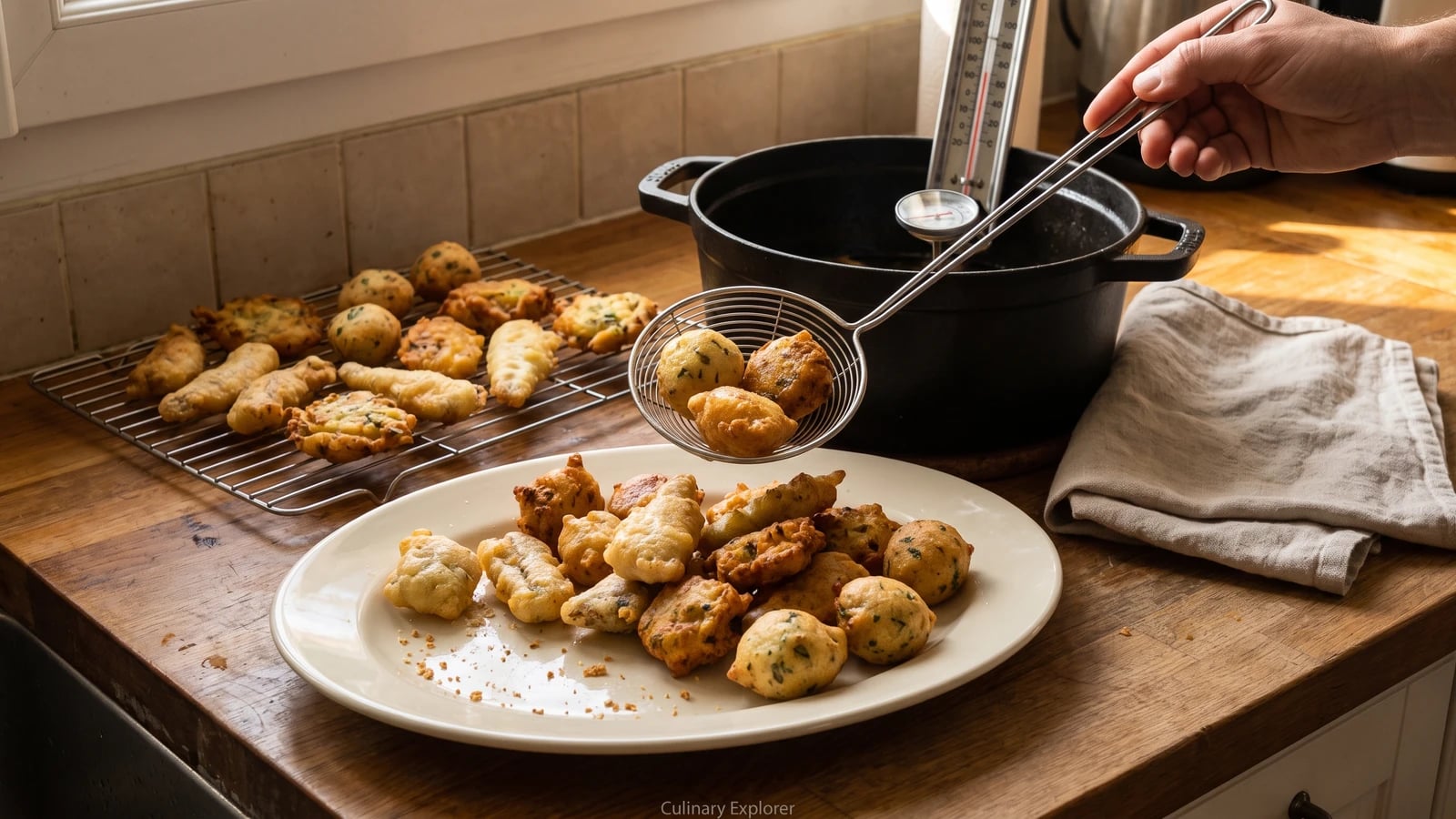
Friture rewards discipline: a heavy pot kept half full, clean fat held at steady heat, and small batches turned crisp and golden without bluster or danger.
Friture teaches the sternest simple rule in the kitchen: hot fat needs empty space. Keep the vessel no more than half full, and the fat can rise around the food without climbing over the rim. Friture isn't one batter or filling; it is the shared process that finishes croquettes, beignets, potatoes, and small fish.
This entry needs no saucier, simmering stock, or salamander. Its professional assumption is a capacious, one-piece copper pan with straight sides and a cook accustomed to handling great quantities of overheated fat. At home, use a 5½- to 6-quart heavy, straight-sided pot, a clip-on thermometer, and two quarts of clean frying fat. Copper becomes heavy iron or sturdy stainless steel because stability matters on a home burner, while brigade volume becomes four small batches so the temperature can recover. The vessel and great quantity are scaffolding; the empty upper half, dry food, steady heat, and calm handling are the technique, so they stay.
The finished pieces should emerge evenly golden, crisp beneath the teeth, and clean rather than greasy. Heat the fat slowly to 350°F (175°C), then let it recover fully between batches. That recovery is the one step that matters most before each piece meets the pan.
Friture belongs to no single French region; its home in the canon is the batterie de cuisine, the foundational equipment and methods shared by Parisian grand kitchens, neighborhood bistros, and household stoves. Professional manuals treated it as a principal cooking process because croquettes, beignets, pommes de terre, and small fish all depended on the same control of fat, vessel, and batch size. Copper was prized for its quick response, but the lasting rule is more surprising: straight sides and an empty upper half mattered as much for safety as the fat itself.
Quantity
2 qt (1.9 L / about 1.75 kg)
Quantity
About 4 cups (950 ml by loose volume / 455 g)
fully cooked or quick-cooking, thoroughly dry and chilled
| Ingredient | Quantity |
|---|---|
| clean, high-smoke-point frying fat, such as refined peanut or sunflower oil | 2 qt (1.9 L / about 1.75 kg) |
| prepared bite-size appetizer piecesfully cooked or quick-cooking, thoroughly dry and chilled | About 4 cups (950 ml by loose volume / 455 g) |
Set a dry 5½- to 6-quart heavy, straight-sided pot on a stable burner. Clip on the thermometer, keeping its tip submerged but clear of the pot floor, then add the frying fat. The level must sit well below halfway; if it doesn't, ladle out cold fat before lighting the burner. Put a fitted metal lid within reach, clear away water and damp cloths, and place a wire rack over a rimmed sheet pan for draining.
Divide the prepared pieces into four batches of about 1 cup (240 ml by loose volume / 115 g) each. Brush away loose crumbs and check every surface for moisture. If anything feels damp, dry it thoroughly and chill it uncovered for 10 minutes. Water erupts in hot fat, while a dry, cold surface holds its shape and forms a cleaner crust.
Heat the fat over medium heat to 350°F (175°C), allowing 10 to 15 minutes and watching it continuously. It should remain clear and calm, never smoking. If it begins to smoke, turn off the burner and leave the pot exactly where it is until completely cool. If the fat catches fire, slide the fitted lid over it from the side and turn off the heat if you can do so safely; never use water, and use an appropriate fire extinguisher if the flame doesn't go out immediately.
Using a completely dry spider or long-handled tongs, lower one batch into the fat piece by piece, directing each away from you. Don't drop them. Let the crust set for 20 to 30 seconds before moving anything, then separate the pieces gently and fry until evenly golden and crisp, usually 2 to 5 minutes depending on size. Hold the fat between 340°F and 360°F (170°C and 182°C), and cook each centre as its own preparation directs.
Lift the batch onto the wire rack, allowing excess fat to fall back into the pot, and leave space between the pieces. If the temperature fell below 330°F (165°C) and the crust looks pale or greasy, ça se rattrape: let the fat return to 350°F (175°C), then fry the drained pieces again for 30 to 60 seconds. Skim out dark crumbs, allow the fat to recover completely, and only then add the next batch.
Bring the friture to the table as soon as the final batch has drained, while the crust is still crisp. Turn off the burner and leave the pot untouched on its stable surface; don't carry hot fat to the sink or attempt to pour it. Let it cool completely for at least 3 hours before straining or discarding it. À table!
1 serving (about 120g)
Culinary guides, cultural storytelling, and the editorial depth that makes cooking meaningful.
Discover Culinary ExplorerChef Juliette
Tiny éperlans, lightly floured and fried until their tails stand crisp, arrive in a generous heap on a napkin with fried parsley and grooved lemon, a weeknight lesson in heat and restraint.

Chef Juliette
Brandade de Morue turns salt cod, warm olive oil, and milk into a pale, silky emulsion: keep everything warm and add the oil slowly, then crown the generous dome with butter-fried bread.

Chef Juliette
Salt cod worked warm with cream, one patient spoonful at a time, until the rough flakes become a glossy Nîmes paste, domed generously and ringed with butter-fried croutons for the table.

Chef Juliette
Wine-poached char packed in its earthenware crock beneath butter gold: a make-ahead first course that turns careful cooling, thorough boning, and one unbroken seal into quiet abundance.