
Chef Juliette
John Dory (St. Pierre)
John Dory has the delicacy of sole and the firmness of turbot. A light flouring, a quick butter sauté, and nut-brown beurre noisette show exactly why looks never mattered.
A cooking platform built around craft, culture, and the stories behind what we eat.
Created by Chef Juliette
Based on No. 775, Divers Ways of Cooking Fish, from Le Guide Culinaire (1907) by Auguste Escoffier
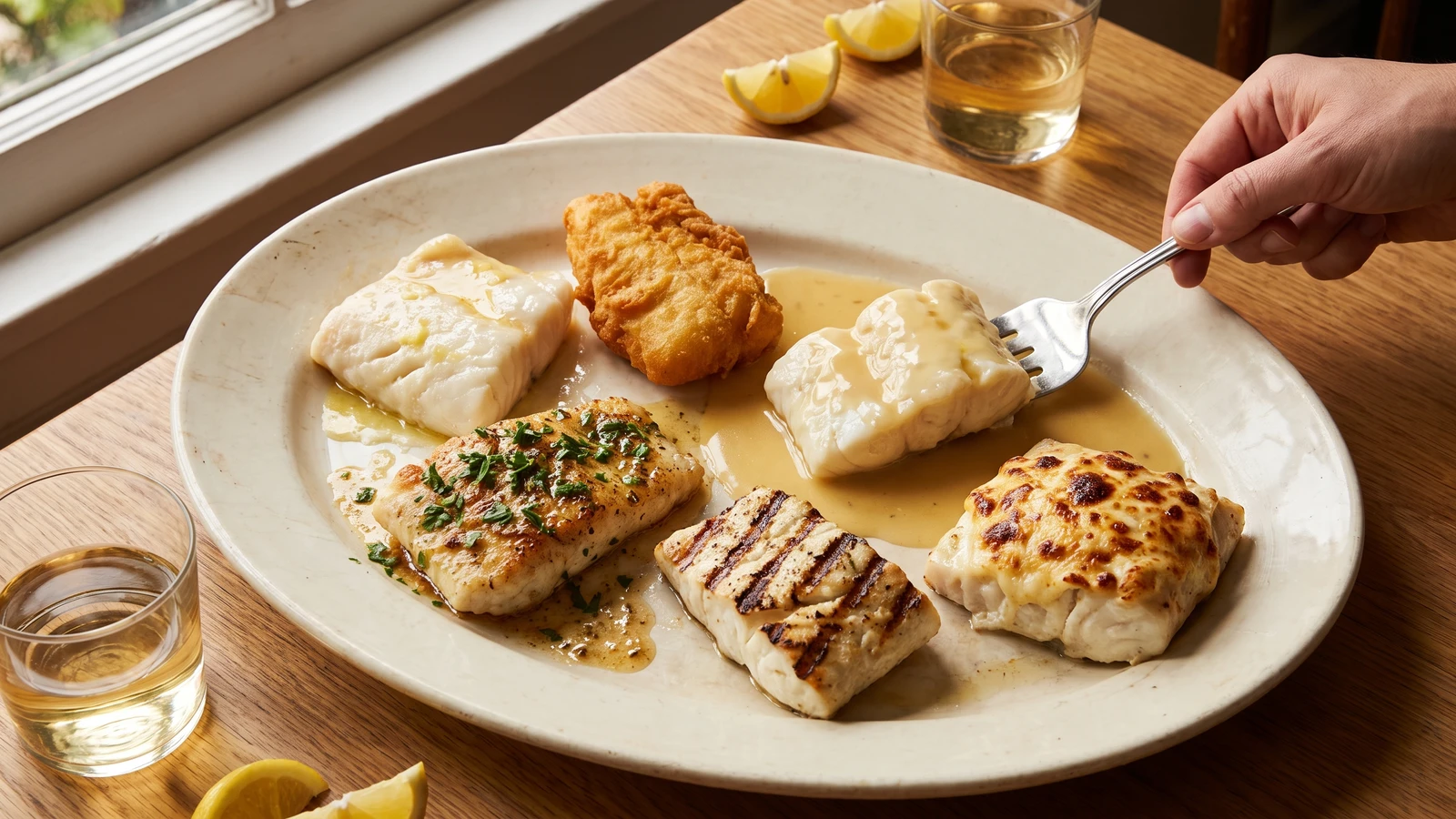
Seven classical roads lead fish through water, fat, butter, moist heat, the grill, and the gratin. Match the cut to the method, and the whole canon opens.
Diverses Façons de Cuire le Poisson (Seven Ways of Cooking Fish) is not a collection of competing recipes. It is a grammar lesson. The one true thing to know before touching a pan is that the cut chooses the fire: thick pieces tolerate water and braising, thin slices welcome frying and meunière, small fillets suit a short poach, and collops belong beneath fierce heat. C'est la même grammaire every time, control moisture, control heat, and stop cooking while the fish is still succulent.
The original entry assumed a saucier on staff, a stock never off the fire, several pans moving at once, and a salamander waiting overhead. Your equivalents are finished referenced preparations, a saucepan, a skillet, a covered sauté pan, and the broiler in your oven. Seven pans firing together were brigade scaffolding and can go; matching each piece to its proper method is the dish and must stay. I have scaled the lesson to seven tasting portions for four people, cooked in manageable waves by one cook, one stove, one evening.
Serve the gentler moist preparations first, then bring the crisp and bronzed pieces as they leave the heat. Before anything else, have the fish cut by thickness and purpose, then dry every surface carefully. That first division decides the entire lesson.
This classification belongs to the teaching tradition of the classical Paris kitchen, where cooks organized the varied practices of French coastal and household tables into families governed by heat, fat, and moisture. Meunière preserved the flour-dusted miller's method, while braising and short poaching translated covered-pan cookery into a precise professional system. The phrase “same as grilling” refers to the small specimens and collops suited to both grilling and au gratin, not to identical finishes; the prepared gratin coating is what distinguishes the latter.
Quantity
2 lb 4 oz / 1 kg
Cut into one 5 oz / 140 g thick steak, two 4 oz / 115 g thin slices, one 5 oz / 140 g small fillet, one 8 oz / 225 g large fillet, one 4 oz / 115 g collop, and one 5 oz / 140 g gratin portion
Quantity
6 cups (1.4 L / 1.4 kg)
Quantity
2 tablespoons (30 ml / 34 g)
divided
Quantity
½ cup (120 ml / 60 g)
divided
Quantity
3 cups (720 ml / 660 g)
Quantity
12 tablespoons (180 ml / 170 g)
divided
Quantity
2 medium
one juiced and one cut into wedges
Quantity
¼ cup (60 ml / 15 g)
finely chopped
Quantity
¾ cup (180 ml / 178 g)
Quantity
1½ cups (360 ml / 360 g) The Preparation of Clarified Consommé for Clear Soups (No. 2)
chilled and degreased
Quantity
2 medium, about ⅔ cup / 160 ml / 80 g
finely chopped
Quantity
1
Quantity
½ teaspoon (2.5 ml / 1 g)
Quantity
1 prepared application from Gratins (No. 268), enough for one 5 oz / 140 g fish portion
| Ingredient | Quantity |
|---|---|
| center-cut cod loin, skinless and bonelessCut into one 5 oz / 140 g thick steak, two 4 oz / 115 g thin slices, one 5 oz / 140 g small fillet, one 8 oz / 225 g large fillet, one 4 oz / 115 g collop, and one 5 oz / 140 g gratin portion | 2 lb 4 oz / 1 kg |
| cold water | 6 cups (1.4 L / 1.4 kg) |
| fine sea saltdivided | 2 tablespoons (30 ml / 34 g) |
| plain flourdivided | ½ cup (120 ml / 60 g) |
| neutral frying oil | 3 cups (720 ml / 660 g) |
| unsalted butterdivided | 12 tablespoons (180 ml / 170 g) |
| lemonsone juiced and one cut into wedges | 2 medium |
| flat-leaf parsleyfinely chopped | ¼ cup (60 ml / 15 g) |
| dry white wine | ¾ cup (180 ml / 178 g) |
| finished clarified consomméchilled and degreased | 1½ cups (360 ml / 360 g) The Preparation of Clarified Consommé for Clear Soups (No. 2) |
| shallotsfinely chopped | 2 medium, about ⅔ cup / 160 ml / 80 g |
| bouquet garni | 1 |
| freshly ground white pepper | ½ teaspoon (2.5 ml / 1 g) |
| prepared rapid-gratin finish | 1 prepared application from Gratins (No. 268), enough for one 5 oz / 140 g fish portion |
Arrange the seven portions in cooking order and label them: cuisson à l'eau salée, friture, meunière, pochage court, braisage, grillade, and au gratin. Pat each completely dry, then season lightly with part of the salt and white pepper just before cooking. Keep the waiting pieces cold. The thick steak and large fillet must remain thick; trimming everything into equal little rectangles would erase the lesson before it begins.
For cuisson à l'eau salée, salted-water cooking, bring the cold water and 1 tablespoon (15 ml / 17 g) of the salt to a full boil in a saucepan. Lower in the thick steak, wait for the water to return almost to the boil, then reduce the heat immediately so the surface barely trembles. Cook for 5 to 7 minutes, until the flesh is opaque around the outside and just pearly at the center. If the outer flakes begin separating before the center is ready, take the pan off the heat, cover it, and let the stored heat finish the fish. Drain well and glaze with 1 tablespoon (15 ml / 14 g) butter.
For friture, deep-frying, heat the oil in a small heavy pot to 350°F / 175°C. Coat one thin slice with ¼ cup (60 ml / 30 g) flour, shake off every loose speck, and lower it carefully into the oil. Fry until crisp and evenly golden, about 3 minutes, turning once if needed. Drain on a rack and season at once. If the coating drinks oil and remains pale, the fat has cooled; lift the fish out, restore the temperature, then return it for a brief finish. Ça se rattrape. Serve with a lemon wedge.
For meunière, flour-dusted fish cooked in butter, coat the second thin slice with the remaining ¼ cup (60 ml / 30 g) flour and shake it clean. Melt 4 tablespoons (60 ml / 57 g) butter in a skillet over medium-high heat. When the foam subsides, add the fish and cook for 2 to 3 minutes per side, until golden and barely done. Transfer it to the platter. Let the butter reach a nutty hazelnut color, add half the lemon juice and 2 tablespoons (30 ml / 8 g) parsley, then pour it over the fish. If the butter turns black or smells sharp, don't sacrifice the fish to it. Discard the butter, wipe the pan, and make the finish again.
For pochage court, a short-moistening poach, butter a small sauté pan with 1 tablespoon (15 ml / 14 g) butter and lay in the small fillet. Add ½ cup (120 ml / 120 g) The Preparation of Clarified Consommé for Clear Soups (No. 2), cover closely, and hold at the gentlest simmer for 5 to 7 minutes. Lift the fish out as soon as it flakes under light pressure. Reduce the moistening to about 2 tablespoons (30 ml / 30 g), take the pan off the heat, and whisk in 1 tablespoon (15 ml / 14 g) cold butter. If the liquid begins boiling hard, pull the pan off the heat and add a spoonful of cold consommé before continuing.
For braisage, braising, heat the oven to 375°F / 190°C. Soften the shallots in 1 tablespoon (15 ml / 14 g) butter without coloring them. Set the large fillet over the shallots, add the white wine, the remaining 1 cup (240 ml / 240 g) The Preparation of Clarified Consommé for Clear Soups (No. 2), and the bouquet garni. Cover and braise for 15 to 20 minutes, until the thickest part reaches 140 to 145°F / 60 to 63°C. If the fish finishes before its liquor has body, lift it out and cover it loosely while the liquid reduces. Never keep cooking the fish merely to thicken its sauce. Strain the reduced liquor and whisk in 2 tablespoons (30 ml / 28 g) cold butter.
For grillade, grilling, heat the broiler fully and place a rack about 6 inches / 15 cm below it. Brush the collop with 1 tablespoon (15 ml / 14 g) melted butter, season lightly, and set it on a preheated broiler-safe pan. Broil for 3 to 4 minutes per side, until bronze marks form and the center is just opaque. If the surface colors before the center is ready, lower the rack rather than letting the exterior scorch. Finish with lemon juice and a pinch of parsley.
Butter a small gratin dish with 1 tablespoon (15 ml / 14 g) butter and place the final fish portion inside. Coat it with the prepared rapid-gratin finish from Gratins (No. 268), keeping that referenced preparation whole rather than rebuilding it here. Set the dish beneath the broiler until the coating bubbles at the rim, bronzes across the top, and the fish flakes under gentle pressure, about 6 to 8 minutes. If the top darkens too quickly, lower the dish and shield the darkest patch loosely with foil while the center finishes.
Cut every cooked portion into four tasting pieces. Serve the cuisson à l'eau salée, pochage court, and braisage first, spooning their butter and reduced liquors over them. Follow immediately with the friture, meunière, grillade, and au gratin while their crisp edges and bronzed surfaces still speak clearly. This is a generous lesson, not a plating exercise. Put the platter in reach, pass the lemon, and compare what each method gave the same fish. À table!
1 serving (about 400g)
Culinary guides, cultural storytelling, and the editorial depth that makes cooking meaningful.
Discover Culinary ExplorerChef Juliette
John Dory has the delicacy of sole and the firmness of turbot. A light flouring, a quick butter sauté, and nut-brown beurre noisette show exactly why looks never mattered.

Chef Juliette
Fresh haddock proves its delicacy in the meunière pan: a fine flour crust, moist pearly flakes, and beurre noisette sharpened with lemon and parsley, ready from one skillet in half an hour.

Chef Juliette
Éperlans à l’Anglaise turns small fish into a lesson in disciplined coating: boned smelts under a close, crisp crumb, pan-fried in clarified butter and finished with bright, half-melted maître d’hôtel butter.

Chef Juliette
Tiny smelts, shallot, mushrooms, white wine, gratin sauce, and fine bread raspings meet a fierce oven, where the fish must turn tender in the same breath the buttered crust bronzes.