Culinary Explorer

A cooking platform built around craft, culture, and the stories behind what we eat.
Discover Culinary Explorer
Consommé Macdonald

Consommé Macdonald

Created by Chef Juliette

Based on No. 578, Consommé Macdonald, from Le Guide Culinaire (1907) by Auguste Escoffier

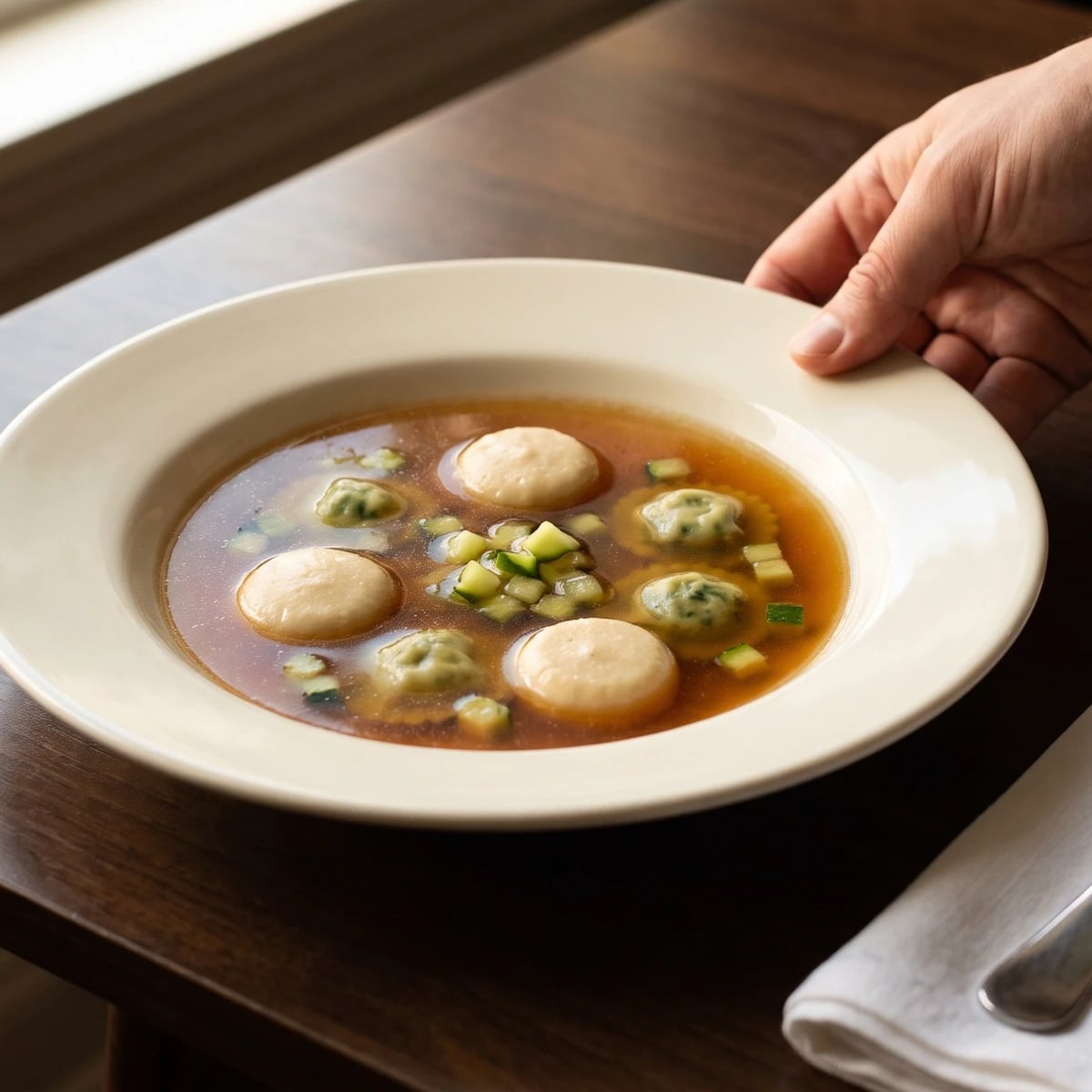
Brilliant beef consommé carries tender brain royale roundels, glazed cucumber dice, and spinach-chicken ravioles, each garnish cooked on its own so the broth reaches the table clear as amber.

Soups & Stews
French
Dinner Party
Special Occasion
Make Ahead
45 min
Active Time
2 hr cook3 hr 15 min total
YieldAbout 2 quarts (8 cups / 1.9 liters), 6 to 8 first-course servings

Consommé Macdonald (clarified beef broth with brain-purée royale, glazed cucumber, and spinach-chicken ravioles) teaches one severe, useful truth: clarity is protected all the way to the tureen. The beef broth is clarified gently, the cucumber is reduced separately, and the ravioles are poached in salted water, because one spoonful of loose starch would undo an hour's careful work. C'est la même grammaire as every consommé: remove what clouds, concentrate what tastes, and disturb nothing once it has gathered.

The original service assumed a saucier, a stockpot never off the fire, and dariole-moulds waiting on the shelf. A home kitchen needs one heavy pot, four small ramekins, and sequence instead of extra hands. One cook, one stove, one evening. Parallel station work is brigade scaffolding and can go; the separate cooking of each garnish is the dish and must stay. The source's one-quart unit becomes two quarts for six to eight first courses, with its two royales, two tablespoons of cucumber, and five ravioles per quart doubled exactly.

The finished bowl should be lucid amber, with pale brain royale roundels, tiny green-flecked ravioles, and lacquered cucumber visible beneath the surface. The one step that decides it comes when the clarification raft rises: stop stirring, keep the broth below a boil, and let the proteins do their quiet work.

Consommé Macdonald belongs to the named-consommé repertoire of Paris's grand kitchens, where a clear beef broth was identified by its precise garnish rather than by a regional stock. Macdonald is defined by brain-purée royale, cucumber reduced to a glaze in consommé, and chicken-spinach ravioles; treating any one of them casually changes the soup's identity. The dedication behind the title is uncertain, but the surviving practice is exact, especially the separate poaching that keeps the broth lucid.

The technique, the tradition, and the story behind every dish.

Discover Culinary Explorer

Ingredients

cold, unsalted, gelatin-rich beef stock

Quantity

10 cups (2.4 liters / 2.4 kg)

very lean ground beef

Quantity

1 pound (about 2 cups / 450 g)

egg whites

Quantity

5 large egg whites

4 for the clarification raft and 1 reserved for rescue if needed

carrot

Quantity

1 cup (240 ml / 125 g)

cut into small dice

leek, white and pale green parts

Quantity

1 cup (240 ml / 90 g)

finely sliced and rinsed

celery

Quantity

1 cup (240 ml / 100 g)

cut into small dice

tomato paste

Quantity

2 tablespoons (30 ml / 32 g)

black peppercorns

Quantity

1 teaspoon (5 ml / 3 g)

lightly crushed

fine sea salt

Quantity

2 to 3 teaspoons (10 to 15 ml / 12 to 18 g)

for seasoning the consommé

cleaned calf's brain

Quantity

6 ounces (about 3/4 cup once puréed / 170 g)

cold water

Quantity

2 quarts (1.9 liters / 1.9 kg)

divided, for soaking and poaching the brain

white wine vinegar

Quantity

1/4 cup (60 ml / 60 g)

fine sea salt

Quantity

1 teaspoon (5 ml / 6 g)

for poaching the brain

unsalted butter

Quantity

1 tablespoon (15 ml / 14 g)

softened, for the moulds

heavy cream

Quantity

1/3 cup (80 ml / 80 g)

large egg

Quantity

1

large egg yolks

Quantity

2

ground white pepper

Quantity

1/8 teaspoon (0.6 ml / 0.3 g)

peeled and seeded cucumber

Quantity

1/4 cup (60 ml / 35 g)

cut into 1/8-inch (3 mm) dice

Ravioli

Quantity

10 small Ravioli (No. 2296)

formed as ravioles and filled with chicken forcemeat combined with one-third its volume of spinach

water

Quantity

3 quarts (2.8 liters / 2.8 kg)

for poaching the ravioles

fine sea salt

Quantity

1 tablespoon (15 ml / 18 g)

for the ravioles' poaching water

Equipment Needed

  • Heavy 6-quart stockpot
  • Fine-mesh sieve and washed cheesecloth
  • Four 3-ounce (90 ml) dariole-moulds or straight-sided ramekins
  • Small roasting pan for the bain-marie
  • Blender or food processor
  • Wide 4-quart pot and slotted spoon
  • Soup tureen

Instructions

  1. 1

    Poach the brain

    Set the cleaned calf's brain in a nonreactive bowl with 1 quart (960 ml) of the cold water and the vinegar. Chill it for 30 minutes, then drain and rinse gently. Bring the remaining 1 quart (960 ml) water and its teaspoon of salt to the barest simmer, lower in the brain, and poach for 12 to 15 minutes, until opaque throughout and 160°F (71°C) at the center. Lift it onto a plate, remove any remaining membrane or dark vessels, and let it cool. If a lobe breaks, nothing is lost; the brain is going into a purée.

    Brains are delicate and highly perishable. Keep them cold until cooking, source them from a licensed butcher, and cook them on the day of purchase.
  2. 2

    Set the royale

    Heat the oven to 300°F (150°C) and butter four 3-ounce (90 ml) dariole-moulds or straight-sided ramekins. Purée the cooled brain with the cream, whole egg, yolks, white pepper, and a small pinch taken from the consommé salt, then press the mixture through a fine sieve. Divide it among the moulds and set them in a small roasting pan. Pour hot water halfway up their sides to make a bain-marie, a water bath, and bake for 20 to 25 minutes, until the edges are set, the centers still quiver slightly, and the royale reaches 160°F (71°C). Cool, cover, and chill in the moulds for at least 45 minutes. If the water boils and leaves the custards porous, lift them out immediately; once chilled, cut roundels from the smooth centers. Ça se rattrape.

    The bain-marie should barely tremble. Fierce water makes bubbles in the royale, while gentle heat gives the fine, close texture needed for clean roundels.
  3. 3

    Raise the raft

    Put 4 egg whites in a heavy 6-quart pot and loosen them with a whisk without beating them to a foam. Work in the ground beef, carrot, leek, celery, tomato paste, and peppercorns, then stir in the cold beef stock. Set the pot over medium-low heat and scrape the bottom continuously with a wooden spoon until the mixture grows warm and pale curds begin rising, about 15 minutes. Once the solids close over the surface in a raft, stop stirring completely and open a 2-inch (5 cm) chimney through its center.

    The stock must begin cold. Warm stock cooks the egg white before it can gather the fine particles that cloud the consommé.
  4. 4

    Clarify without boiling

    Lower the heat until liquid moves gently beneath the raft without reaching a rolling boil. Hold it there for 60 minutes, spooning a little broth from the chimney over any dry patches every 15 minutes without breaking the raft. If boiling tears it, turn off the heat for 5 minutes and resume at the gentlest setting. Should the strained broth remain cloudy, cool it until lukewarm, whisk the reserved egg white with 1 cup (240 ml) of the broth, stir it back into the pot, and bring everything slowly to a bare simmer for 15 minutes before straining again. Ça se rattrape, but only if you give the egg white time to gather the cloudiness.

  5. 5

    Strain and season

    Ladle the broth through a fine sieve lined with damp, double-layered cheesecloth into a clean pot. Do not pour the raft into the sieve and never press it, because pressure drives the captured particles back into the liquid. Skim every bead of fat from the surface. You should have about 8 cups (1.9 liters); if there is more, reduce it gently to that volume. Season with the measured salt until the consommé tastes full and slightly more assertive than an ordinary sipping broth, since the royale and ravioles will soften it. Hold below a simmer, or cool promptly if serving later.

    Wet the cheesecloth before straining. Dry cloth drinks the first ladle of broth and can shed fibers into the consommé.
  6. 6

    Glaze the cucumber

    Measure 1/2 cup (120 ml) of the clarified consommé into a small saucepan and add the cucumber dice. Simmer uncovered until the cucumber is tender but still distinct and the consommé has reduced to a glossy glaze clinging to every piece, about 8 to 12 minutes. This reduction is not brigade decoration; it is how cucumber enters the soup without watering it. If the glaze catches before the cucumber is ready, loosen it with 1 tablespoon (15 ml) more consommé and lower the heat.

  7. 7

    Poach the ravioles

    Exactly 12 minutes before serving, bring the 3 quarts (2.8 liters) water and its tablespoon of salt to a boil in a separate wide pot. Lower in the 10 small Ravioli (No. 2296), reduce the water to a gentle boil, and poach for 12 minutes. Lift them with a slotted spoon, drain thoroughly, and blot the spoon's underside before carrying them toward the tureen. Never poach them in the consommé. Their starch and spinach belong in this water, not in the clear broth. If one splits, lower the heat and remove it; the failure is contained, which is precisely why the pots are separate.

    Give the ravioles room. Crowding presses their seams together and makes tearing more likely when you lift them.
  8. 8

    Assemble the tureen

    Warm the soup tureen with hot water, then empty and dry it. Dip each royale mould briefly in warm water, unmould the custards, and cut them crosswise into roundels 1/3 inch (8 mm) thick. Arrange the roundels, glazed cucumber, and well-drained Ravioli (No. 2296) in the tureen. Bring the remaining consommé to a full boil only at the last moment, skim once more, and pour it directly over the garnish. Serve immediately, before the ravioles soften or the royale loses its clean edge. À table!

Chef Tips

  • Begin with stock that turns softly gelatinous when cold. Clarification removes particles and some body, so a thin boxed broth emerges clear but tastes hollow. If your stock is weak, reduce it before chilling and beginning the raft.
  • Calf's brain has the mild flavor and fine texture expected here. If it is unavailable but lamb brains are legally sold by a trusted butcher, use the same cleaned weight; the royale will taste slightly more pronounced. Do not replace the brain with pâté or liver mousse, which changes the garnish entirely.
  • The listed time begins with the Ravioli (No. 2296) already prepared, because the book treats it as a separate finished component. For Consommé Macdonald, form small ravioles and use chicken forcemeat combined with spinach equal to one-third of the forcemeat's volume.
  • Taste the consommé after the cucumber portion has been removed. It should be highly seasoned without becoming salty, because egg-rich royale and pasta both mute the broth once the bowl is assembled.
  • A restrained white Burgundy suits the brain royale and chicken filling without flattening the clear beef broth. Pour small glasses; the consommé should keep command of the first course.

Advance Preparation

  • Clarify the consommé up to 3 days ahead. Cool it promptly in a shallow container, cover, and refrigerate; lift off the firm fat while cold, then reheat gently on the day of service.
  • The brain royale can be poached, baked, and chilled in its moulds 1 day ahead. Keep the moulds covered and unmould only when the tureen is ready.
  • Prepare the Ravioli (No. 2296) 1 day ahead and refrigerate them in a single, lightly floured layer. They may also be frozen in that layer and transferred to a container once firm.
  • Glaze the cucumber earlier on the day of service and keep it covered separately. The final poaching and assembly must wait until the guests are seated.

Frequently Asked Questions

Nutrition Information

1 serving (about 300g)

Calories
180 calories
Total Fat
10 g
Saturated Fat
4 g
Trans Fat
0 g
Unsaturated Fat
5 g
Cholesterol
750 mg
Sodium
1050 mg
Total Carbohydrates
8 g
Dietary Fiber
0 g
Sugars
1 g
Protein
14 g

Note: Chef personas and recipes are created with AI assistance. Cook with care: follow safe food-handling practices, check doneness with a thermometer when needed, and adapt for allergies and your kitchen.

Where cooking meets culture.

Culinary guides, cultural storytelling, and the editorial depth that makes cooking meaningful.

Discover Culinary Explorer