
Chef Juliette
Smelt (Éperlans)
Tiny éperlans, lightly floured and fried until their tails stand crisp, arrive in a generous heap on a napkin with fried parsley and grooved lemon, a weeknight lesson in heat and restraint.
A cooking platform built around craft, culture, and the stories behind what we eat.
Created by Chef Juliette
Based on No. 534, Cold Eggs Moscovite, from Le Guide Culinaire (1907) by Auguste Escoffier
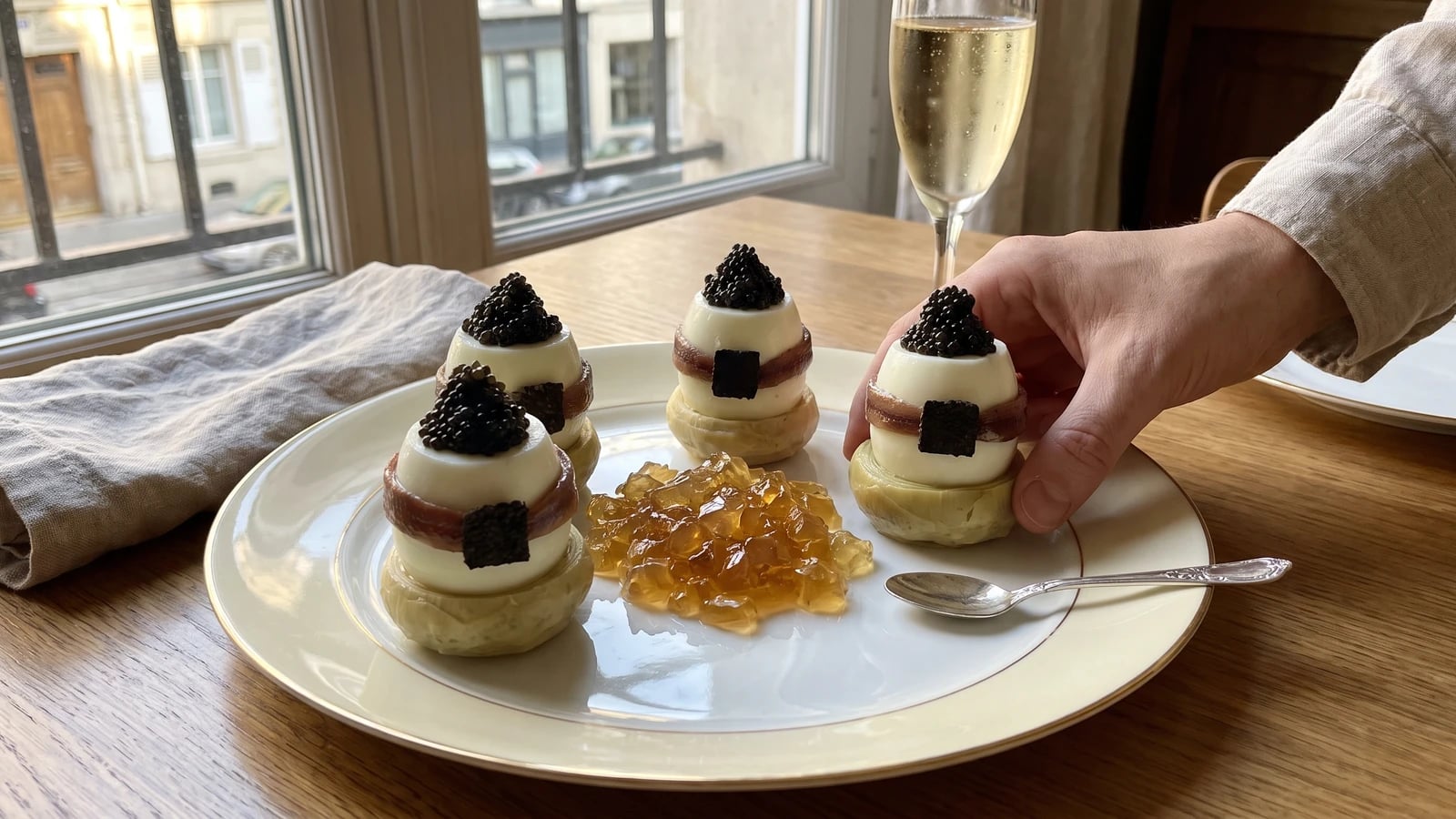
Little egg barrels ringed with anchovy, marked with black truffle, and filled to a shining caviar point, each seated in pale artichoke and chopped gelée for a composed cold first course.
Œufs froids moscovite (Cold Eggs Moscovite) teach the architecture of the classical cold platter: every component must be firm, chilled, and dry enough to hold its place, yet nothing should taste merely constructed. The one true thing before you touch a pan is that the egg must remain whole around its hollow. Once that ivory shell tears, no quantity of caviar restores the little barrel.
The original recipe assumed a garde-manger with gelée (clear savory aspic) always set, artichoke bottoms cooked à blanc by another pair of hands, a tubular cutter, and caviar ready for a brigade platter. At home, you need a shallow tray of gelatin-set clear stock, preserved whole artichoke bottoms, and a plain metal piping tip. I have scaled the arrangement to four eggs. Maintaining jelly by the pot and turning raw artichokes are brigade scaffolding; the anchovy hoops, truffle bung, caviar point, pale artichoke cradle, and circle of chopped gelée are the dish itself, so every one stays. One cook, one stove, one evening.
This is cold food with presence: ivory egg, dark anchovy bands, a square of truffle, and glossy black caviar rising above the rim. Chill the eggs completely before you level and hollow them. A warm white flexes under the cutter, while a cold one cuts cleanly, and that clean central hollow is the step that decides the dish.
Œufs froids moscovite belongs to the Parisian classical garde-manger, the branch of the kitchen responsible for cold hors d'oeuvre, aspics, and decorated buffet pieces. In French menu language, moscovite points to caviar and a Russian association, not to a household egg dish from Moscow; the barrel disguise is French decorative wit applied to that prized garnish. Artichoke bottoms and chopped gelée let each piece stand upright on the formal platter, and the preparation passed naturally to private dinner tables because every part could be readied before guests sat down.
Quantity
1½ cups (360 ml / 360 g)
chilled
Quantity
3 teaspoons (15 ml / 9 g)
divided
Quantity
5
4 for serving and 1 insurance egg
Quantity
4 large
drained, rinsed, and blotted dry
Quantity
12 (about ¼ cup / 50 g drained)
blotted dry
Quantity
1 tablespoon (15 ml / 10 g)
cut into 4 small square bungs
Quantity
¼ cup (60 ml / 60 g)
thoroughly chilled
| Ingredient | Quantity |
|---|---|
| very clear, lightly salted chicken stockchilled | 1½ cups (360 ml / 360 g) |
| powdered unflavored gelatindivided | 3 teaspoons (15 ml / 9 g) |
| large eggs4 for serving and 1 insurance egg | 5 |
| preserved whole artichoke bottomsdrained, rinsed, and blotted dry | 4 large |
| small oil-packed anchovy filletsblotted dry | 12 (about ¼ cup / 50 g drained) |
| preserved black trufflecut into 4 small square bungs | 1 tablespoon (15 ml / 10 g) |
| black sturgeon caviarthoroughly chilled | ¼ cup (60 ml / 60 g) |
Sprinkle 2½ teaspoons of the gelatin over ¼ cup (60 ml) of the cold stock and leave it for 5 minutes to swell. Heat the remaining stock just until it begins to tremble at the edge, then take it off the heat and whisk in the softened gelatin until completely dissolved. Pour it through a fine sieve into a shallow 8-inch (20 cm) dish, skim away any bubbles, and chill for at least 3 hours, until firm enough to cut and chop. If the gelée remains too soft, melt it gently, bloom the reserved ½ teaspoon gelatin in 1 tablespoon of cold water, whisk it in, and reset it. Ça se rattrape.
Put the eggs in a saucepan in one layer and cover them with cold water by 1 inch (2.5 cm). Bring the water gradually to a gentle simmer, nudging and turning the eggs carefully during the first 3 minutes; this encourages the yolks toward the center, where the cutter needs them. Simmer for 10 minutes, then transfer the eggs immediately to ice water and chill them completely. Keep them cold for at least 30 minutes before peeling.
Turn out the firm gelée and chop it finely into irregular crystals no larger than ⅛ inch (3 mm); return it to the cold. Examine the artichoke bottoms and trim only enough from beneath to stop any wobbling, keeping their shallow cups intact. Blot the artichokes and anchovies once more, and cut the truffle into four neat, dark squares. Moisture makes the barrel decorations slide, so everything must be cold and dry before assembly.
Peel the eggs carefully and choose the four smoothest. Slice the thinnest possible piece from the broad base of each egg so it stands, then level the narrow top without cutting into the yolk. For each egg, use three small anchovy fillets to make two hoops, joining one and a half fillets around the upper end and the remaining one and a half around the base. Overlap the joins at the back. Melt a teaspoon of gelée and use the smallest touch beneath each band to secure it, then fix one truffle square halfway up the front like a barrel bung. Chill for 10 minutes. If a hoop slides, dry the egg again and tack it with another pinhead of melted gelée; pressing harder only bruises the white.
Set an egg upright and center a ½-inch (12 mm) plain metal piping tip over its narrow top. Twist the tip straight down through the upper white and into the yolk, stopping before it cuts the lower wall. Withdraw the core, then use a narrow demitasse spoon or the handle of a small spoon to remove the remaining yolk without thinning the outer white. Don't chase the final crumb at the price of a tear. If the bore begins to wander, widen it inward toward the yolk, never outward through the white; if an egg splits, bring forward the spare.
Keep the caviar cold until this moment. With a small nonreactive spoon, fill each hollow gently, letting the beads settle under their own weight rather than tamping them. Build the final spoonful into a small point rising beyond the edge of the egg, exactly as the original platter intended. The caviar is not a decorative teaspoon here; it is the center of the bite.
Spoon a bed of chopped gelée into each artichoke bottom and nest one filled egg upright in its cup. Pack a little more gelée around the base to steady it without covering the lower anchovy hoop. Arrange the four artichoke bottoms in a circle on a chilled round platter and heap the remaining chopped gelée loosely in the center. Chill for 15 minutes, then bring the platter out while the gelée is bright and the caviar remains glossy. À table!
1 serving (about 220g)
Culinary guides, cultural storytelling, and the editorial depth that makes cooking meaningful.
Discover Culinary ExplorerChef Juliette
Tiny éperlans, lightly floured and fried until their tails stand crisp, arrive in a generous heap on a napkin with fried parsley and grooved lemon, a weeknight lesson in heat and restraint.

Chef Juliette
Brandade de Morue turns salt cod, warm olive oil, and milk into a pale, silky emulsion: keep everything warm and add the oil slowly, then crown the generous dome with butter-fried bread.

Chef Juliette
Salt cod worked warm with cream, one patient spoonful at a time, until the rough flakes become a glossy Nîmes paste, domed generously and ringed with butter-fried croutons for the table.

Chef Juliette
Wine-poached char packed in its earthenware crock beneath butter gold: a make-ahead first course that turns careful cooling, thorough boning, and one unbroken seal into quiet abundance.