
Chef Juliette
Smelt (Éperlans)
Tiny éperlans, lightly floured and fried until their tails stand crisp, arrive in a generous heap on a napkin with fried parsley and grooved lemon, a weeknight lesson in heat and restraint.
A cooking platform built around craft, culture, and the stories behind what we eat.
Created by Chef Juliette
Based on No. 394, Marinaded Trout, from Le Guide Culinaire (1907) by Auguste Escoffier
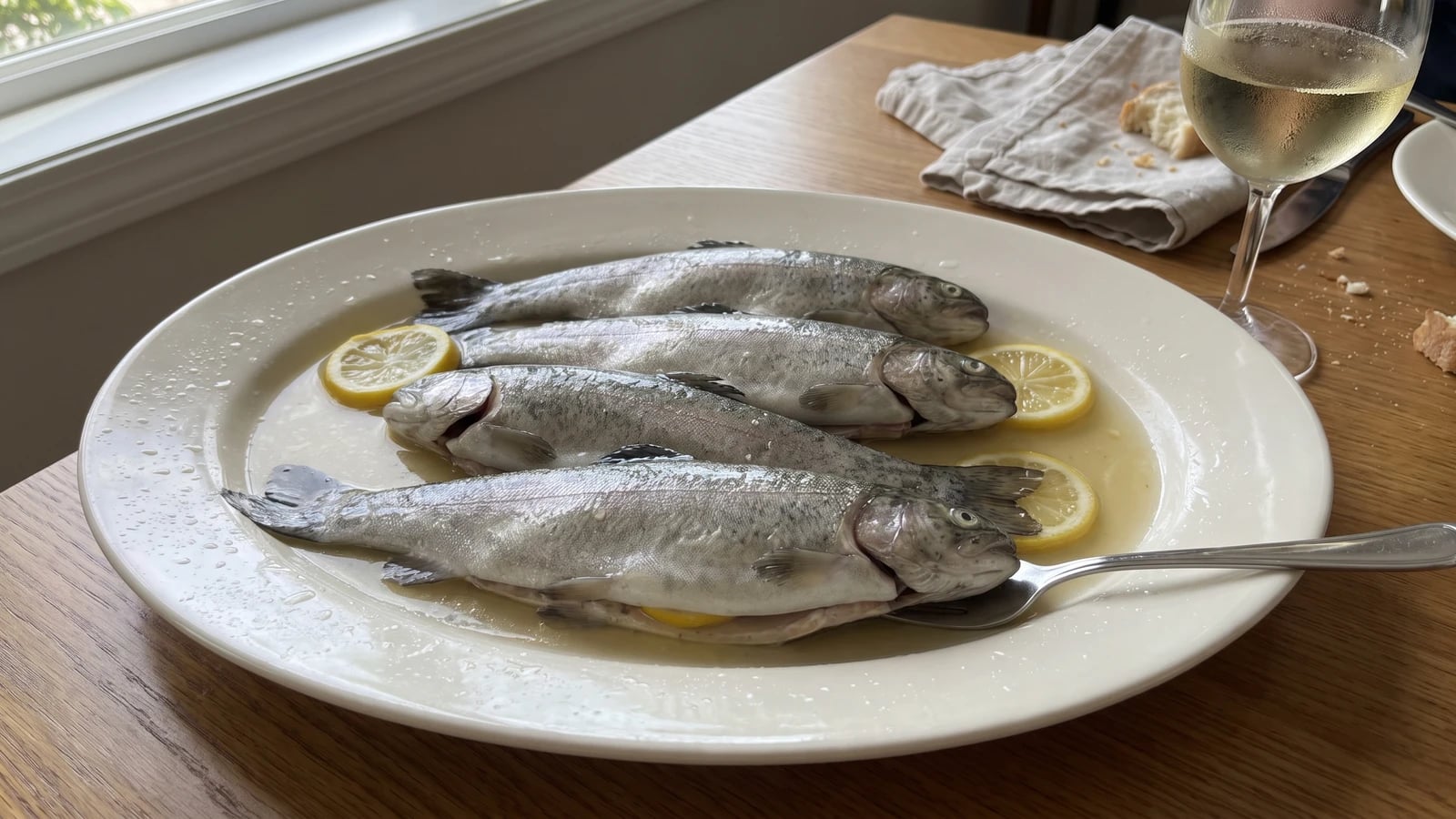
Truites marinées teach the quiet art of acid poaching: four small trout cooked at a bare tremble, cooled in their sharp white-wine liquor, and served cold with lemon.
Truites marinées (cold acid-poached trout) teach one essential lesson: cooling in the poaching liquor is part of the cooking. The vinegar sets the delicate flesh while the trout are warm, then seasons them all the way through as they become cold. Lift them out early and you lose the very thing that makes the dish.
The original recipe assumes a full brigade batch of Court-bouillon with White Wine (No. 164), already strained through tammy, and a fish kettle long enough to hold several trout. Here, four small fish lie in a shallow stainless-steel roasting pan, while the finished court-bouillon is measured down without changing its proportion of one part vinegar to three parts liquor. The large batch and special fish kettle are brigade scaffolding and can go. The sharp poach and the cooling liquor are the dish, and they stay.
When they reach the table, the trout should be cold and intact, their silver skin glistening under a few spoonfuls of pale liquor, with thin lemon slices laid across them. Keep the poach below a boil and leave the fish undisturbed until cold. That gentle handling is the step that matters most.
Truites marinées belong to the French classical hors-d'oeuvre table, where the smallest river and lake fish were poached whole, cooled, and presented with a little of their liquor instead of being covered by a sauce. White-wine court-bouillon became closely associated with freshwater fish, while vinegar gave the cold preparation both firmness and appetite. Despite the English title “marinaded,” the trout aren't raw-cured: they are fully poached, then seasoned as they cool in the acidic liquor.
Quantity
4, about 5 to 7 ounces (140 to 200 g) each
cleaned and dressed
Quantity
6 cups (1.42 L / 1.42 kg) Court-bouillon with White Wine (No. 164)
Quantity
2 cups (475 ml / 475 g)
preferably 5 to 6 percent acidity
Quantity
1 medium (about 4 ounces / 115 g)
scrubbed
| Ingredient | Quantity |
|---|---|
| very small whole troutcleaned and dressed | 4, about 5 to 7 ounces (140 to 200 g) each |
| Court-bouillon with White Wine | 6 cups (1.42 L / 1.42 kg) Court-bouillon with White Wine (No. 164) |
| white wine vinegarpreferably 5 to 6 percent acidity | 2 cups (475 ml / 475 g) |
| lemonscrubbed | 1 medium (about 4 ounces / 115 g) |
Heat the oven to 300°F (150°C). Check the cavities for any remaining bloodline or scales, wipe them clean, and pat the trout dry. Arrange them in one layer in a shallow 9 by 13-inch stainless-steel roasting pan, alternating heads and tails so they fit without bending. Keep the fish whole; the skin protects the delicate flesh during the poach.
Combine the Court-bouillon with White Wine (No. 164) and white wine vinegar in a nonreactive saucepan. This preserves the book's exact proportion: one volume of vinegar for every three volumes of court-bouillon. Warm the mixture to 175°F (80°C), when the surface begins to quiver but never boils. Pour it around the trout rather than directly onto them. The liquor should just cover the fish; if it doesn't, move them to a snugger pan rather than diluting the poach with water.
Cut a sheet of parchment to sit directly on the liquor and lay it over the trout, keeping every fish submerged. Transfer the pan to the oven and poach for 8 to 14 minutes, depending on size, until the thickest flesh beside the backbone reaches 145°F (63°C) and separates cleanly when tested through the cavity. Never let the liquor boil, because hard bubbling splits the skin and tightens the flesh. If it begins boiling, remove the pan from the oven at once. Ça se rattrape: leave the parchment in place and let the retained heat finish the centre gently.
Leave the trout untouched in their liquor for 10 minutes. Set the metal roasting pan inside a larger tray of ice water, keeping water away from the poach, and refresh the ice until the liquor is cool to the touch. Refrigerate the trout, still fully immersed beneath the parchment, for at least 2 hours and up to overnight. Don't lift or turn them while warm. The flesh is fragile now, but the acid firms it as it cools.
Cut five or six shallow channels lengthwise through the lemon peel with a channel zester. If you don't own one, use the corner of a sharp vegetable peeler and work lightly. Slice the lemon crosswise into very thin, grooved rounds, about 1/8 inch (3 mm). This simple finish replaces the brigade's canelle knife without changing the presentation.
Lift each cold trout with two wide fish spatulas and let the excess liquor drain back into the pan. Arrange the fish on a chilled oval platter, alternating heads and tails. Spoon 3 to 4 tablespoons (45 to 60 ml / 45 to 60 g) of the clear poaching liquor around them and lay the grooved lemon slices across the fish. Serve cold, with the bones left in as the original preparation intends. One cook, one stove, one evening. À table!
1 serving (about 115g)
Culinary guides, cultural storytelling, and the editorial depth that makes cooking meaningful.
Discover Culinary ExplorerChef Juliette
Tiny éperlans, lightly floured and fried until their tails stand crisp, arrive in a generous heap on a napkin with fried parsley and grooved lemon, a weeknight lesson in heat and restraint.

Chef Juliette
Brandade de Morue turns salt cod, warm olive oil, and milk into a pale, silky emulsion: keep everything warm and add the oil slowly, then crown the generous dome with butter-fried bread.

Chef Juliette
Salt cod worked warm with cream, one patient spoonful at a time, until the rough flakes become a glossy Nîmes paste, domed generously and ringed with butter-fried croutons for the table.

Chef Juliette
Wine-poached char packed in its earthenware crock beneath butter gold: a make-ahead first course that turns careful cooling, thorough boning, and one unbroken seal into quiet abundance.