Chef Juliette
Mayonnaise de Volaille
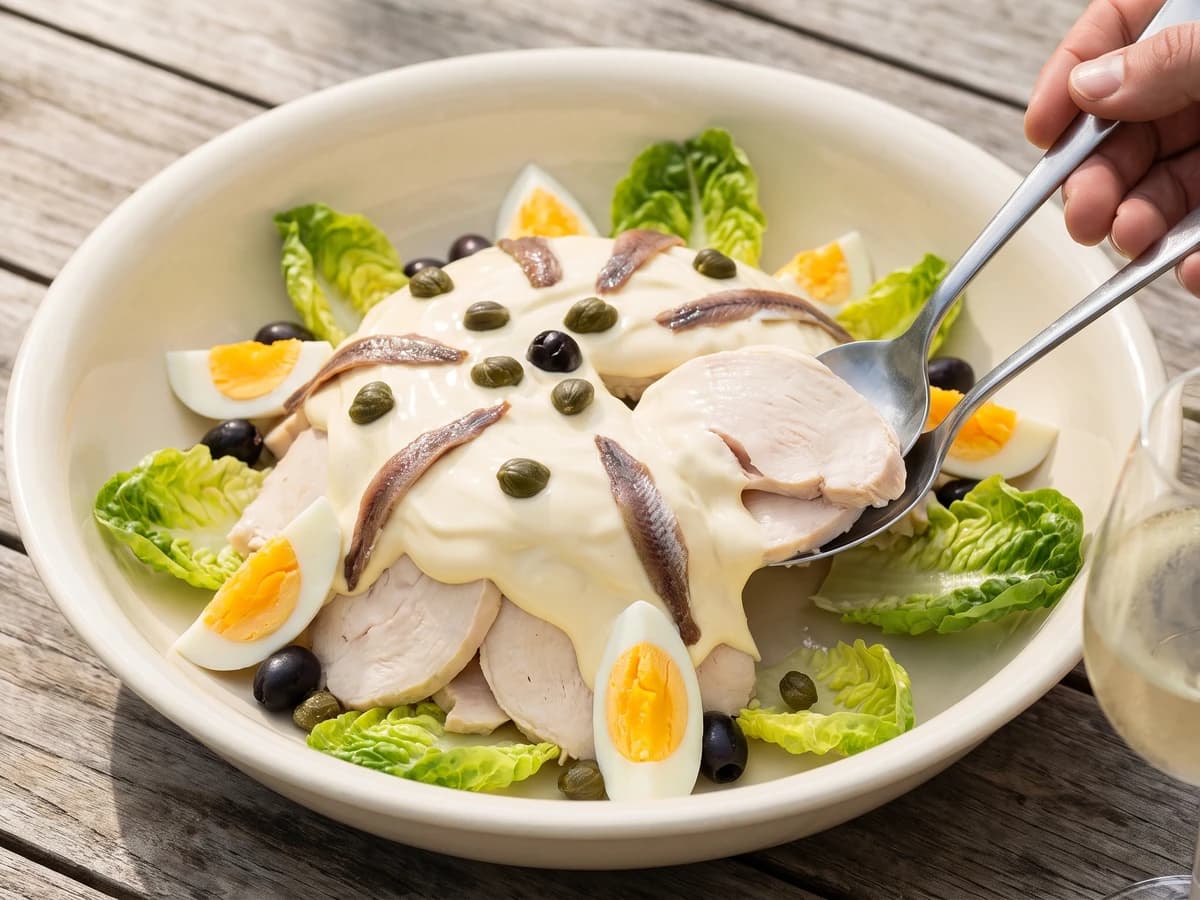
Cold roast chicken, ciseled lettuce, and a shining coat of homemade mayonnaise, arranged with capers, olives, anchovies, eggs, and lettuce hearts, then tossed at the table as the canon intends.
A cooking platform built around craft, culture, and the stories behind what we eat.
Created by Chef Juliette
Based on No. 391, Tomatoes à l’Américaine, from Le Guide Culinaire (1907) by Auguste Escoffier
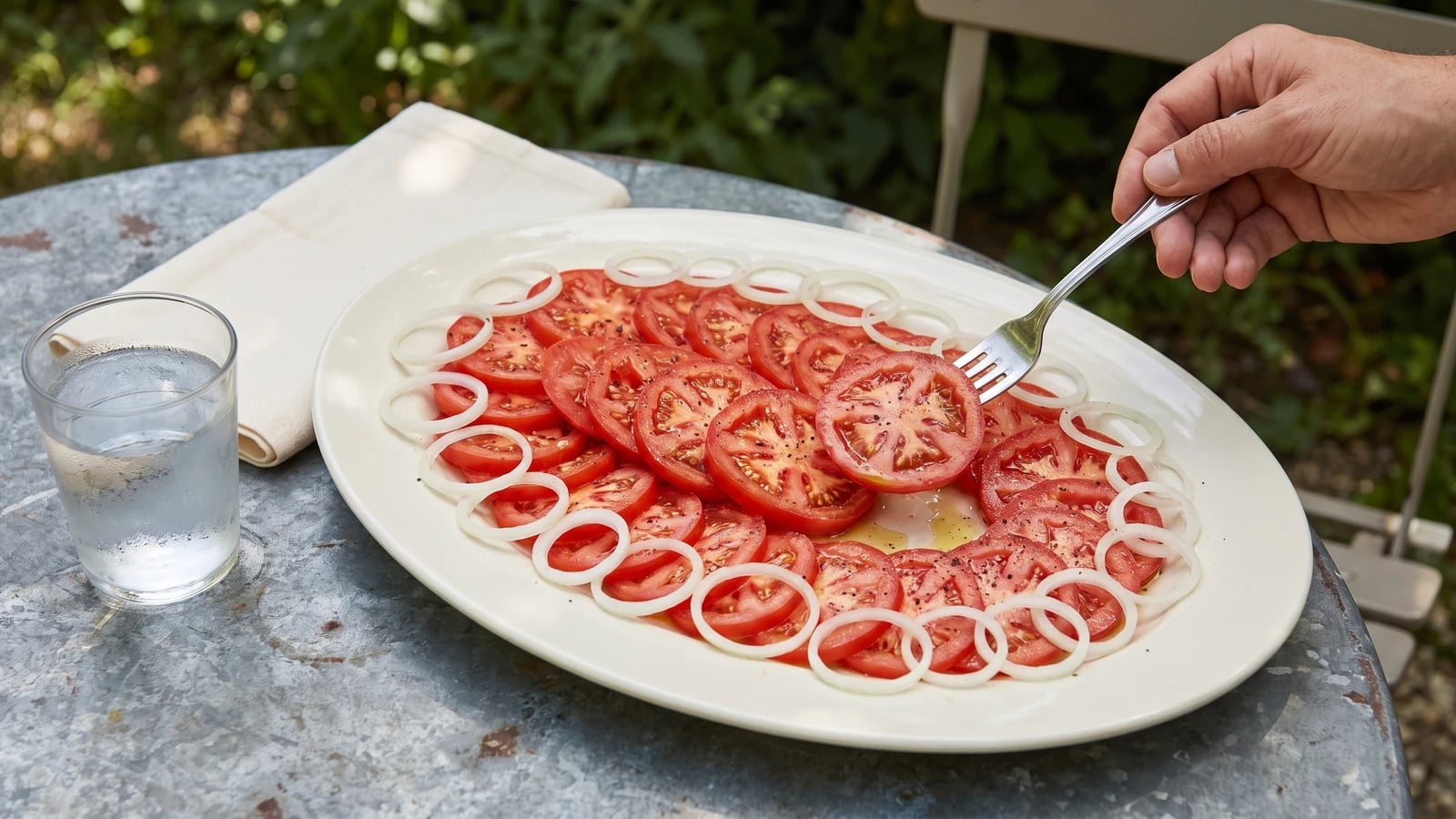
Tomates à l’Américaine proves that macération is enough: firm tomato slices, lightly glossed with oil and vinegar, rested twenty minutes, then composed beneath a crisp border of fine onion rings.
Tomates à l’Américaine (thin marinated tomato salad) teaches one true thing: the twenty-minute macération, the brief seasoned rest, is the dish. Salt draws out the tomato’s juice, oil carries its perfume, and restrained vinegar gives the whole plate a clean edge. Stop too soon and the seasoning sits on the surface; wait too long and those fine slices lose their posture.
The source assumes a cold station arranging hors-d’œuvre platters and points to Cooked Marinade for Venison (No. 168), prepared separately in a five-quart brigade quantity. Here, four tomatoes fill one generous home platter, and one teaspoon of the finished, chilled marinade carries that seasoning forward without overwhelming the book’s few drops of vinegar. There is no saucier, stockpot, or salamander in this work because none belongs here. The separate marinating dish is not brigade scaffolding, however: it lets you leave excess tomato water behind when you compose the final plate.
What reaches the table is cool, bright, and properly dressed, with overlapping red slices under a light sheen and fine onion rings marking the border. Slice evenly, then respect the full twenty-minute macération. That is the step that matters.
Tomates à l’Américaine belongs to the French classical hors-d’œuvre table, where raw vegetables are sliced, briefly seasoned, and composed on a dedicated serving dish before the meal. Its title reflects the canon’s habit of assigning à la names to fixed presentations, not a claim that this is a regional American salad, and it should not be confused with the cooked shellfish preparation also called américaine. From professional cold service it passed naturally to home tables and picnic baskets because its discipline lies entirely in the cut, the macération, and the arrangement.
Quantity
4 medium (about 1½ pounds / 680 g)
Quantity
1 small (about 3 ounces / 85 g)
cut into very fine rings
Quantity
2 tablespoons (30 ml / 27 g)
Quantity
1 teaspoon (5 ml / 5 g) Cooked Marinade for Venison (No. 168)
fully chilled
Quantity
½ teaspoon (2.5 ml / 2.5 g)
Quantity
¾ teaspoon (3.75 ml / 4.5 g)
Quantity
¼ teaspoon (1.25 ml / 0.6 g)
| Ingredient | Quantity |
|---|---|
| firm ripe tomatoes | 4 medium (about 1½ pounds / 680 g) |
| white onioncut into very fine rings | 1 small (about 3 ounces / 85 g) |
| mild olive oil | 2 tablespoons (30 ml / 27 g) |
| Cooked Marinade for Venisonfully chilled | 1 teaspoon (5 ml / 5 g) Cooked Marinade for Venison (No. 168) |
| white wine vinegar | ½ teaspoon (2.5 ml / 2.5 g) |
| fine sea salt | ¾ teaspoon (3.75 ml / 4.5 g) |
| freshly ground black pepper | ¼ teaspoon (1.25 ml / 0.6 g) |
Peel the onion and cut it across the equator into rings no thicker than 1 to 2 mm. Separate the rings gently, keeping the neatest ones whole for the border, then cover them while you prepare the tomatoes. The onion stays raw, so fineness matters: a thick ring bullies the tomato, while a fine one gives crispness and a clean little bite.
Remove the stems and any hard core, then slice the tomatoes crosswise about 3 mm thick with a sharp serrated knife. Keep the rounds as even and intact as you can. Lay them in one or two loose layers in a shallow nonreactive dish; do not heap them, because the slices underneath would take all the salt and collapse.
Season the tomatoes evenly with the salt and pepper. Drizzle over the olive oil, the chilled Cooked Marinade for Venison (No. 168), and the white wine vinegar, distributing the liquids across the whole dish rather than pouring them into one corner. Tilt the dish gently to move the seasoning underneath, then leave the tomatoes at cool room temperature for twenty minutes. Halfway through, spoon the collected juices over the top without stirring the fragile slices.
Lift the tomato slices onto an oval hors-d’œuvre platter, overlapping them in loose rows or concentric rings. If the marinating dish holds a lake of liquid, do not pour it all over and drown the plate. Ça se rattrape: whisk the juices briefly until the oil and tomato liquor turn cloudy, then spoon back only enough to leave every slice glossed. Arrange the fine onion rings around the outer border, exactly as the source directs.
Taste one tomato with a strand of onion and correct only if necessary with a pinch of salt or a few drops of vinegar. Serve at once, cool but not numbed by the refrigerator, while the tomato slices still hold their shape and the onion remains crisp. Cooking well is not cooking fancy. À table!
1 serving (about 201g)
Culinary guides, cultural storytelling, and the editorial depth that makes cooking meaningful.
Discover Culinary ExplorerChef Juliette
Cold roast chicken, ciseled lettuce, and a shining coat of homemade mayonnaise, arranged with capers, olives, anchovies, eggs, and lettuce hearts, then tossed at the table as the canon intends.

Chef Juliette
Cold roast or poached chicken with fine ribbons of lettuce, dressed at the final moment with oil and vinegar: a composed salad whose freshness depends entirely on timing.

Chef Juliette
Five leaves, one living rule: laitue, romaine, chicorée, mâche, or pissenlit must be washed, dried, and dressed only as they go to the table, while every leaf still carries its light vinaigrette.

Chef Juliette
Salade de Betteraves proves that baking, not boiling, is the whole argument: concentrated garnet sweetness, tender baked onion, sharp mustard, and herbs cut into a weeknight salad worth making ahead.