
Chef Juliette
Smelt (Éperlans)
Tiny éperlans, lightly floured and fried until their tails stand crisp, arrive in a generous heap on a napkin with fried parsley and grooved lemon, a weeknight lesson in heat and restraint.
A cooking platform built around craft, culture, and the stories behind what we eat.
Created by Chef Juliette
Based on No. 383, Arles, Bologne or Large Lyons Sausages, from Le Guide Culinaire (1907) by Auguste Escoffier
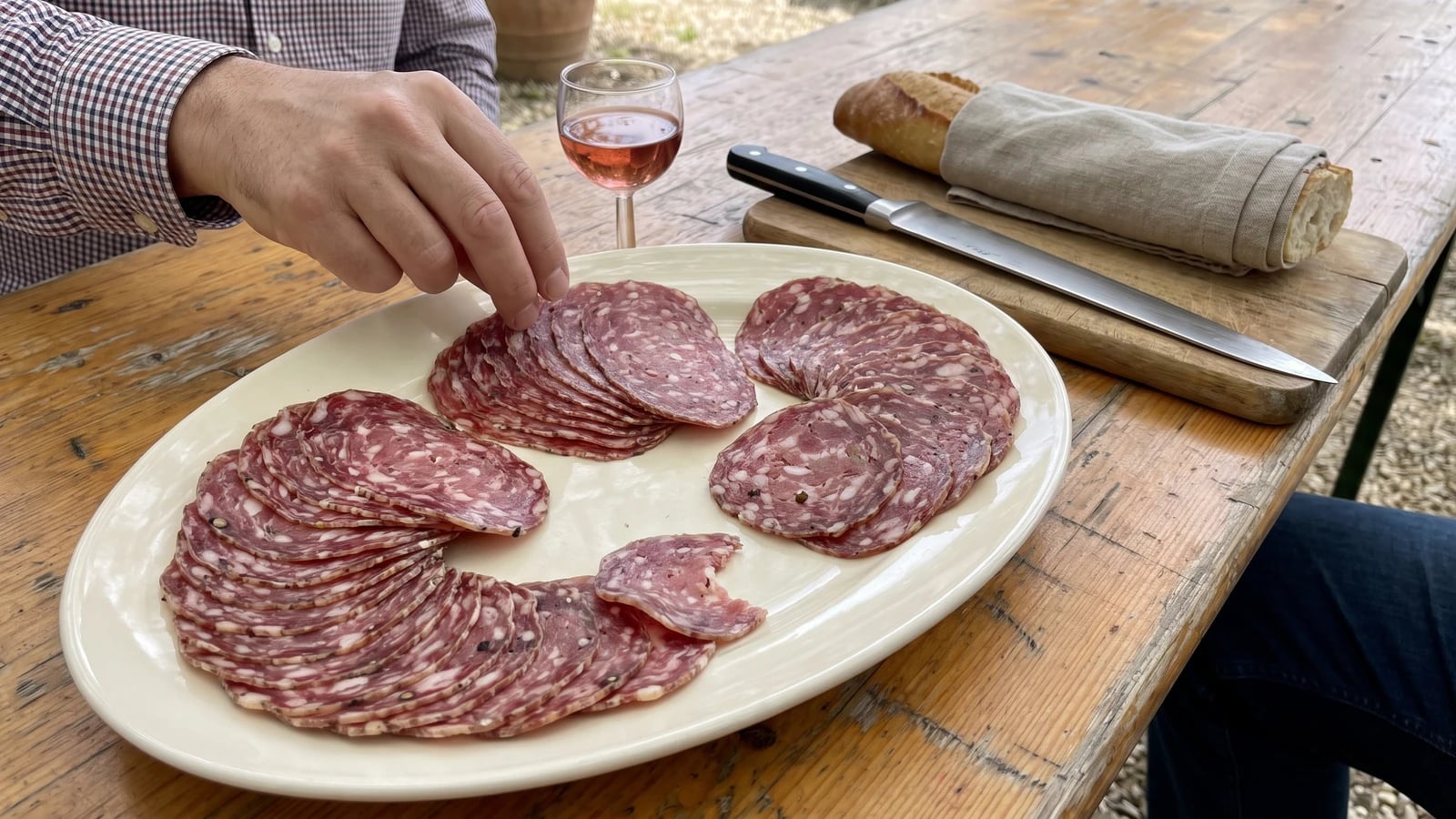
Three great sausages, one quiet lesson: cut them thin, keep each character distinct, and overlap the slices generously. No cooking, no fussy garnish, just charcuterie arranged with a sure hand.
Saucissons d’Arles, de Bologne ou gros saucissons de Lyon (thin-sliced large cured sausages) teach a severe little lesson: when nothing is cooked, the cut becomes the technique. The one true thing to know before touching a pan is that no pan should be touched. Slice across the sausage in clean, nearly translucent rounds, and fat, lean, and spice arrive together; cut thickly and the same sausage becomes chewy and blunt.
The original entry assumed a garde-manger (cold-kitchen cook), whole sausages waiting in the larder, a long slicing knife, and a banquet platter large enough to feed a room. The home equivalent is 12 ounces of good ready-to-eat saucisson, one sharp knife, and a single oval plate for four people. Elaborate buffet symmetry is brigade scaffolding and can go. Thin, even cutting and generous overlapping are the dish itself and must stay. One cook, one stove left cold, one evening.
The finished platter should show broad marbled rounds lying in loose, orderly fans, each variety kept together so its seasoning and texture remain distinct. If the sausage smears beneath the knife, it is simply too warm; chill it briefly and begin again. Ça se rattrape. Start with the saucisson cool and a truly sharp blade, because that clean, thin slice decides the whole plate.
Saucisson d’Arles belongs to Arles in Provence, where mixed-meat dry curing became a recognizable local specialty, while the large sausages of Lyon come from the city’s distinct pork-butchery tradition and reveal a broad mosaic of lean meat and firm white fat when cut. Bologne points beyond France to Bologna in Emilia-Romagna; its presence on a French hors-d’oeuvre table records an admiration for imported charcuterie, not a claim that all three sausages share one regional larder. Their common method is service rather than origin: thin slicing carried each from the charcutier’s counter to the dining-room platter while leaving its own grain and seasoning visible.
Quantity
12 oz (340 g) total
kept whole and cool until slicing; use one variety or a selection
| Ingredient | Quantity |
|---|---|
| fully cured, ready-to-eat Saucisson d’Arles, Saucisson de Bologne, or Gros Saucisson de Lyonkept whole and cool until slicing; use one variety or a selection | 12 oz (340 g) total |
Confirm that every sausage is fully cured and marked ready to eat; fresh sausage belongs at the stove and cannot be substituted here. Remove string, clips, paper, and any casing marked inedible. If the natural casing is delicate and pleasant to chew, leave it; if it is leathery, peel it only from the length you intend to slice so the remainder stays protected.
Set the cool sausage on a stable board and cut straight across it into rounds about 1 to 2 mm thick, drawing the full length of the knife through each slice instead of sawing. The thinness is the technique: each piece should bend easily and deliver fat, lean, and seasoning in one bite. If the fat smears or the rounds buckle, stop, chill the sausage for 10 to 15 minutes, and wipe the blade clean. Ça se rattrape. If a very dry sausage cracks, cut it slightly thicker, about 2 to 3 mm, and tuck the broken first pieces beneath the complete rounds.
Lay the slices on a 12-inch platter in broad fans or gently curving rows, overlapping each round by roughly one-third. Keep different sausages in separate groups rather than mixing them into a decorative mosaic; the eye should recognize each cut, and the diner should be able to compare them. Use the small end slices to support the first row. This orderly generosity, not elaborate decoration, is what the original instruction means by arranging them like salami.
Cover the platter loosely and let the saucissons lose their refrigerator chill for 15 to 20 minutes. They are ready when the white fat develops a gentle sheen and the aromas become clear, but the slices still hold their shape. Serve the platter exactly as it is, with no garnish hiding the cut surfaces. Cooking well is not cooking fancy. À table!
1 serving (about 85g)
Culinary guides, cultural storytelling, and the editorial depth that makes cooking meaningful.
Discover Culinary ExplorerChef Juliette
Tiny éperlans, lightly floured and fried until their tails stand crisp, arrive in a generous heap on a napkin with fried parsley and grooved lemon, a weeknight lesson in heat and restraint.

Chef Juliette
Brandade de Morue turns salt cod, warm olive oil, and milk into a pale, silky emulsion: keep everything warm and add the oil slowly, then crown the generous dome with butter-fried bread.

Chef Juliette
Salt cod worked warm with cream, one patient spoonful at a time, until the rough flakes become a glossy Nîmes paste, domed generously and ringed with butter-fried croutons for the table.

Chef Juliette
Wine-poached char packed in its earthenware crock beneath butter gold: a make-ahead first course that turns careful cooling, thorough boning, and one unbroken seal into quiet abundance.