
Chef Juliette
Smelt (Éperlans)
Tiny éperlans, lightly floured and fried until their tails stand crisp, arrive in a generous heap on a napkin with fried parsley and grooved lemon, a weeknight lesson in heat and restraint.
A cooking platform built around craft, culture, and the stories behind what we eat.
Created by Chef Juliette
Based on No. 382, Gotha and Milan Salami, from Le Guide Culinaire (1907) by Auguste Escoffier
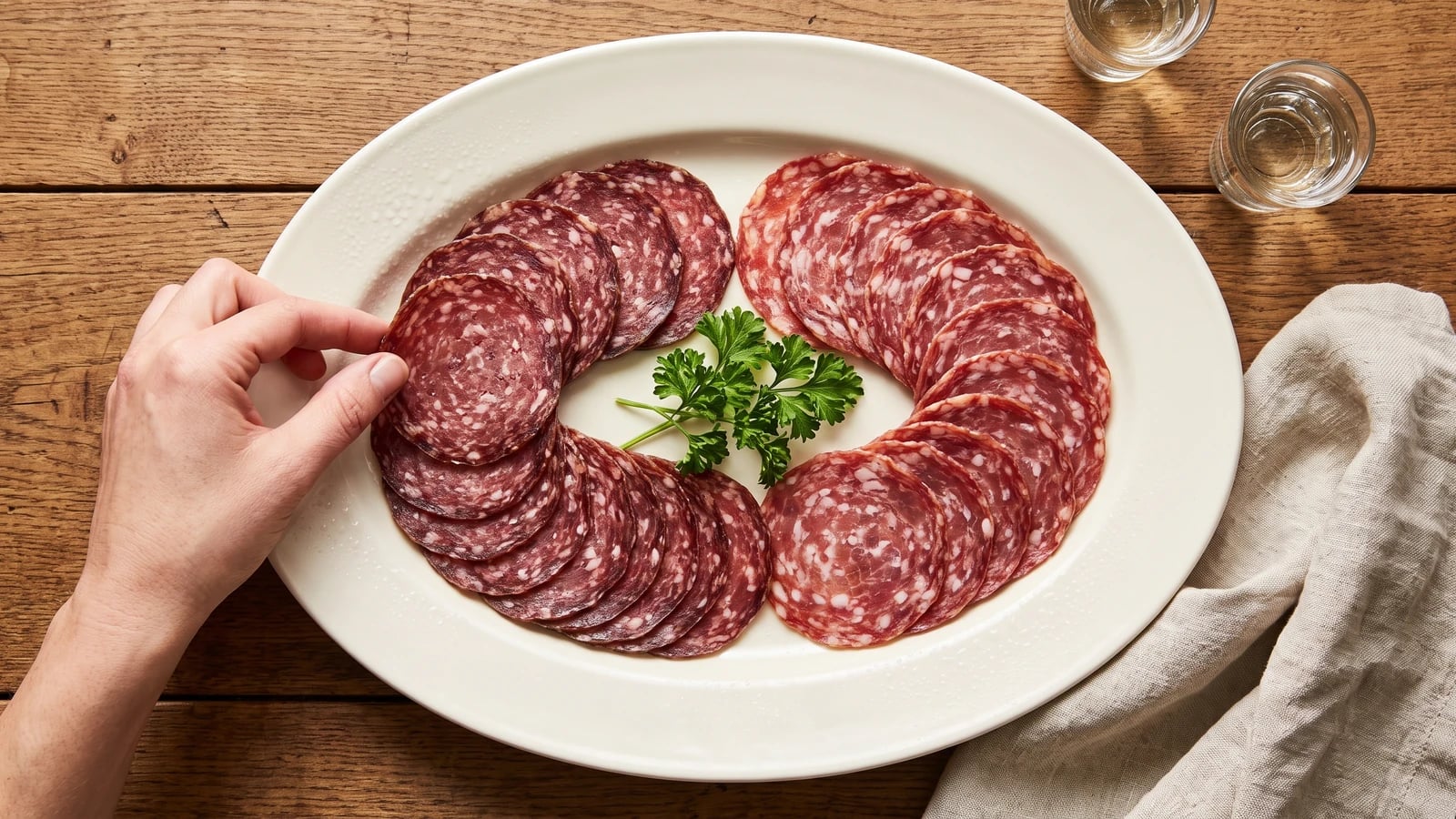
Two distinguished cures, one exact knife: Gotha and Milan salami overlapped into a generous crown with parsley at its centre, proving that a proper hors-d'œuvre needs no cooking when the slicing is precise.
Saucissons de Gotha et de Milan (Gotha and Milan salami) teach the discipline of the cold hors-d'œuvre: when there is no cooking to hide behind, the cut is the dish. There is one true thing to know before touching a pan. Don't touch one. Each slice must be thin enough to soften on the tongue rather than demand chewing.
The original entry assumed whole imported sausages in a cold larder, a practiced hand with a long slicing knife, and a platter proportioned for a generous service. For four, 100 grams of each sausage is ample, and the deli counter's slicer is the honest home equivalent if your knife won't make a clean one-millimetre cut. The brigade quantity is scaffolding and goes. The very thin slicing and overlapping crown are the dish, so they stay exactly where they belong.
On the platter, the deeper reds and pale flecks of fat form a generous ring around one curled parsley sprig. Nothing is dressed, sauced, or disguised. Chill the sausages until firm and take your time with the slicing, because that single step decides everything.
Gotha sausage comes from Gotha in Thuringia, while salame Milano belongs to Milan and the charcuterie tradition of Lombardy; their appearance together records how widely the classical French cold larder looked beyond France. French service treated them as hors-d'œuvre, foods valued for curing, precise slicing, and arrangement rather than transformation by sauce or heat. The crown and curled parsley do not claim French origins for the sausages, but show the French table's formal manner of presenting imported charcuterie.
Quantity
3½ ounces (100 g)
in one piece with casing removed
Quantity
3½ ounces (100 g)
in one piece with casing removed
Quantity
1 sprig, or 1 small bunch (about 1 packed cup / 30 g) for the flat presentation
rinsed and thoroughly dried
| Ingredient | Quantity |
|---|---|
| Gotha salamiin one piece with casing removed | 3½ ounces (100 g) |
| Milan salamiin one piece with casing removed | 3½ ounces (100 g) |
| curled-leaf parsleyrinsed and thoroughly dried | 1 sprig, or 1 small bunch (about 1 packed cup / 30 g) for the flat presentation |
Chill both sausages until the fat is firm and the pieces hold cleanly under the knife. Set the serving dish in the refrigerator for ten minutes as well. Remove every trace of tough casing, but keep each sausage whole until you are ready to slice so the cut surfaces don't dry.
Using a very sharp, thin-bladed knife, cut the salamis crosswise into rounds about 1 millimetre thick. Draw the blade through each piece in one long stroke rather than pressing down, which squashes the round and smears the fat. If the slices buckle or drag, the sausage has grown too warm; chill it for another ten minutes and begin again. If a few rounds tear, tuck their damaged edges beneath the next slice. Ça se rattrape.
Arrange the Gotha slices in one semicircle and the Milan slices in the other, joining them into a complete crown near the rim of the chilled hors-d'œuvre dish. Overlap each round by roughly two-thirds so the slices support one another and can be lifted neatly. Curl the best parsley sprig loosely into the centre. If the crown opens, deepen the overlaps rather than adding supports or decoration.
Let the finished platter stand for five to ten minutes, just until the slices lose their refrigerator stiffness and the fat gains a faint sheen. Serve promptly while the edges remain supple and fresh. The plate needs no sauce and no extra garnish. Cooking well is not cooking fancy. À table!
1 serving (about 58g)
Culinary guides, cultural storytelling, and the editorial depth that makes cooking meaningful.
Discover Culinary ExplorerChef Juliette
Tiny éperlans, lightly floured and fried until their tails stand crisp, arrive in a generous heap on a napkin with fried parsley and grooved lemon, a weeknight lesson in heat and restraint.

Chef Juliette
Brandade de Morue turns salt cod, warm olive oil, and milk into a pale, silky emulsion: keep everything warm and add the oil slowly, then crown the generous dome with butter-fried bread.

Chef Juliette
Salt cod worked warm with cream, one patient spoonful at a time, until the rough flakes become a glossy Nîmes paste, domed generously and ringed with butter-fried croutons for the table.

Chef Juliette
Wine-poached char packed in its earthenware crock beneath butter gold: a make-ahead first course that turns careful cooling, thorough boning, and one unbroken seal into quiet abundance.