
Chef Juliette
Smelt (Éperlans)
Tiny éperlans, lightly floured and fried until their tails stand crisp, arrive in a generous heap on a napkin with fried parsley and grooved lemon, a weeknight lesson in heat and restraint.
A cooking platform built around craft, culture, and the stories behind what we eat.
Created by Chef Juliette
Based on No. 379, Red Mullet à l’Orientale, from Le Guide Culinaire (1907) by Auguste Escoffier
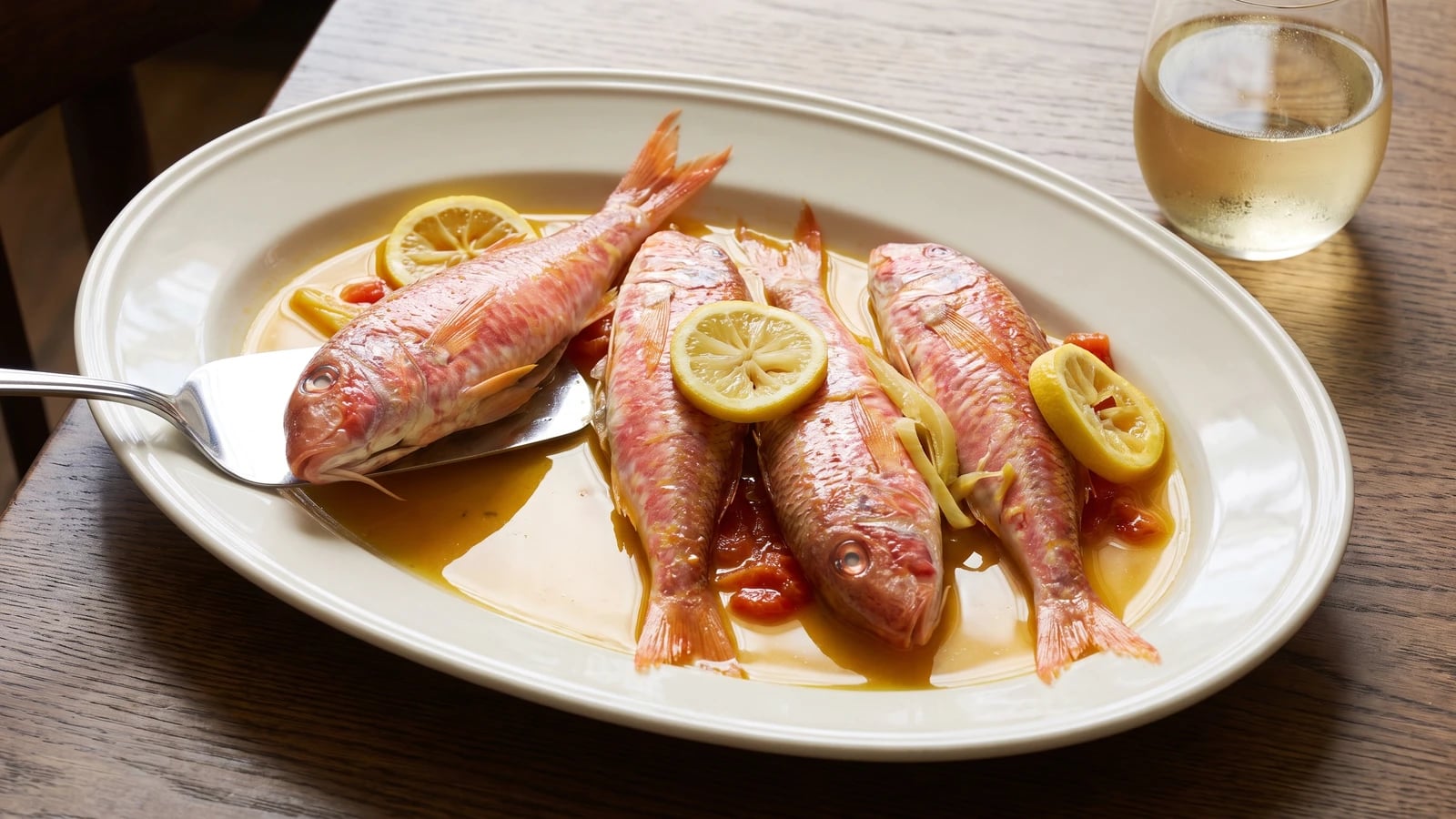
Small whole red mullet poached at a bare tremble in white wine, tomato, fennel, coriander, and saffron, then cooled in their golden liquor and served cold with peeled lemon.
Rougets à l’Orientale (small red mullet poached in saffroned white wine) teaches the narrow but essential distance between boiling and poaching. The wine must reach its first boil, then fall immediately to a bare tremble. Small fish are delicate, and a rolling boil tightens their flesh before the saffron, coriander, tomato, and fennel have time to settle around them.
The original kitchen assumed a long fish pan, brigade quantities, and a cool place at the side of a coal-fired range. This entry needs no saucier, perpetual stockpot, or salamander. For one cook, one stove, one evening, four small mullet fit into a snug sauté pan, and the smallest burner supplies that gentle side heat. The professional scaffolding of scale has gone; the wine-only poach, saffron dominance, and cooling in the cuisson all remain because they are the dish.
Cold, the mullet should be tender and faintly rosy beneath the skin, surrounded by a golden liquor fragrant with saffron rather than merely stained by it. The tomato softens the wine, the fennel and coriander carry its perfume, and peeled lemon brings the clean final edge. Watch that first boil. It is the one moment that decides everything.
Red mullet belongs to the Mediterranean fish markets of Provence, especially Marseille and Toulon, while the title à l’Orientale belongs to the national classical repertoire rather than to a named French region. In classical menu language it signaled a saffron-led seasoning supported here by tomato, fennel, coriander, and garlic, not a claim that the preparation represented one single cuisine east of France. Cooling the fish in its cuisson, the cooking liquor, carried it naturally from the hot fish course to the cold hors d’œuvre and buffet table.
Quantity
4 fish, about 5 oz / 140 g each and 20 oz / 560 g total
scaled, gutted, and gills removed
Quantity
1 tablespoon (15 ml / 14 g)
for the pan
Quantity
2 medium, yielding about 1 cup (240 ml / 200 g)
peeled, seeded, and prepared as a concass
Quantity
1 small, yielding about 1/2 cup (120 ml / 60 g)
peeled and thinly sliced
Quantity
1/2 small bulb, yielding about 3/4 cup (180 ml / 75 g)
thinly sliced
Quantity
2 sprigs
Quantity
1
Quantity
1 small clove, about 1 teaspoon (5 ml / 3 g)
thinly sliced
Quantity
1 teaspoon (5 ml / 2.5 g)
Quantity
1/2 teaspoon (2.5 ml / 1 g)
lightly crushed
Quantity
1/2 teaspoon, loosely packed (2.5 ml / 0.2 g)
Quantity
1 bottle, about 3 1/8 cups (750 ml / 745 g)
enough to cover the fish in a snug pan
Quantity
1 teaspoon (5 ml / 6 g)
Quantity
1
peel and white pith removed, thinly sliced
| Ingredient | Quantity |
|---|---|
| small whole red mulletscaled, gutted, and gills removed | 4 fish, about 5 oz / 140 g each and 20 oz / 560 g total |
| olive oilfor the pan | 1 tablespoon (15 ml / 14 g) |
| ripe tomatoespeeled, seeded, and prepared as a concass | 2 medium, yielding about 1 cup (240 ml / 200 g) |
| parsley rootpeeled and thinly sliced | 1 small, yielding about 1/2 cup (120 ml / 60 g) |
| fennel bulbthinly sliced | 1/2 small bulb, yielding about 3/4 cup (180 ml / 75 g) |
| fresh thyme | 2 sprigs |
| bay leaf | 1 |
| garlicthinly sliced | 1 small clove, about 1 teaspoon (5 ml / 3 g) |
| whole black peppercorns | 1 teaspoon (5 ml / 2.5 g) |
| coriander seedslightly crushed | 1/2 teaspoon (2.5 ml / 1 g) |
| saffron threads | 1/2 teaspoon, loosely packed (2.5 ml / 0.2 g) |
| dry white wineenough to cover the fish in a snug pan | 1 bottle, about 3 1/8 cups (750 ml / 745 g) |
| fine sea salt | 1 teaspoon (5 ml / 6 g) |
| unwaxed lemonpeel and white pith removed, thinly sliced | 1 |
Cut a shallow cross in the base of each tomato, lower them into boiling water for 20 seconds, then cool them in cold water. Slip off the skins, halve the tomatoes, press out the seeds, and chop the flesh roughly. This is the tomato concass: concass means to chop roughly, so leave distinct pieces rather than making a purée. Slice the parsley root, fennel, and garlic while the tomatoes drain.
Pat the cleaned mullet dry and inspect the cavities for any trace of blood, which can cloud and embitter the liquor. Oil a snug 12 to 13-inch shallow sauté pan, then lay the fish in a single layer. Scatter over the tomato concass, parsley root, fennel, thyme, bay, garlic, peppercorns, and coriander. Rub the saffron lightly between your fingertips as you add it so its perfume opens through the wine. Pour in the wine until the fish are just covered, then add the salt moderately. If the wine cannot cover them, move everything to a smaller pan rather than diluting the cuisson with water.
Set the pan over medium heat and bring the wine just to the first boil. Immediately lower the heat to its gentlest setting, or move the pan to the smallest burner, and lay a parchment cartouche directly on the liquid to keep the fish submerged. Poach at a bare tremble for 12 minutes for fish of about 5 oz / 140 g, allowing up to 18 minutes for larger ones. The flesh at the backbone should be opaque and reach 145°F / 63°C. If the liquid breaks into a rolling boil, lift the pan off the burner, remove the cartouche, and let it settle for one minute before returning it to the lowest heat. Ça se rattrape. One brief boil will not ruin the fish, but repeated boiling will tighten it.
Remove the pan from the heat and leave the fish untouched in their cuisson for 15 minutes. Set the pan into a shallow bath of ice water and cool the liquor promptly, taking care that no water enters the pan. Once the cuisson is no warmer than room temperature, cover and refrigerate the fish in it for at least 4 hours. If the pan will not fit in the refrigerator, support each fish with two broad spatulas, transfer them to a shallow dish, and pour every drop of liquor and aromatics over them. Cooling in the cuisson is not brigade scaffolding; it is the step that seasons the flesh through and keeps it succulent.
Taste the chilled cuisson and correct the salt only now, because cold mutes seasoning. Lift the fish carefully onto a chilled oval platter, discard the thyme stems and bay leaf, then arrange the softened tomato, fennel, and parsley root around them. Spoon over enough saffron-gold cuisson to make a shallow pool without drowning the fish. Add the peeled lemon slices at the last moment so their pithless acidity stays clean and never turns bitter. Serve one small mullet to each guest. À table!
1 serving (about 200g)
Culinary guides, cultural storytelling, and the editorial depth that makes cooking meaningful.
Discover Culinary ExplorerChef Juliette
Tiny éperlans, lightly floured and fried until their tails stand crisp, arrive in a generous heap on a napkin with fried parsley and grooved lemon, a weeknight lesson in heat and restraint.

Chef Juliette
Brandade de Morue turns salt cod, warm olive oil, and milk into a pale, silky emulsion: keep everything warm and add the oil slowly, then crown the generous dome with butter-fried bread.

Chef Juliette
Salt cod worked warm with cream, one patient spoonful at a time, until the rough flakes become a glossy Nîmes paste, domed generously and ringed with butter-fried croutons for the table.

Chef Juliette
Wine-poached char packed in its earthenware crock beneath butter gold: a make-ahead first course that turns careful cooling, thorough boning, and one unbroken seal into quiet abundance.