
Chef Juliette
Smelt (Éperlans)
Tiny éperlans, lightly floured and fried until their tails stand crisp, arrive in a generous heap on a napkin with fried parsley and grooved lemon, a weeknight lesson in heat and restraint.
A cooking platform built around craft, culture, and the stories behind what we eat.
Created by Chef Juliette
Based on No. 373, Various Hard-boiled Eggs, from Le Guide Culinaire (1907) by Auguste Escoffier
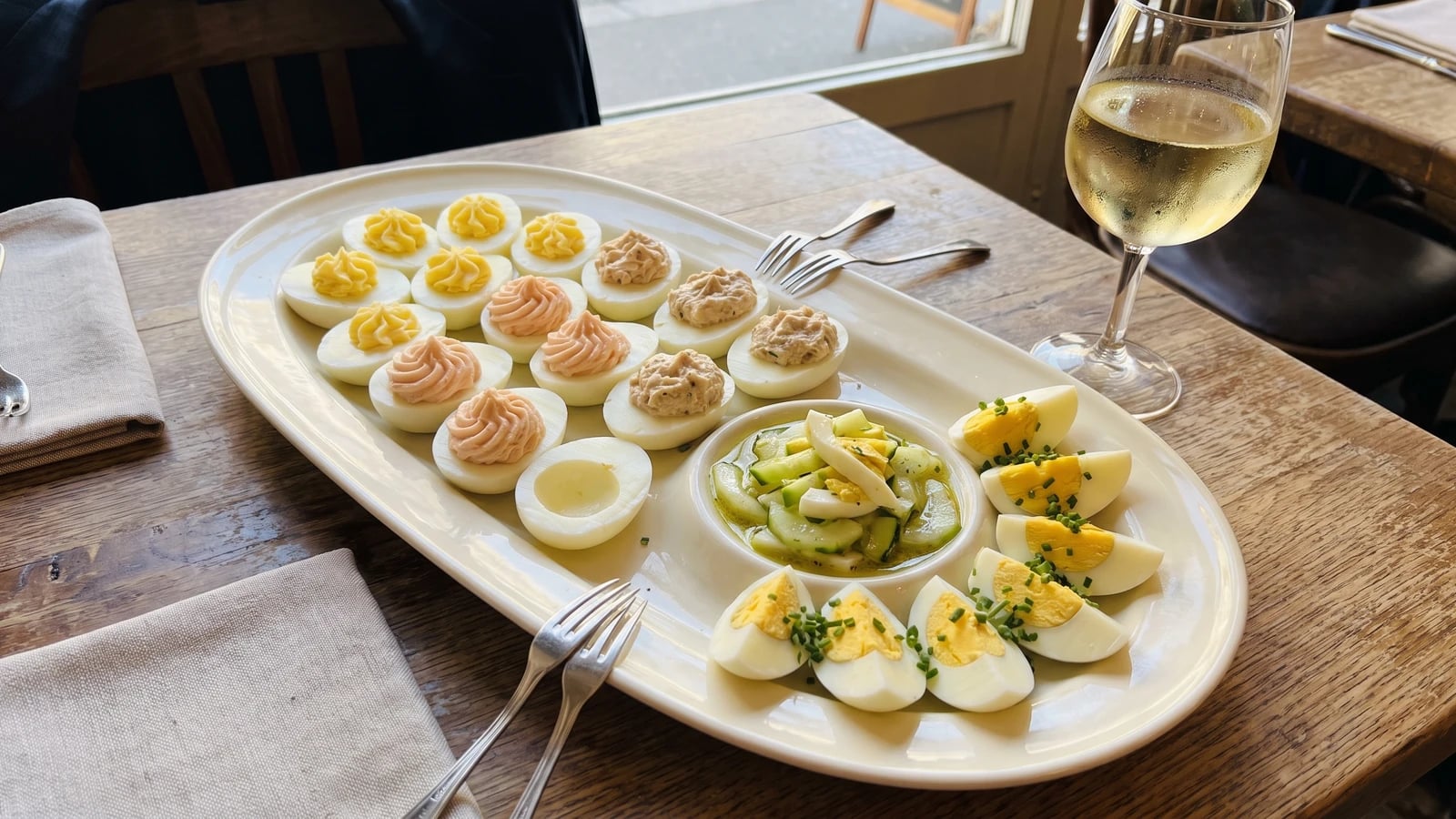
One well-cooked egg becomes a whole cold table: butter-rosetted discs, fish and vegetable-filled halves, neat quarters, and salad, all held together by smooth texture, sharp seasoning, and a proper chill.
Œufs durs variés (various hard-boiled eggs) teach the grammar of the cold hors-d'œuvre: one plain ingredient can carry compound butter, fish purée, a Macédoine, meaning a fine mixture of small vegetables, or a sharp little salad. C'est la même grammaire throughout. Every element must be cleanly cut, firmly bound, and seasoned for serving cold. The one true thing to know before touching the pan is that cooling is part of cooking; leave the eggs warm and their yolks continue toward that grey-green ring.
The source never needed a saucier, a stockpot, or a salamander; it assumed the garde-manger, the cold-kitchen station, had mayonnaise, compound butters, cold Béchamel, aspic jelly, fluted pipes, and spare hands ready. For a home platter, those stores become one small-bowl mayonnaise, fresh Shrimp Butter, and three spoonfuls of Béchamel. The carved oblong hollows are brigade scaffolding and can go; intact oval whites save food and hold the fillings just as well. Smooth, pipeable fillings and deliberate shapes are the dish, and they stay. One cook, one stove, one evening.
The finished platter should look abundant rather than fussy: pale egg discs under ridged pink butter, satin whites filled with tuna or bright vegetables, herb-flecked quarters, and cucumber salad gleaming lightly with vinaigrette. Before any knife or piping bag appears, give the eggs their full ice bath; that single step decides the clear yolks, resilient whites, and clean cuts.
Œufs durs variés belong to the French repertoire of hors-d'œuvres froids, shaped most fully at the Parisian garde-manger and carried onto bourgeois dinner tables as a composed first course. The egg served as an economical, neutral base for compound butters, fish purées, Salpicon, meaning fine dice bound with sauce, and Macédoine, allowing the cold kitchen to produce great variety from one boiling pot. Carved whites and piped ornaments came from formal service, while home tables kept the fillings and simplified the geometry.
Quantity
12
preferably not farm-fresh
Quantity
1
Quantity
1 teaspoon (5 ml / 5 g)
Quantity
1 tablespoon plus 2 teaspoons (25 ml / 25 g), divided
Quantity
1/2 cup (120 ml / 110 g)
Quantity
2 teaspoons (10 ml / 10 g), divided
Quantity
1 1/2 teaspoons (7.5 ml / 9 g), divided
Quantity
1/4 teaspoon (1.25 ml / 0.5 g), divided
Quantity
4 tablespoons (60 ml / 57 g)
softened
Quantity
1/3 cup (80 ml / 50 g)
finely chopped
Quantity
1/2 cup (120 ml / 85 g)
thoroughly drained
Quantity
1/2 cup (120 ml / 80 g)
finely diced where needed
Quantity
1 teaspoon (5 ml / 5 g)
Quantity
1 teaspoon (5 ml / 3 g)
Quantity
3 tablespoons (45 ml / 46 g)
Quantity
1 tablespoon (15 ml / 14 g)
softened
Quantity
1 tablespoon (15 ml / 3 g)
finely cut
Quantity
1 cup (240 ml / 120 g)
thinly sliced
Quantity
3 tablespoons (45 ml / 41 g)
| Ingredient | Quantity |
|---|---|
| large eggspreferably not farm-fresh | 12 |
| pasteurized large egg yolk | 1 |
| Dijon mustard | 1 teaspoon (5 ml / 5 g) |
| white wine vinegar | 1 tablespoon plus 2 teaspoons (25 ml / 25 g), divided |
| neutral oil | 1/2 cup (120 ml / 110 g) |
| cold water | 2 teaspoons (10 ml / 10 g), divided |
| fine salt | 1 1/2 teaspoons (7.5 ml / 9 g), divided |
| ground white pepper | 1/4 teaspoon (1.25 ml / 0.5 g), divided |
| unsalted butter for the Shrimp Buttersoftened | 4 tablespoons (60 ml / 57 g) |
| cooked peeled shrimpfinely chopped | 1/3 cup (80 ml / 50 g) |
| oil-packed tunathoroughly drained | 1/2 cup (120 ml / 85 g) |
| carrot, green beans, and peas for the Macédoinefinely diced where needed | 1/2 cup (120 ml / 80 g) |
| unsalted butter for the Béchamel | 1 teaspoon (5 ml / 5 g) |
| plain flour | 1 teaspoon (5 ml / 3 g) |
| whole milk | 3 tablespoons (45 ml / 46 g) |
| unsalted butter for the yolk fillingsoftened | 1 tablespoon (15 ml / 14 g) |
| chivesfinely cut | 1 tablespoon (15 ml / 3 g) |
| cucumber roundsthinly sliced | 1 cup (240 ml / 120 g) |
| extra-virgin olive oil | 3 tablespoons (45 ml / 41 g) |
Bring a wide saucepan of water to a steady boil. Lower the 12 eggs into it with a spoon, reduce the heat to a gentle boil, and cook for 10 minutes. Transfer them immediately to a deep bowl of ice water and leave them there for at least 10 minutes, replacing warm water with more cold water if necessary. If an egg cracks while cooking, lower the boil at once; reserve that egg for the salad if its shape suffers. Ça se rattrape.
Crack each cold shell all over, roll it gently beneath your palm, and peel from the broad end where the air pocket sits. If the shell clings, peel beneath a thin stream of cool water rather than tearing the white. Set aside 3 eggs for discs, 3 for tuna halves, 2 for Macédoine halves, 2 for herb quarters, and 2 for salad. Cut the tuna, Macédoine, and quarter eggs lengthwise, then lift out their yolks. Keep the 3 tuna yolks separate; combine the other 4 yolks for the herb filling. Leave the natural oval hollows intact. The source's carved oblong cavities and indented edges were service scaffolding; clean cuts and fluted piping give the home platter all the order it needs.
Whisk the pasteurized yolk with the Dijon mustard, 2 teaspoons of the white wine vinegar, 1 teaspoon of the cold water, a pinch of the measured salt, and a little white pepper. Add the neutral oil drop by drop until the emulsion takes hold, then pour it in a thin thread while whisking constantly. The finished mayonnaise should stand in a soft peak. If it splits, stop. Put the remaining teaspoon of cold water in a clean bowl and whisk in the broken mayonnaise one spoonful at a time until it becomes smooth again. Ça se rattrape. Refrigerate it while preparing the fillings.
Cut the 3 reserved eggs crosswise into roundels about 1/3 inch (8 mm) thick. Trim away the narrow end pieces and save them for the salad so the serving discs are nearly uniform and their yolks appear centered. Pound or process the shrimp into a fine paste, then beat it thoroughly into the 4 tablespoons of softened butter with a pinch each of salt and white pepper. Press the Shrimp Butter through a fine sieve if any coarse pieces remain, load it into a piping bag fitted with a grooved star tip, and pipe a small rosette onto every disc. If the ridges slump, chill the bag for 5 minutes; if the butter is too stiff to pipe, warm it briefly between your hands.
Mash the 3 reserved tuna yolks until no lumps remain. Work in the drained tuna and 4 tablespoons (60 ml) of mayonnaise, then season with a little of the measured salt and white pepper. Press the purée through a sieve for a formal smoothness, or mash it very thoroughly with a fork for a softer home texture. Pipe or spoon it generously into the 6 corresponding egg-white halves. If the filling seems loose, chill it for 10 minutes before piping; if too stiff, beat in reserved mayonnaise a teaspoon at a time.
Cook the carrot, green beans, and peas in lightly salted simmering water until tender but still distinct, 3 to 4 minutes. Drain, cool quickly, and dry them thoroughly on a clean towel. Fold the Macédoine with 3 tablespoons (45 ml) of mayonnaise and enough white pepper to sharpen it, then mound it into the 4 designated egg-white halves. Water left on the vegetables will loosen the mayonnaise; if that happens, drain the mixture in a fine sieve for a minute and fold in a spoonful of the mashed yolk mixture from the next step.
Melt 1 teaspoon of butter in the smallest saucepan you own, stir in the flour, and cook for 30 seconds without coloring it. Whisk in the milk little by little and simmer until the Béchamel becomes thick enough to hold the whisk's trace, about 2 minutes. Scrape it onto a cold plate and let it cool completely. Mash the 4 reserved yolks with the tablespoon of softened butter, the cold Béchamel, chives, a pinch of salt, and white pepper. Fill the remaining 4 egg-white halves, chill them for 20 minutes, then cut each half crosswise into 2 neat quarters with a damp, thin-bladed knife. If the filling drags or crumbles, chill it longer; if it remains dry, beat it with a teaspoon of reserved mayonnaise and refill the whites.
Whisk the remaining tablespoon of white wine vinegar with the olive oil, a pinch of salt, and white pepper. Slice the last 2 eggs into rounds and arrange them in alternating rows with the cucumber. Chop the reserved end pieces from the egg discs and tuck them through the middle. Spoon over just enough vinaigrette to make the surfaces gleam without leaving a puddle beneath them. Hold any remaining dressing for the table.
Arrange the Shrimp Butter discs, tuna halves, Macédoine halves, and herb quarters in distinct loose rows on a chilled platter, with the salad in a shallow dish alongside or at one end. Cover without pressing the wrapping onto the piped fillings and chill for at least 30 minutes. Bring the platter out 15 minutes before serving so the butter softens enough to taste fully, but keep it away from a warm room for longer than 2 hours. Serve with small forks and napkins. À table!
1 serving (about 160g)
Culinary guides, cultural storytelling, and the editorial depth that makes cooking meaningful.
Discover Culinary ExplorerChef Juliette
Tiny éperlans, lightly floured and fried until their tails stand crisp, arrive in a generous heap on a napkin with fried parsley and grooved lemon, a weeknight lesson in heat and restraint.

Chef Juliette
Brandade de Morue turns salt cod, warm olive oil, and milk into a pale, silky emulsion: keep everything warm and add the oil slowly, then crown the generous dome with butter-fried bread.

Chef Juliette
Salt cod worked warm with cream, one patient spoonful at a time, until the rough flakes become a glossy Nîmes paste, domed generously and ringed with butter-fried croutons for the table.

Chef Juliette
Wine-poached char packed in its earthenware crock beneath butter gold: a make-ahead first course that turns careful cooling, thorough boning, and one unbroken seal into quiet abundance.