
Chef Juliette
Smelt (Éperlans)
Tiny éperlans, lightly floured and fried until their tails stand crisp, arrive in a generous heap on a napkin with fried parsley and grooved lemon, a weeknight lesson in heat and restraint.
A cooking platform built around craft, culture, and the stories behind what we eat.
Created by Chef Juliette
Based on No. 372, Lapwings’ Eggs à la Moscovite, from Le Guide Culinaire (1907) by Auguste Escoffier
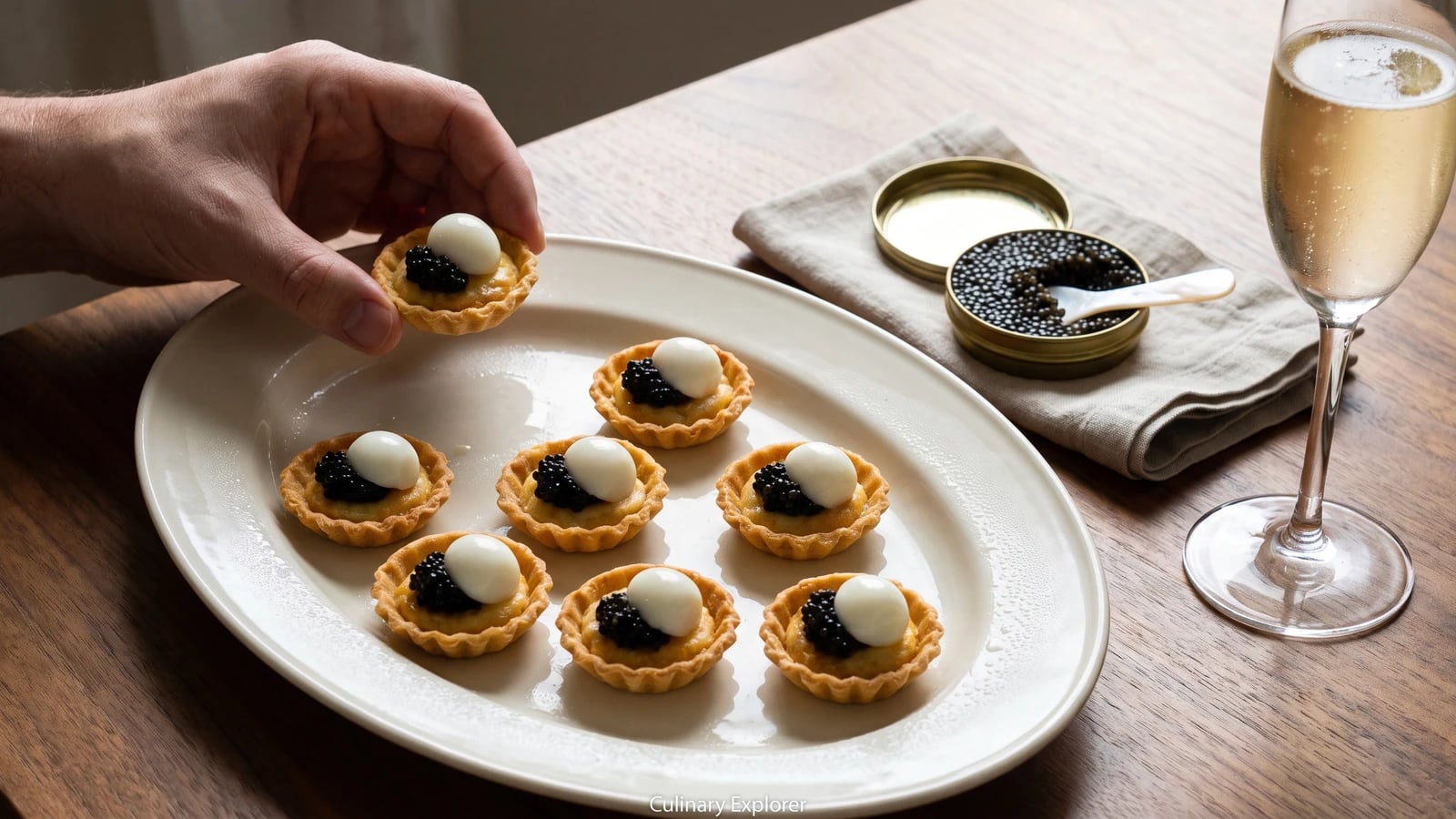
Œufs de Vanneau à la Moscovite pairs a cold, plainly cooked egg with a crisp butter shell and black caviar, teaching the classical virtue of contrast in one exact, generous bite.
Œufs de Vanneau à la Moscovite (lapwings’ eggs, Moscow style) teaches one exact principle: contrast survives only when every element keeps its character. The egg must be hard-set, mild, and cold; the caviar saline and yielding; the little butter crust dry enough to crack cleanly under the teeth. Before touching a pan, know this: everything must be fully cold before the caviar meets the tartlet.
The original entry assumed a grand pantry able to procure wild lapwing eggs and a pastry station turning out identical little crusts. There is no saucier, stockpot, or salamander hiding here. Procurement and repetition were the brigade scaffolding. Lapwing eggs are protected and cannot be honestly sourced for a home recipe, so use eight quail eggs and eight 5 cm tartlets for four guests. The boiling time and crust diameter shrink with the egg; the source’s one-to-one ratio does not.
The uniform hand of a pastry station can go. A mini tartlet tin and careful rolling replace it perfectly well. The hard egg, real caviar, crisp butter crust, and cold service are the dish itself, and every one stays. Cool the eggs and shells completely before filling. That is the step that decides it.
Œufs de vanneau à la moscovite belongs to the Parisian grand-service table, where lapwing eggs were prized as a fleeting spring delicacy and the adjective moscovite signaled caviar and a Russian association. The name is French culinary grammar, not proof of a Moscow birthplace; the preparation traveled into the cold hors-d’œuvre repertoire as a compact display of plain egg against costly roe. Wild lapwings and their nests are protected across much of their range, so quail eggs carry the structure into the home kitchen without pretending to reproduce the unavailable ingredient exactly.
Quantity
8
Quantity
1 cup (240 ml / 120 g)
Quantity
¼ teaspoon (1.25 ml / 1.5 g)
Quantity
4 tablespoons (60 ml / 57 g)
cut into 1 cm cubes
Quantity
2 tablespoons (30 ml / 30 g), plus up to 1 teaspoon (5 ml / 5 g) if needed
Quantity
8 level coffee-spoonfuls (8 teaspoons / 40 ml / about 40 g)
| Ingredient | Quantity |
|---|---|
| quail eggs | 8 |
| all-purpose flour | 1 cup (240 ml / 120 g) |
| fine sea salt | ¼ teaspoon (1.25 ml / 1.5 g) |
| cold unsalted buttercut into 1 cm cubes | 4 tablespoons (60 ml / 57 g) |
| ice water | 2 tablespoons (30 ml / 30 g), plus up to 1 teaspoon (5 ml / 5 g) if needed |
| chilled black sturgeon caviar | 8 level coffee-spoonfuls (8 teaspoons / 40 ml / about 40 g) |
Bring a small saucepan of water to a full boil. Lower in the quail eggs with a spoon, keep the water at a lively simmer, and cook for 4 minutes so the whites and yolks set completely. Transfer them immediately to ice water for 5 minutes. Crack each shell all over, roll it gently beneath your palm, and peel from the broad end under cool water. If the shell clings, stop picking at the white; slip the bowl of a teaspoon beneath the membrane and ease it around the egg. Ça se rattrape. Dry the peeled eggs and chill them, covered.
Combine the flour and salt, then rub in the cold butter until the mixture resembles coarse crumbs with a few thin flakes of butter remaining. This is pâte brisée, a short butter pastry, and those cold flakes give the shells their crispness. Add the 2 tablespoons of ice water and press the mixture together without kneading. If dry flour remains, add the final teaspoon of water a few drops at a time. Flatten the dough into a disc, wrap it, and chill for 30 minutes.
Roll the cold dough between two sheets of parchment to about 3 mm thick. Cut eight 8 cm rounds and ease them into eight 5 cm tartlet tins, pressing into the corners without stretching the pastry. Trim the rims, prick the bases lightly with a fork, and chill for 20 minutes. If the dough softens while you work, return it to the cold for 10 minutes; warm butter smears into the flour and gives a hard crust.
Heat the oven to 190°C (375°F). Line each shell with a small square of foil and fill it with dry rice or baking weights. Bake for 10 minutes, remove the foil and weights, then bake for another 6 to 8 minutes, until the bases are dry and the rims are a clear butter-gold. If a base puffs despite the weights, press it down at once with the back of a teaspoon while the pastry is still pliable. Cool for 10 minutes, unmold, and leave the shells on a rack until completely cold.
Check that the peeled eggs and tartlet shells are cold and perfectly dry, then leave the caviar refrigerated until the last moment. Warm pastry softens beneath caviar, while moisture makes the crust leathery. If the empty shells have softened during storage, re-crisp them at 175°C (350°F) for 4 minutes and let them cool completely before filling.
Spoon one level coffee-spoonful, about 1 teaspoon, of caviar into each tartlet and spread it into a shallow bed. Set one whole quail egg exactly in the middle of each, leaving a black rim of caviar visible around it. Add no salt; the caviar seasons the egg. Arrange the tartlets on a chilled platter and serve within 15 minutes, while the shells remain crisp and the caviar cold. À table!
1 serving (about 73g)
Culinary guides, cultural storytelling, and the editorial depth that makes cooking meaningful.
Discover Culinary ExplorerChef Juliette
Tiny éperlans, lightly floured and fried until their tails stand crisp, arrive in a generous heap on a napkin with fried parsley and grooved lemon, a weeknight lesson in heat and restraint.

Chef Juliette
Brandade de Morue turns salt cod, warm olive oil, and milk into a pale, silky emulsion: keep everything warm and add the oil slowly, then crown the generous dome with butter-fried bread.

Chef Juliette
Salt cod worked warm with cream, one patient spoonful at a time, until the rough flakes become a glossy Nîmes paste, domed generously and ringed with butter-fried croutons for the table.

Chef Juliette
Wine-poached char packed in its earthenware crock beneath butter gold: a make-ahead first course that turns careful cooling, thorough boning, and one unbroken seal into quiet abundance.