
Chef Juliette
Smelt (Éperlans)
Tiny éperlans, lightly floured and fried until their tails stand crisp, arrive in a generous heap on a napkin with fried parsley and grooved lemon, a weeknight lesson in heat and restraint.
A cooking platform built around craft, culture, and the stories behind what we eat.
Created by Chef Juliette
Based on No. 368, Plain Lapwings’ and Plovers’ Eggs, from Le Guide Culinaire (1907) by Auguste Escoffier
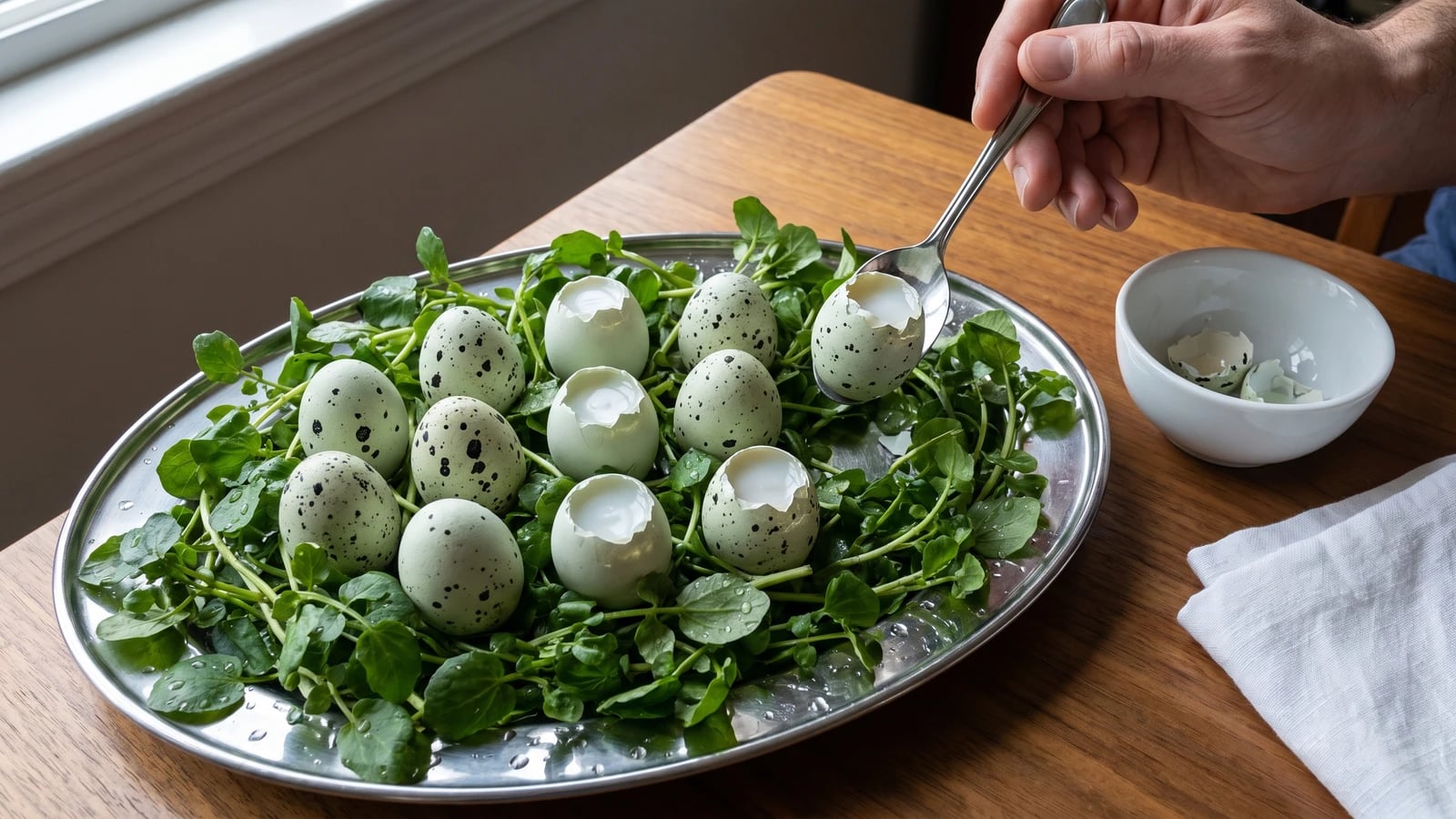
Twelve rare eggs, cold-started and boiled for eight precise minutes, then opened at the point and set upright in watercress, their naturally milky whites showing exactly as they should.
Œufs de vanneaux et de pluviers au naturel teach a rare discipline: judge an ingredient by its own nature, not by the hen’s egg you already know. Their albumen remains milky and less solid even when the yolk is hard, so the one true thing to understand before touching the pan is this: that tender white is not undercooking, and more heat will only spoil the yolk.
The original entry assumed a professional larder could receive very fresh, seasonal wild-bird eggs through the game market. It needed no saucier, stockpot, or salamander; its brigade scaffolding was plentiful eggs and another pair of hands to cool and arrange them. The home translation is twelve eggs with documented legal provenance, one saucepan, an ice bath, and a watercress nest. The ice bath is the only added step, used to halt carryover cooking and make the pointed caps easier to open. The eight minutes after boiling, the milky albumen, and the spare presentation are the dish itself, and they stay untouched. One cook, one stove, one evening.
Test every egg in cold water before heating and discard any that floats, but remember that this measures age, not complete safety. Then begin with fresh cold water and watch the clock: the step that decides the dish is starting those eight minutes only when the water reaches a full boil.
Œufs de vanneaux et de pluviers au naturel belong to the Parisian grand-kitchen register of cold hors-d’œuvre, supplied through the European game markets rather than tied to one French region. They were prized not because their whites resembled those of hens, but because the cooked albumen remained distinctively milky and tender around a firm yolk. Wild lapwings and plovers are now protected across much of their range, so the preparation belongs only where the eggs have documented legal provenance; taking them from nests is not part of keeping the canon alive.
Quantity
12
intact and accompanied by documented provenance
Quantity
10 cups (2.4 L / 2.4 kg)
divided
Quantity
4 cups (950 ml / about 600 g)
Quantity
4 lightly packed cups (950 ml / 120 g)
tough stems removed, washed, and dried thoroughly
| Ingredient | Quantity |
|---|---|
| legally sourced lapwing and/or plover eggsintact and accompanied by documented provenance | 12 |
| cold waterdivided | 10 cups (2.4 L / 2.4 kg) |
| ice cubes | 4 cups (950 ml / about 600 g) |
| cultivated watercresstough stems removed, washed, and dried thoroughly | 4 lightly packed cups (950 ml / 120 g) |
Confirm the eggs came with documented legal provenance and inspect them for cracks, leakage, or an off smell. Lower them into a deep bowl of cold water. Keep those that sink and discard any that float, exactly as the classical entry directs. The test reveals an enlarged air cell and doubtful freshness, but a sinking egg is not a guarantee of safety; provenance and an intact shell still matter.
Arrange the tested eggs in a single layer in a saucepan and add fresh cold water to cover them by 1 inch (2.5 cm). Bring the water steadily to a full boil over medium heat. Don't crowd the pan or let the eggs rattle violently against one another; their shells are part of the presentation.
Start the timer only when the water reaches a full boil, then cook the eggs for exactly 8 minutes, adjusting the heat to maintain a controlled boil. The yolks must become hard, while the whites will remain milky and less firm than ordinary egg white. If that softness alarms you, don't return them to the pan. It is the natural character of these eggs, not a failure of the method.
Lift the eggs immediately into a bowl filled with the ice and remaining cold water. Leave them for 8 to 10 minutes, until cold throughout, then dry them gently. This ice bath replaces the extra hands of the old kitchen: it stops carryover cooking while you prepare the serving dish.
Spread the thoroughly dried watercress across an oval serving dish, turning the stems inward to make a dense, peppery nest that will hold the eggs upright. Leave it undressed. Oil, salt, or sauce would wilt the leaves and distract from a preparation whose restraint is the whole point.
Tap only the pointed end of each egg and peel away a small cap of shell, exposing the milky white while leaving the rest of the mottled shell intact. If the membrane clings, wet the point with cold water and ease it away with the edge of a clean teaspoon. If a little white tears, ça se rattrape: turn the blemish toward the centre of the nest and settle that egg slightly deeper among the leaves.
Set the eggs upright in the watercress with their opened points showing. Keep them chilled until they reach the table and provide a small dish for the remaining shells. Three eggs per guest make a proper hors-d’œuvre. Nothing is stuffed, sauced, or disguised; this is the entry as written, scaled for four. À table!
1 serving (about 100g)
Culinary guides, cultural storytelling, and the editorial depth that makes cooking meaningful.
Discover Culinary ExplorerChef Juliette
Tiny éperlans, lightly floured and fried until their tails stand crisp, arrive in a generous heap on a napkin with fried parsley and grooved lemon, a weeknight lesson in heat and restraint.

Chef Juliette
Brandade de Morue turns salt cod, warm olive oil, and milk into a pale, silky emulsion: keep everything warm and add the oil slowly, then crown the generous dome with butter-fried bread.

Chef Juliette
Salt cod worked warm with cream, one patient spoonful at a time, until the rough flakes become a glossy Nîmes paste, domed generously and ringed with butter-fried croutons for the table.

Chef Juliette
Wine-poached char packed in its earthenware crock beneath butter gold: a make-ahead first course that turns careful cooling, thorough boning, and one unbroken seal into quiet abundance.