
Chef Juliette
Smelt (Éperlans)
Tiny éperlans, lightly floured and fried until their tails stand crisp, arrive in a generous heap on a napkin with fried parsley and grooved lemon, a weeknight lesson in heat and restraint.
A cooking platform built around craft, culture, and the stories behind what we eat.
Created by Chef Juliette
Based on No. 365, Smoked Breast of Goose, from Le Guide Culinaire (1907) by Auguste Escoffier
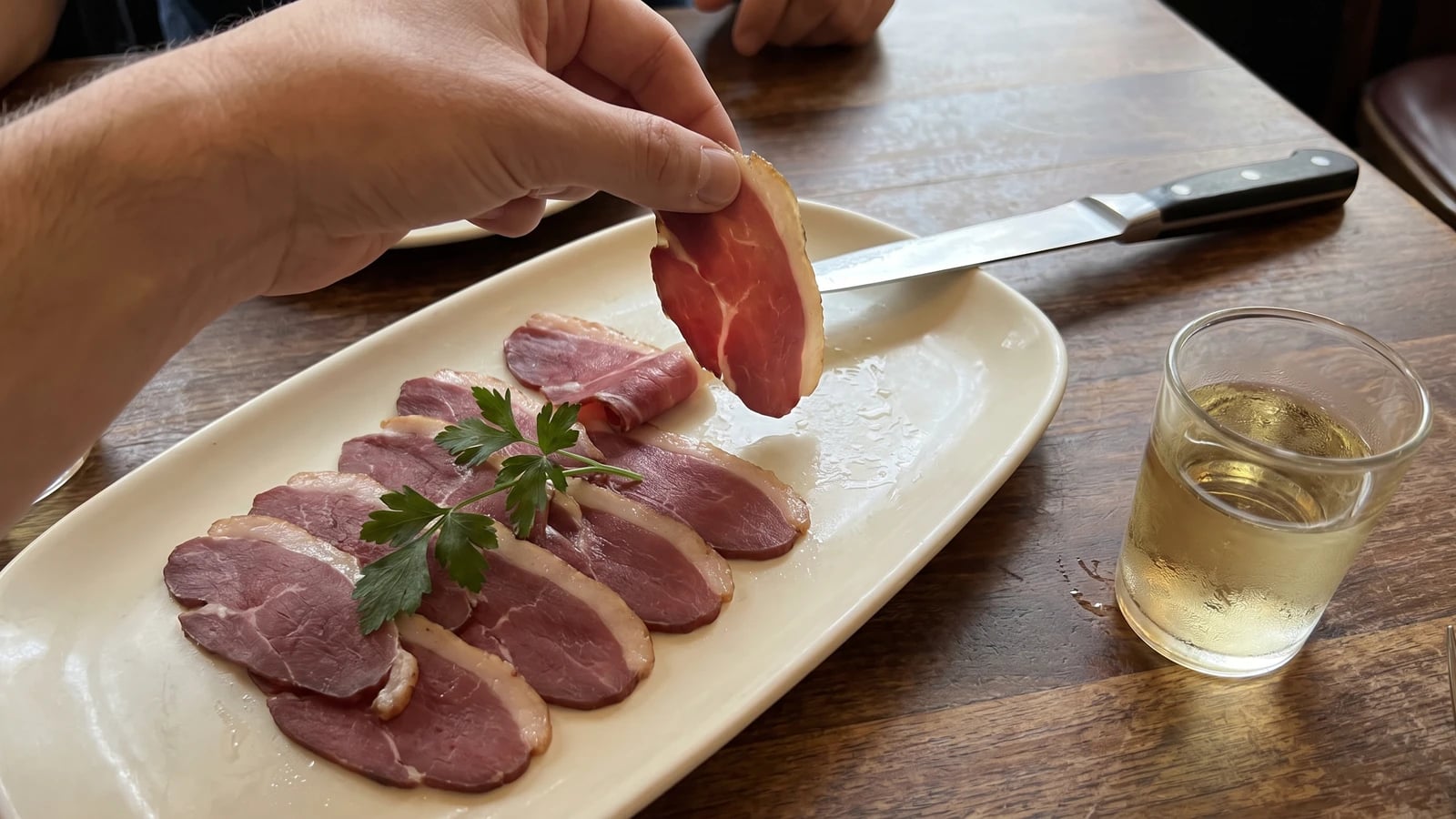
Poitrine d’oie fumée asks for no fire, only a cold breast, a keen knife, and the patience to cut each smoky, rose-colored slice thin enough to fold.
Poitrine d’oie fumée (smoked goose breast) teaches the cold table’s sharpest lesson: slicing is not presentation here, it is the technique. The one true thing to know before you touch a pan is that this dish should never meet one. The cured breast is cut raw, meaning without further cooking, into supple, almost translucent leaves that balance deep smoke, salt, and soft goose fat.
The original instruction assumed a charcutier had already cured and smoked the breast, followed by a practiced hand able to shave it to order. No saucier, stockpot, or salamander belongs here; those are brigade scaffolding for other dishes. The honest home equivalent is a ready-to-eat smoked breast, twenty minutes of firming in the freezer, and the longest sharp knife you own. The only modernization is a stated home quantity: one small 8-ounce breast gives four generous appetizer portions without changing the method.
Keep the pale fat attached and add nothing beyond the very green parsley the source demands. Mustard, pickles, and dressings would smother the clean smoke. The step that decides everything is the cut: work across the grain in long strokes, making each slice thin enough to bend under its own weight.
On the French cold table, poitrine d’oie fumée carries its strongest regional kinship with Alsace, where goose, salting, and smoke share the preserving larder with the region’s other charcuterie. Household preservation passed naturally into the work of charcutiers and then into hors-d’oeuvre service, the breast arriving already finished so the cook’s work was cutting and presentation. In classical instructions, cut raw means served without further cooking after curing and smoking, never untreated goose.
Quantity
1 small breast, 8 oz (225 g)
well chilled
Quantity
8 sprigs
refreshed in ice water and dried thoroughly
| Ingredient | Quantity |
|---|---|
| ready-to-eat cured and smoked goose breastwell chilled | 1 small breast, 8 oz (225 g) |
| very green fresh parsleyrefreshed in ice water and dried thoroughly | 8 sprigs |
Check that the smoked goose breast is labeled ready-to-eat. Remove its wrapping and any inedible casing, but leave the clean pale fat attached; that fat carries the smoke and softens the salt. Wrap the breast loosely in parchment and place it in the freezer for 20 minutes, until firm at the edges but not frozen solid.
While the breast firms, place the parsley in ice water for 5 minutes to restore its color and lift. Drain it and dry it completely between clean towels. The parsley must be very green, as the original directs, but it must also be dry; water droplets dull the surface of the meat.
Set the breast securely on the board and identify the direction of the grain. Slice across it with the knife held at a slight angle, drawing the blade from heel to tip in one long stroke. Aim for slices about 1 mm thick, thin enough to fold without breaking. Do not saw or press downward, which crushes the fat and makes ragged slices. If the meat buckles or tears, stop. Ça se rattrape: return it to the freezer for 10 minutes, wipe and sharpen the blade, then resume with longer, lighter strokes. If it has frozen too hard, leave it on the board for 5 minutes before continuing.
Lay the slices in loose overlapping folds on a chilled platter, exposing both the rose-colored meat and its narrow ivory edge of fat. Tuck the very green parsley around the breast without chopping it or covering the slices. Let the platter stand for 5 minutes so the fat softens slightly, then serve cool rather than numb. The knife has done all the cooking this dish requires. À table!
1 serving (about 58g)
Culinary guides, cultural storytelling, and the editorial depth that makes cooking meaningful.
Discover Culinary ExplorerChef Juliette
Tiny éperlans, lightly floured and fried until their tails stand crisp, arrive in a generous heap on a napkin with fried parsley and grooved lemon, a weeknight lesson in heat and restraint.

Chef Juliette
Brandade de Morue turns salt cod, warm olive oil, and milk into a pale, silky emulsion: keep everything warm and add the oil slowly, then crown the generous dome with butter-fried bread.

Chef Juliette
Salt cod worked warm with cream, one patient spoonful at a time, until the rough flakes become a glossy Nîmes paste, domed generously and ringed with butter-fried croutons for the table.

Chef Juliette
Wine-poached char packed in its earthenware crock beneath butter gold: a make-ahead first course that turns careful cooling, thorough boning, and one unbroken seal into quiet abundance.