
Chef Juliette
Smelt (Éperlans)
Tiny éperlans, lightly floured and fried until their tails stand crisp, arrive in a generous heap on a napkin with fried parsley and grooved lemon, a weeknight lesson in heat and restraint.
A cooking platform built around craft, culture, and the stories behind what we eat.
Created by Chef Juliette
Based on No. 359, Ardennes Ham, from Le Guide Culinaire (1907) by Auguste Escoffier
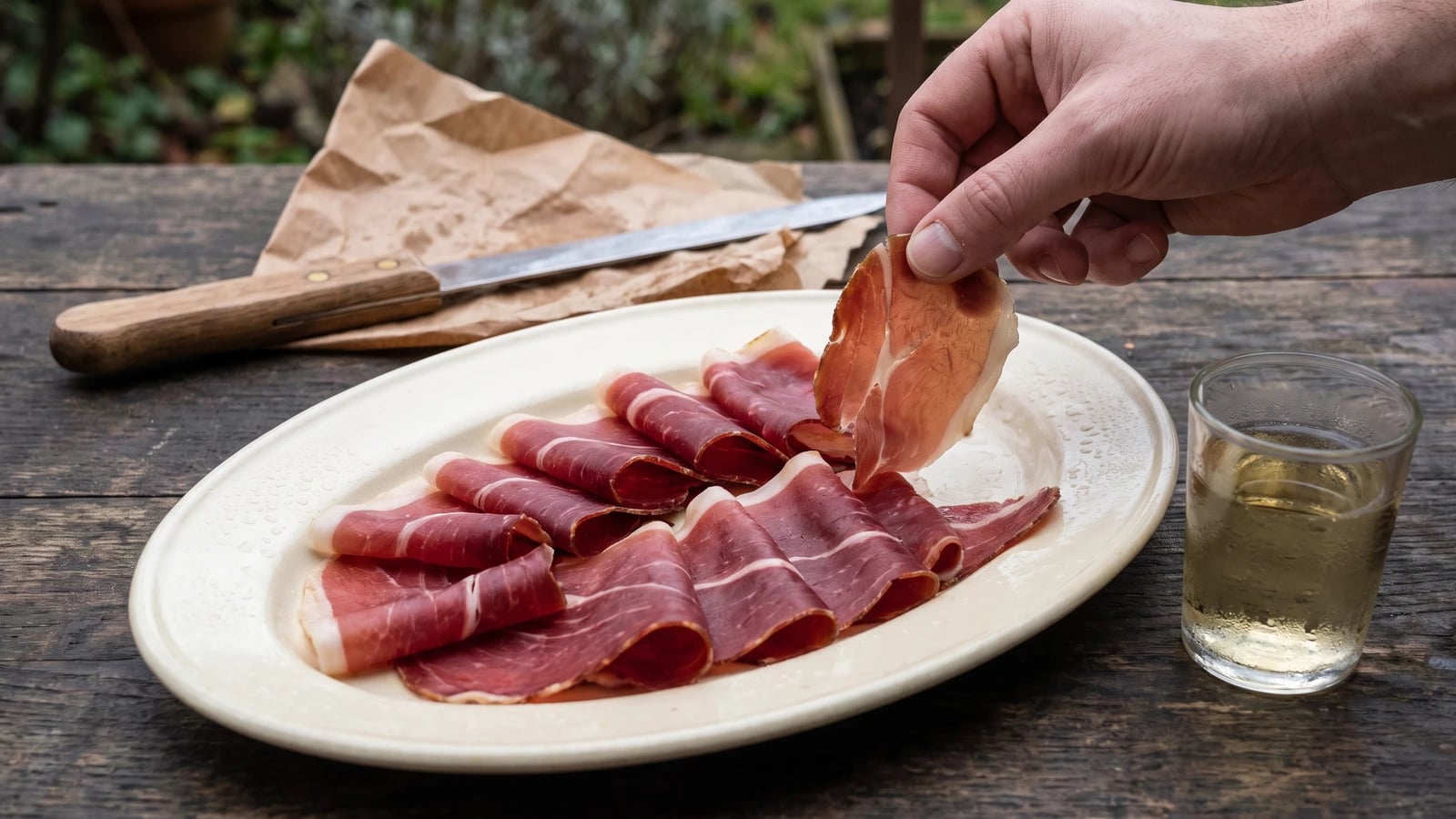
Jambon des Ardennes asks for no cooking and permits no camouflage: chill the cured ham until firm, shave it across the grain, and let each thin slice soften on the tongue.
Jambon des Ardennes (Ardennes dry-cured ham) teaches the discipline of the knife. The one true thing to know is this: thinness is not decoration here, it is the preparation. A slice cut fine enough softens at once, its lean savory and its fat supple; cut thick, the same ham becomes chewy and over-salted. No pan will improve what the knife has failed to do.
The old entry assumed a whole cured ham, a long carving knife, and a hand practiced through service. It needed no saucier, standing stockpot, or salamander, because none belongs here. For one cook, one stove, one evening, the honest equivalent is a 7-ounce piece of ready-cured ham, a thoroughly sharpened knife, and a short chill to firm the fat. Only the scale has changed, and the curing is bought from the charcutier because the book gives a service direction, not a curing formula. The brigade's whole ham is scaffolding; thin, even slicing is the dish.
Slice across the grain with long, unhurried strokes. If the ham buckles or smears, stop and chill it again. Ça se rattrape. Firming the meat before the first cut is the one step that decides the platter.
Ardennes ham belongs to the forested Ardennes massif, spanning the French department of Ardennes and the Belgian and Luxembourg borderlands, where pork is preserved through dry salting, maturing, and local smoking traditions. French jambon sec des Ardennes and Belgian jambon d'Ardenne are close border cousins rather than one uniform product, and smoke is not the defining mark of every French ham from the region. Classical hors-d'oeuvre service borrowed the presentation of smoked goose breast: the cured meat was served without further cooking and cut finely enough for its fat to soften at the table.
Quantity
7 ounces (200 g)
dry-cured, unsliced, and well chilled
| Ingredient | Quantity |
|---|---|
| ready-to-eat Jambon sec des Ardennesdry-cured, unsliced, and well chilled | 7 ounces (200 g) |
Check the label before unwrapping: the ham must be dry-cured and ready to eat. In the source, raw means uncooked after curing, never fresh uncured pork. Remove netting or an inedible casing, then trim away only the tough outer rind and keep the clean ivory fat. Set the ham uncovered on a plate in the freezer for 15 minutes, until the surface feels firm and dry but the center still yields when pressed.
Set the ham securely on its broadest side and look for the direction of the muscle fibers. Position the knife to cut across them, which shortens the fibers and keeps each slice tender. If the piece rocks, cut one thin strip from the underside to make a stable base; a moving ham and a long blade are poor companions.
Draw the full length of the knife through the ham in one long stroke, using little downward pressure. Aim for slices about 1/32 inch (1 mm) thick, nearly translucent at the edges and even from end to end. If the ham buckles, smears, or clings to the blade, don't press harder. Wipe the knife clean and chill the ham for another 10 minutes. Ça se rattrape. Keep finished slices loosely covered with parchment so their surfaces don't dry.
Lay the slices on a cool oval platter in shallow overlapping rows, as you would smoked goose breast, keeping every slice visible rather than rolling it into rosettes. Tuck any torn slice beneath an intact one; nothing is lost. Let the platter stand for 10 minutes, just until the fat loses its chalky refrigerator firmness and gains a soft satin sheen. Serve without sauce or garnish. The ham has already done the seasoning. À table!
1 serving (about 50g)
Culinary guides, cultural storytelling, and the editorial depth that makes cooking meaningful.
Discover Culinary ExplorerChef Juliette
Tiny éperlans, lightly floured and fried until their tails stand crisp, arrive in a generous heap on a napkin with fried parsley and grooved lemon, a weeknight lesson in heat and restraint.

Chef Juliette
Brandade de Morue turns salt cod, warm olive oil, and milk into a pale, silky emulsion: keep everything warm and add the oil slowly, then crown the generous dome with butter-fried bread.

Chef Juliette
Salt cod worked warm with cream, one patient spoonful at a time, until the rough flakes become a glossy Nîmes paste, domed generously and ringed with butter-fried croutons for the table.

Chef Juliette
Wine-poached char packed in its earthenware crock beneath butter gold: a make-ahead first course that turns careful cooling, thorough boning, and one unbroken seal into quiet abundance.