
Chef Juliette
Smelt (Éperlans)
Tiny éperlans, lightly floured and fried until their tails stand crisp, arrive in a generous heap on a napkin with fried parsley and grooved lemon, a weeknight lesson in heat and restraint.
A cooking platform built around craft, culture, and the stories behind what we eat.
Created by Chef Juliette
Based on No. 344, Karoly Éclairs, from Le Guide Culinaire (1907) by Auguste Escoffier
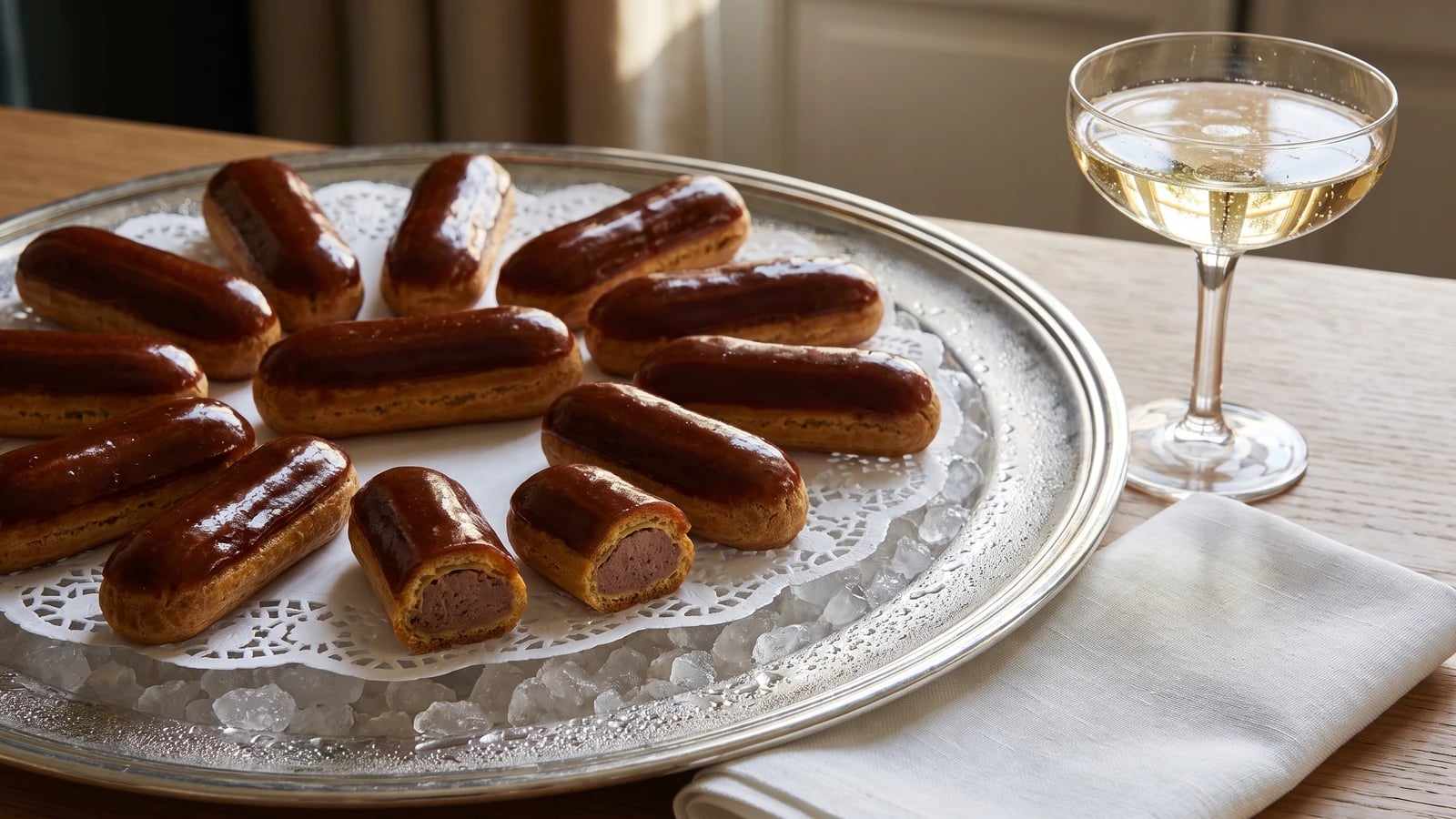
Éclairs Karoly turn pâte à choux into a cold game showpiece: Champagne-scented woodcock offal inside, brown chaud-froid outside, and a clear veil of game jelly that must gleam, never clump.
Éclairs Karoly (little savory choux filled with woodcock offal) teach the discipline of cold glazing. Three textures must remain distinct: a dry shell, a butter-soft purée, and two smooth coats that set without soaking the pastry. The one truth to know before touching a pan is this: each component must be properly cold before it meets the next.
The original formula assumed a pastry cook's tray of éclairs, a game larder, a saucier holding brown chaud-froid and game jelly, and enough hands to glaze a banquet platter. At home, one small batch of pâte à choux replaces the pastry station, while a concentrated game stock supplies both coatings. The old word entrails also covered parts no prudent home cook should serve without professional inspection. Here it means the edible giblets, liver, heart, and cleaned gizzard, from legally obtained woodcock; the intestines and gallbladder are excluded because their safe cleaning cannot be assured at the kitchen table. That is the only change of substance, and it is made plainly.
The brigade quantities and elaborate paper ornament are scaffolding, so they can go. The Champagne-scented, buttered purée, brown chaud-froid, clear game jelly, and iced service are the dish, so they stay. One cook, one stove, one evening. Most of all, do not brush on the clear jelly until the brown coat is fully cold and firm.
Éclairs Karoly belong to the Parisian grand-kitchen register of cold game hors d'oeuvre rather than to any single French region. Their form borrows the familiar pastry éclair for savory choux, then follows the classical cold-service sequence of seasoned game offal, brown chaud-froid, and a final masking of game jelly. Karoly suggests a personal dedication, but the formula identifies no namesake, so claims of a Hungarian origin go further than the dish itself permits.
Quantity
1/2 cup (120 ml / 120 g)
Quantity
4 tablespoons (60 ml / 57 g)
cubed
Quantity
1/2 cup plus 2 tablespoons (150 ml / 75 g)
sifted
Quantity
2 (about 1/2 cup / 100 g without shells)
beaten
Quantity
about 1/2 cup (120 ml / 70 g), from 4 legally obtained woodcocks
livers, hearts, and cleaned gizzards only
Quantity
4 tablespoons (60 ml / 57 g)
divided
Quantity
1/4 cup (60 ml / 60 g)
Quantity
2 cups (480 ml / 480 g)
well strained and divided
Quantity
1 tablespoon (15 ml / 14 g)
Quantity
1 tablespoon (15 ml / 8 g)
Quantity
1 teaspoon (5 ml / 3 g)
Quantity
2 tablespoons (30 ml / 30 g)
Quantity
1 1/2 teaspoons (7.5 ml / 5 g)
Quantity
2 tablespoons (30 ml / 30 g)
Quantity
3/4 teaspoon (3.75 ml / 4.5 g), plus more as needed
divided
Quantity
1 small pinch
Quantity
4 cups (1 L / 900 g)
| Ingredient | Quantity |
|---|---|
| water, for the pâte à choux | 1/2 cup (120 ml / 120 g) |
| unsalted butter, for the pâte à chouxcubed | 4 tablespoons (60 ml / 57 g) |
| plain flour, for the pâte à chouxsifted | 1/2 cup plus 2 tablespoons (150 ml / 75 g) |
| large eggsbeaten | 2 (about 1/2 cup / 100 g without shells) |
| edible woodcock gibletslivers, hearts, and cleaned gizzards only | about 1/2 cup (120 ml / 70 g), from 4 legally obtained woodcocks |
| unsalted butter, for the fillingdivided | 4 tablespoons (60 ml / 57 g) |
| brut Champagne | 1/4 cup (60 ml / 60 g) |
| strong, unsalted game stockwell strained and divided | 2 cups (480 ml / 480 g) |
| unsalted butter, for the brown chaud-froid | 1 tablespoon (15 ml / 14 g) |
| plain flour, for the brown chaud-froid | 1 tablespoon (15 ml / 8 g) |
| powdered gelatin, for the brown chaud-froid | 1 teaspoon (5 ml / 3 g) |
| cold water, for blooming the brown chaud-froid gelatin | 2 tablespoons (30 ml / 30 g) |
| powdered gelatin, for the game jelly | 1 1/2 teaspoons (7.5 ml / 5 g) |
| cold water, for blooming the game-jelly gelatin | 2 tablespoons (30 ml / 30 g) |
| fine saltdivided | 3/4 teaspoon (3.75 ml / 4.5 g), plus more as needed |
| finely ground white pepper | 1 small pinch |
| crushed ice, for the serving platter | 4 cups (1 L / 900 g) |
Clear space in a refrigerator held at 4°C or colder and prepare a bowl of ice water for cooling the purée and sauces. Examine the woodcock giblets under strong light, removing connective tissue, blood clots, feathers, and any shot fragments. Use only the livers, hearts, and thoroughly cleaned gizzards; discard the intestinal tract, gallbladder, and any liver marked by green bile. Keep the giblets covered and cold until the pan is ready.
Heat the oven to 220°C. Put the water, choux butter, and 1/4 teaspoon of the salt in a 2-quart saucepan. Bring to a full boil so the butter is completely melted, add the sifted flour at once, and beat firmly with a wooden spoon until the panade, the cooked flour paste, gathers into a ball. Continue over medium heat for 2 minutes, turning the dough against the pan until a thin film forms on the bottom. Transfer it to a bowl and let it cool for 3 minutes.
Beat in the eggs a little at a time, holding back the final spoonful until you judge the texture. The finished dough should be glossy and fall from the spoon in a heavy V; if it tears away in a lump, add the reserved egg by teaspoons. Pipe twelve logs about 7 cm long and 1.5 cm wide onto a parchment-lined tray, spacing them well apart. Smooth their points with a wet fingertip. Bake for 10 minutes, lower the oven to 190°C, and bake for another 18 to 22 minutes without opening the door during the first 20 minutes. The shells are ready when deeply golden, light in the hand, and hollow-sounding underneath. Pierce both ends, then dry them for 5 to 8 minutes at 160°C before cooling completely on a rack. If they soften as they cool, return them to the 160°C oven for 5 minutes. Ça se rattrape.
Finely chop the hearts and cleaned gizzards, keeping the livers separate. Melt 1 tablespoon of the filling butter in a small sauté pan and cook the hearts and gizzards over medium heat for 3 minutes without scorching. Add 1/4 cup of the game stock, cover, and cook gently for 10 minutes. Uncover, add the livers and Champagne, then cook until the liquid has reduced to a moist glaze and every piece of offal has reached 74°C. Blend immediately until smooth, then work in the remaining 3 tablespoons of cold filling butter a piece at a time. Season lightly with 1/4 teaspoon salt and the white pepper, push the purée through a fine sieve, and cool it rapidly over the ice bath. If it looks grainy, blend in 1 teaspoon of warm game stock followed by a small piece of cold butter. Ça se rattrape.
Chill the purée until firm enough to pipe but still supple. Fit a piping bag with a narrow plain tip and use the holes at the ends of each cold éclair to fill it from both directions. Stop when the shell feels evenly weighted and the purée just reaches the openings; overfilling splits the dry choux. Wipe the ends clean and refrigerate the filled éclairs while you make the coating.
Bloom the brown chaud-froid gelatin in its cold water for 5 minutes. Melt the chaud-froid butter in a small saucepan, stir in the flour, and cook the roux over medium-low heat until it reaches a deep hazelnut brown and smells toasted, about 4 minutes. Gradually whisk in 1 cup of game stock, scraping the corners of the pan, then simmer gently for 10 to 12 minutes until the sauce naps the back of a spoon. Remove it from the heat, dissolve in the bloomed gelatin, season with about 1/8 teaspoon salt, and strain. Cool over ice, stirring, until it reaches roughly 28°C and falls in a thick, continuous ribbon. If it sets too firmly, warm it over barely warm water; if it runs like broth, cool it another few minutes. Do not add raw flour.
Set the filled éclairs on a rack over a clean tray. Spoon the brown chaud-froid evenly over each one, covering the top and sides in a thin, opaque coat. Let the excess fall away, then refrigerate for at least 20 minutes, until the coating is dry to a gentle fingertip and no longer tacky. If the sauce slides off transparently, the éclairs or the sauce were too warm; collect the drips, cool both components, and coat them again.
Bloom the game-jelly gelatin in its cold water for 5 minutes. Bring the remaining 3/4 cup game stock to a bare simmer, skim the surface carefully, and reduce it to about 2/3 cup. Remove it from the heat, dissolve in the bloomed gelatin, taste for salt, and pass it through a fine cloth or coffee filter without pressing. Cool it over ice until clear, glossy, and slightly syrupy. If it begins setting into threads in the bowl, place the bowl over barely warm water and stir just until fluid again. Never boil gelatin after adding it.
Brush one thin, complete layer of the syrupy game jelly over each firmly chilled éclair. Refrigerate for 45 minutes, until the jelly forms a clear, smooth mask over the brown chaud-froid. Line a chilled serving platter with a restrained white paper lace or clean parchment, set it over a shallow tray of crushed ice, and arrange the éclairs in loose rows. Keep them thoroughly cold and bring them to the table within an hour. À table!
1 serving (about 170g)
Culinary guides, cultural storytelling, and the editorial depth that makes cooking meaningful.
Discover Culinary ExplorerChef Juliette
Tiny éperlans, lightly floured and fried until their tails stand crisp, arrive in a generous heap on a napkin with fried parsley and grooved lemon, a weeknight lesson in heat and restraint.

Chef Juliette
Brandade de Morue turns salt cod, warm olive oil, and milk into a pale, silky emulsion: keep everything warm and add the oil slowly, then crown the generous dome with butter-fried bread.

Chef Juliette
Salt cod worked warm with cream, one patient spoonful at a time, until the rough flakes become a glossy Nîmes paste, domed generously and ringed with butter-fried croutons for the table.

Chef Juliette
Wine-poached char packed in its earthenware crock beneath butter gold: a make-ahead first course that turns careful cooling, thorough boning, and one unbroken seal into quiet abundance.