
Chef Juliette
Smelt (Éperlans)
Tiny éperlans, lightly floured and fried until their tails stand crisp, arrive in a generous heap on a napkin with fried parsley and grooved lemon, a weeknight lesson in heat and restraint.
A cooking platform built around craft, culture, and the stories behind what we eat.
Created by Chef Juliette
Based on No. 343, Norwegian Duchesses, from Le Guide Culinaire (1907) by Auguste Escoffier
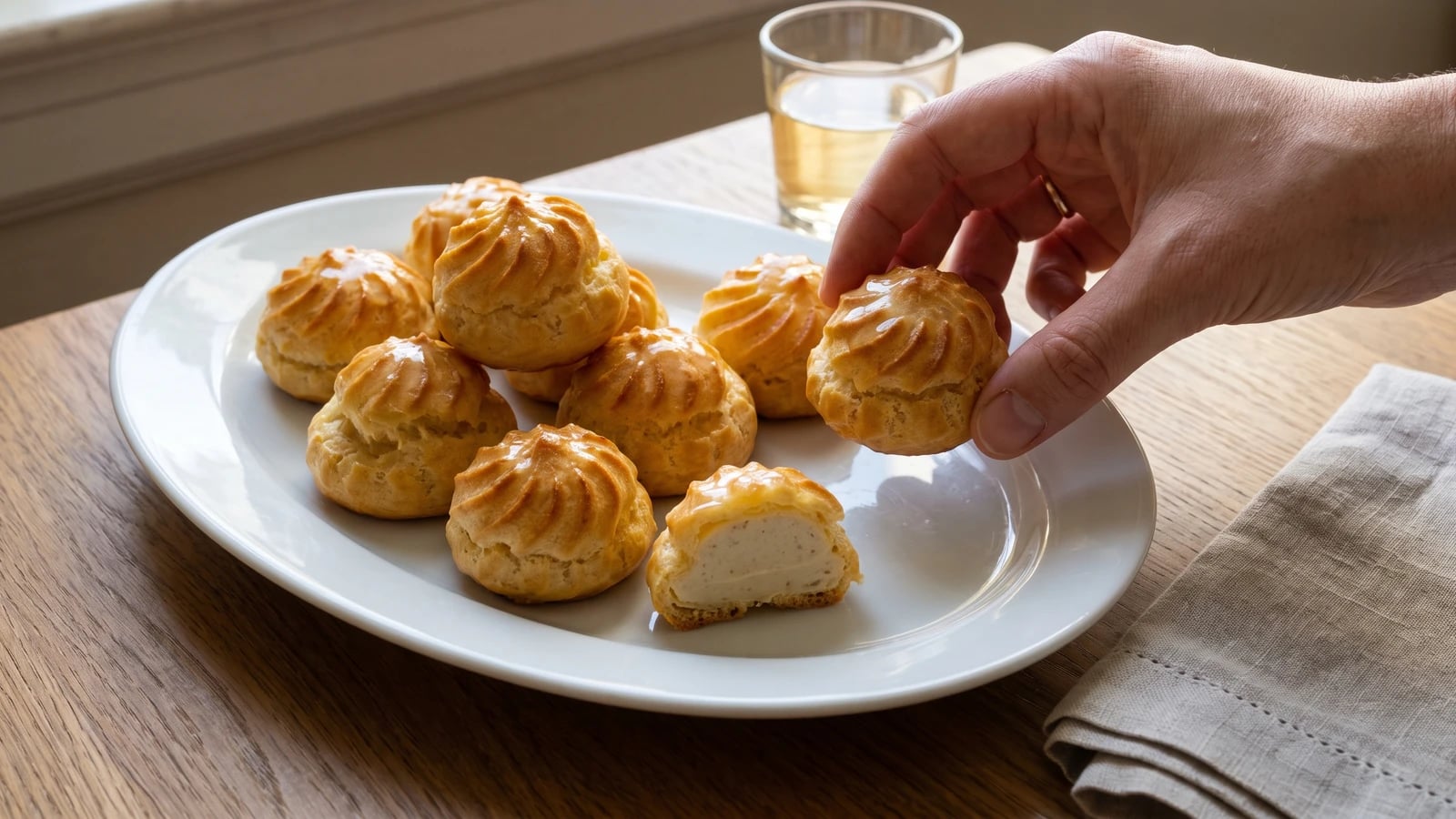
Little golden choux filled with a smooth Kilkis-and-butter purée and brushed with clear savory jelly, a French cold-larder bite whose success depends on dry shells and cool fillings.
Duchesses norvégiennes (little Norwegian-style stuffed choux) teach the discipline of temperature. The choux must be dry and completely cool, the Kilkis butter soft enough to pipe but firm enough to hold, and the jelly barely fluid. Warm jelly over warm butter gives you a greasy, sagging mouthful. Cool components give you crisp pastry, a melting center, and a fine translucent glaze.
The original entry assumed a pastry station with ready choux, a garde-manger (cold station) holding fish butter and clear jelly, and enough hands to fill a banquet tray. This home version makes 24 with one saucepan, one oven, and a small processor or sieve. Because the entry supplies no brigade quantity, it uses equal weights of drained Kilkis and butter, enough to form a smooth, distinctly fish-led purée. Separate stations and hundreds of pieces were scaffolding. The choux, the Kilkis-and-butter purée, and the jelly glaze are the dish, so none disappear.
When they are right, the little crowns are deep butter-gold, hollow beneath the crust, and glossy with the thinnest coat of jelly. The cured sprat strikes first, then the butter rounds the salt and smoke. Dry the choux until their bases feel firm and their centers hollow before you fill them. That is the step that decides the dish.
Duchesses norvégiennes belong to the French classical cold hors-d'oeuvre table, where filled and glazed choux were served as bouchées (small bites). The name points to the cured Norwegian sprat in the filling, not to a Norwegian pastry tradition; French menus often named a preparation for the imported fish or garnish that gave it character. The clear jelly coat comes from garde-manger practice, sealing and polishing the bite while leaving the choux recognizable beneath it.
Quantity
½ cup (120 ml / 120 g)
Quantity
4 tablespoons (60 ml / 57 g)
cut into pieces
Quantity
¼ teaspoon (1.25 ml / 1.5 g)
Quantity
½ cup plus 1 tablespoon (135 ml / 75 g)
sifted
Quantity
2 (about 100 g without shells)
beaten
Quantity
¾ cup (180 ml / 115 g)
drained and patted thoroughly dry
Quantity
½ cup (120 ml / 115 g)
softened but still cool
Quantity
½ cup (120 ml / 120 g)
fully set
| Ingredient | Quantity |
|---|---|
| water | ½ cup (120 ml / 120 g) |
| unsalted buttercut into pieces | 4 tablespoons (60 ml / 57 g) |
| fine sea salt | ¼ teaspoon (1.25 ml / 1.5 g) |
| all-purpose floursifted | ½ cup plus 1 tablespoon (135 ml / 75 g) |
| large eggsbeaten | 2 (about 100 g without shells) |
| Kilkis cured Norwegian spratsdrained and patted thoroughly dry | ¾ cup (180 ml / 115 g) |
| unsalted buttersoftened but still cool | ½ cup (120 ml / 115 g) |
| clear savory jellyfully set | ½ cup (120 ml / 120 g) |
Heat the oven to 400°F (200°C). Line a heavy baking sheet with parchment and fit a piping bag with a ½-inch (12 mm) plain tip. Have the flour sifted, the eggs beaten, and a wooden spoon or stiff spatula ready before the saucepan meets the heat; choux waits for no rummaging.
Put the water, 4 tablespoons butter, and salt in a 2-quart saucepan. Bring them to a full boil so the butter is completely melted, then remove the pan from the heat and add all the flour at once. Beat firmly until no dry flour remains. Return the pan to medium heat and stir for about 2 minutes, until the paste gathers into a smooth ball and leaves a thin film on the pan floor. This drying gives the Choux enough structure to rise and stay hollow.
Let the panade cool for 2 minutes, then beat in the egg in four additions, holding back the final spoonful. Each addition will make the paste look slippery and broken before it becomes smooth again. Keep beating and don't add more egg until the last addition has disappeared. Ça se rattrape. Add only enough of the reserved egg for the paste to turn glossy and fall from the spoon in a heavy V; if it already does, leave the remaining egg out.
Pipe 24 mounds about 1¼ inches (3 cm) wide, leaving space between them. Flatten any sharp peaks with a damp fingertip. Bake for 15 minutes without opening the door, then lower the oven to 350°F (175°C) and bake for another 10 to 13 minutes, until the choux are deep gold and firm underneath. Pierce each base with the tip of a small knife and return them to the switched-off oven with its door ajar for 5 minutes. If they begin to soften or sink, return them to 350°F (175°C) for 5 to 8 minutes. Pale choux are underbaked choux, and more drying will rescue them. Cool completely on a rack.
Put the thoroughly dried Kilkis in a small processor and work them to a paste, scraping the bowl often. Add the softened butter a spoonful at a time and process until the purée is smooth, pale, and firm enough to hold a ridge. For the finest texture, press it through a fine sieve. If it turns oily, the butter became too warm. Chill it for 10 minutes, then beat again until smooth. Ça se rattrape. Transfer the purée to a piping bag fitted with a small plain tip.
Warm the clear savory jelly over the gentlest heat only until it becomes liquid. Do not boil it. Remove it from the heat and stir occasionally until it is cool but still fluid, with enough body to coat the back of a spoon in a thin film. If it sets before you finish, warm it again briefly. If it feels warm against your wrist, wait; jelly that is too warm will melt the butter filling.
Make a small opening in the base of each completely cooled choux. Pipe in the Kilkis purée until the shell feels noticeably heavier but has not begun to split. Wipe the bases clean and set the filled choux upright. If the purée has become too firm to pipe, leave the bag at cool room temperature for 5 minutes and knead it gently with your hands.
Hold each duchesse by its base and dip the crown into the barely fluid jelly, allowing the excess to run back into the pan. The glaze should be thin enough to show the golden choux beneath it. Set the duchesses upright and chill them uncovered for 15 minutes, just until the jelly firms, then cover loosely. Let them stand outside the refrigerator for 10 minutes before serving so the butter filling loses its chill while keeping its shape. À table!
1 serving (about 100g)
Culinary guides, cultural storytelling, and the editorial depth that makes cooking meaningful.
Discover Culinary ExplorerChef Juliette
Tiny éperlans, lightly floured and fried until their tails stand crisp, arrive in a generous heap on a napkin with fried parsley and grooved lemon, a weeknight lesson in heat and restraint.

Chef Juliette
Brandade de Morue turns salt cod, warm olive oil, and milk into a pale, silky emulsion: keep everything warm and add the oil slowly, then crown the generous dome with butter-fried bread.

Chef Juliette
Salt cod worked warm with cream, one patient spoonful at a time, until the rough flakes become a glossy Nîmes paste, domed generously and ringed with butter-fried croutons for the table.

Chef Juliette
Wine-poached char packed in its earthenware crock beneath butter gold: a make-ahead first course that turns careful cooling, thorough boning, and one unbroken seal into quiet abundance.