
Chef Juliette
Smelt (Éperlans)
Tiny éperlans, lightly floured and fried until their tails stand crisp, arrive in a generous heap on a napkin with fried parsley and grooved lemon, a weeknight lesson in heat and restraint.
A cooking platform built around craft, culture, and the stories behind what we eat.
Created by Chef Juliette
Based on No. 340, Duchesses à la Sultane, from Le Guide Culinaire (1907) by Auguste Escoffier
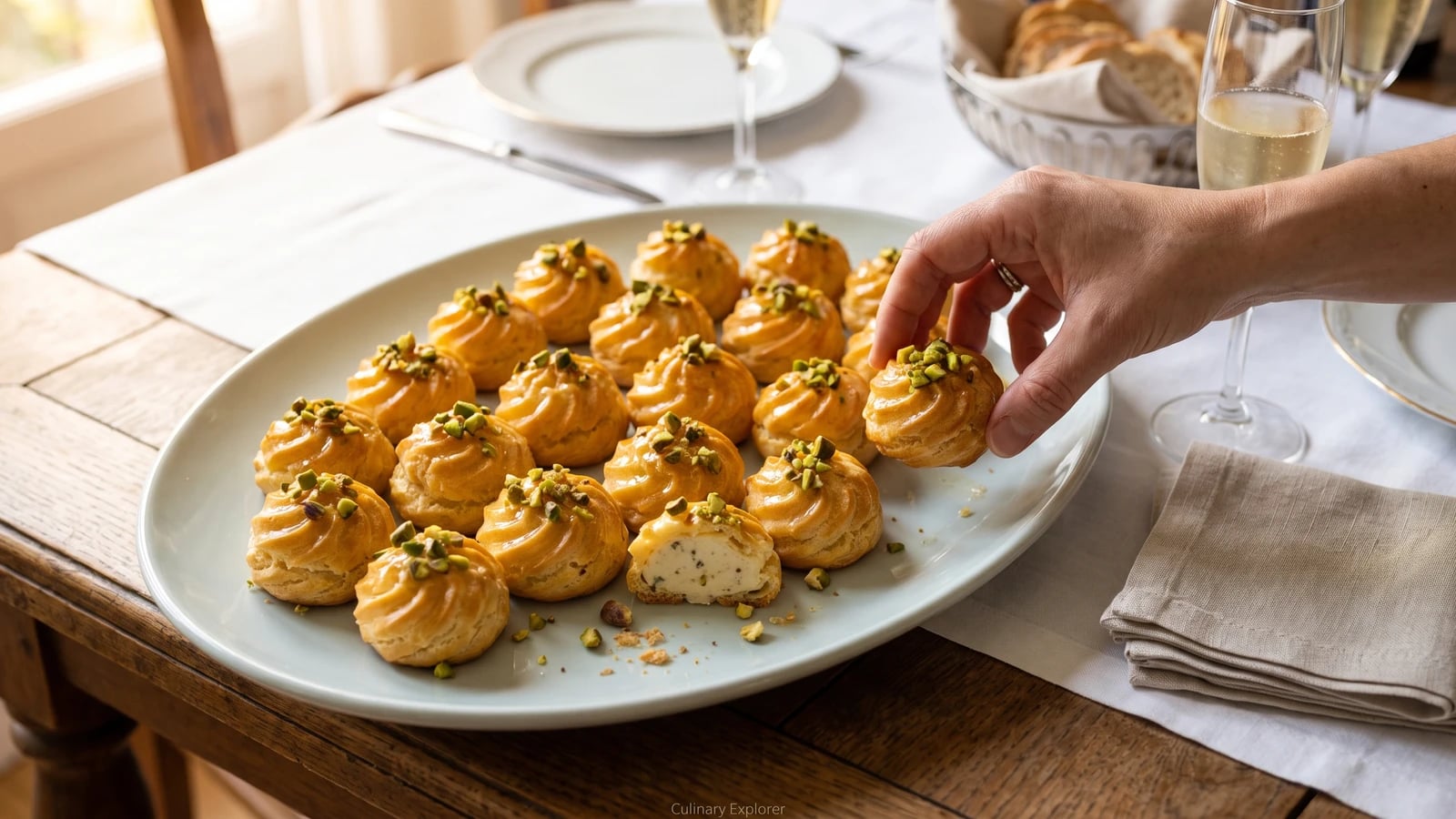
Tiny choux with crisp, hollow shells, a satin fowl purée enriched by pistachio butter, and a clear jelly gloss under chopped pistachios: green on green, made for passing with drinks.
Duchesses à la Sultane (little choux filled with pistachio fowl purée) teaches control of moisture in miniature. Before touching a pan, know this: the choux must be baked hollow and dry, because no filling or glaze can make a damp shell light.
The old formula assumed a pastry station, cooked fowl on hand, a stock never off the fire, pistachio butter worked in a mortar, and a garde-manger with clarified jelly waiting. Your home equivalent is one chicken breast gently poached in good stock, a small processor in place of the mortar and sieve, and gelatin to give that stock a clean, delicate set. The separate kitchen stations were brigade scaffolding, so they go. The little choux, the fowl purée completed with pistachio butter, the jelly glaze, and the chopped pistachios are the dish, so every one stays.
What changes is the scale and labor, not the intent: twenty-four generous bites, made by one cook, one stove, one evening. Dry the panade until a film forms across the saucepan before you add the first egg. That hollow shell is the foundation for everything that follows.
Duchesses à la Sultane belong to the Parisian grand-kitchen tradition of cold hors d'oeuvre, where pâte à choux became an edible case for finely pounded poultry and aspic supplied the polished finish. The title does not place the dish in a French region or at an Ottoman household table; here à la Sultane names its pistachio character, green worked through the butter and repeated over the glaze. From formal dining rooms, such filled choux passed naturally onto bourgeois reception buffets, where their make-ahead nature and one-bite scale suited a gathering.
Quantity
½ cup (120 ml / 120 g)
Quantity
3½ tablespoons (52 ml / 50 g)
cut into pieces
Quantity
¼ teaspoon (1.25 ml / 1.5 g)
Quantity
⅝ cup (150 ml / 75 g)
sifted
Quantity
2 large eggs (about 100 g out of shell)
beaten
Quantity
¾ cup (180 ml / 100 g)
divided
Quantity
4 tablespoons (60 ml / 56 g)
softened
Quantity
2 cups (480 ml / 480 g)
Quantity
10 ounces (285 g)
Quantity
⅓ cup (80 ml / 80 g)
well chilled
Quantity
¾ teaspoon (3.75 ml / 4.5 g)
Quantity
⅛ teaspoon (0.6 ml / 0.25 g)
Quantity
1¼ teaspoons (6 ml / 4 g)
| Ingredient | Quantity |
|---|---|
| water | ½ cup (120 ml / 120 g) |
| unsalted butter for the chouxcut into pieces | 3½ tablespoons (52 ml / 50 g) |
| fine salt for the choux | ¼ teaspoon (1.25 ml / 1.5 g) |
| all-purpose floursifted | ⅝ cup (150 ml / 75 g) |
| large eggsbeaten | 2 large eggs (about 100 g out of shell) |
| blanched unsalted pistachiosdivided | ¾ cup (180 ml / 100 g) |
| unsalted butter for the pistachio buttersoftened | 4 tablespoons (60 ml / 56 g) |
| clear unsalted chicken stock | 2 cups (480 ml / 480 g) |
| boneless, skinless chicken breast | 10 ounces (285 g) |
| heavy creamwell chilled | ⅓ cup (80 ml / 80 g) |
| fine salt for the filling | ¾ teaspoon (3.75 ml / 4.5 g) |
| ground white pepper | ⅛ teaspoon (0.6 ml / 0.25 g) |
| unflavored powdered gelatin | 1¼ teaspoons (6 ml / 4 g) |
Set aside ¼ cup (60 ml / 30 g) of the pistachios and chop them finely for the finish. Grind the remaining ½ cup (120 ml / 70 g) in a mini processor until very fine, stopping before they turn oily. Add the softened butter and process to a smooth, pale-green paste. Scrape the pistachio butter into a small bowl and keep it cool but pliable.
Put the chicken breast and stock in a small saucepan. Bring the liquid just to a tremble over medium-low heat, then lower the heat and poach gently until the thickest part of the chicken reaches 165°F (74°C), about 12 to 16 minutes. A boil tightens the meat and gives you a grainy purée, so keep the surface quiet. Lift out the chicken and let it cool. Strain the stock, reserve 2 tablespoons (30 ml / 30 g) for the filling, then reduce 1 cup (240 ml / 240 g) of the remaining stock to ¾ cup (180 ml / 180 g) for the jelly. Cool the reduced stock completely.
Heat the oven to 425°F (220°C) with a rack in the center. Bring the water, choux butter, and salt to a full boil in a medium saucepan. Take the pan off the heat, add all the flour at once, and beat firmly with a wooden spoon until no dry flour remains. Return it to medium heat and stir for 2 to 3 minutes, until the panade gathers into a smooth ball and leaves a thin film across the bottom of the pan. This drying is the step that makes room for the eggs and gives the choux their hollow center.
Let the panade cool for 3 minutes, then beat in the egg a little at a time, fully incorporating each addition before the next. Hold back the final spoonful until you check the texture: the dough should be glossy and fall from the spoon in a heavy V, not pour like batter. If it remains stiff, add the reserved egg by teaspoons. Pipe twenty-four rounds about 1¼ inches (3 cm) wide onto a parchment-lined sheet pan, leaving room between them, then smooth the points with a damp fingertip.
Bake for 10 minutes without opening the oven, then reduce the heat to 375°F (190°C) and bake for another 14 to 18 minutes. The choux are ready when they are evenly golden, firm at the sides, and light for their size. Pierce each one near the base with a skewer, return them to the turned-off oven with the door slightly open, and let them dry for 8 minutes. Cool completely on a rack. If any shells begin to sag, return them to a 325°F (165°C) oven for 8 minutes, then cool again; a little more drying restores them.
Cut the cooled chicken into small pieces and process it with the reserved 2 tablespoons of stock until finely ground. Add the cold cream gradually and process until the purée is smooth, thick, and soft enough to pipe. Press it through a fine-mesh sieve for the classical silk, then beat in the pistachio butter, salt, and white pepper. The pistachio butter goes in last because it completes the fowl purée rather than replacing it. If the filling feels loose, chill it for 20 minutes before judging it; the butter will firm, and the purée should hold a soft peak without becoming heavy.
Put 2 tablespoons (30 ml / 30 g) of the cold reduced stock in a bowl, sprinkle the gelatin evenly over it, and leave it for 5 minutes. Warm the remaining reduced stock until hot but not boiling, then stir in the bloomed gelatin until completely dissolved. Strain it and set the bowl over ice, stirring occasionally, until the jelly lightly coats a pastry brush like thin syrup. If it sets solid, warm the bowl over barely warm water; if it runs straight off the brush, return it to the ice. Ça se rattrape.
Make a small opening in the base of each cooled chou with a paring knife. Transfer the cold fowl purée to a piping bag fitted with a narrow plain tip and fill each shell until it feels satisfyingly heavy, without forcing it until it splits. If a base cracks, cut a small lid from the top, spoon in the filling, and replace the lid; the jelly will soften the seam.
Arrange the filled choux on a rack over a tray. Brush each one with a thin, complete coat of the syrupy poultry jelly, then immediately sprinkle a little chopped pistachio over its crown before the glaze sets. Chill for 20 minutes, just until the jelly is clear and firm. Serve cool rather than numbingly cold, preferably within 3 hours of filling. À table!
1 serving (about 130g)
Culinary guides, cultural storytelling, and the editorial depth that makes cooking meaningful.
Discover Culinary ExplorerChef Juliette
Tiny éperlans, lightly floured and fried until their tails stand crisp, arrive in a generous heap on a napkin with fried parsley and grooved lemon, a weeknight lesson in heat and restraint.

Chef Juliette
Brandade de Morue turns salt cod, warm olive oil, and milk into a pale, silky emulsion: keep everything warm and add the oil slowly, then crown the generous dome with butter-fried bread.

Chef Juliette
Salt cod worked warm with cream, one patient spoonful at a time, until the rough flakes become a glossy Nîmes paste, domed generously and ringed with butter-fried croutons for the table.

Chef Juliette
Wine-poached char packed in its earthenware crock beneath butter gold: a make-ahead first course that turns careful cooling, thorough boning, and one unbroken seal into quiet abundance.