
Chef Juliette
Smelt (Éperlans)
Tiny éperlans, lightly floured and fried until their tails stand crisp, arrive in a generous heap on a napkin with fried parsley and grooved lemon, a weeknight lesson in heat and restraint.
A cooking platform built around craft, culture, and the stories behind what we eat.
Created by Chef Juliette
Based on No. 338, Nantua Duchesses, from Le Guide Culinaire (1907) by Auguste Escoffier
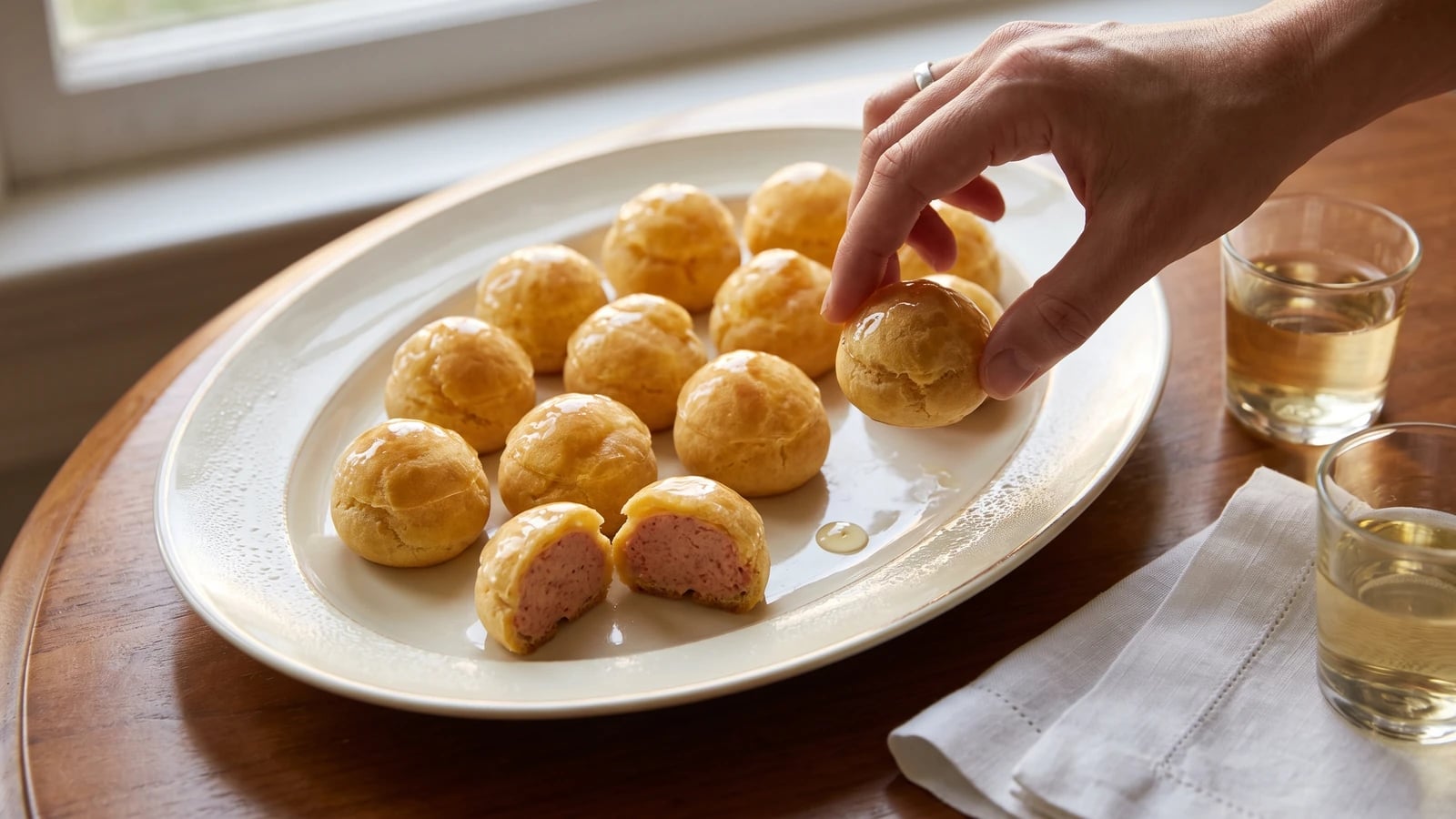
Petite Choux hide a rose crayfish purée beneath layer after layer of clear gelée. The lesson is temperature and patience: each transparent film must set before the next one goes on.
Duchesses Nantua (little crayfish-filled Choux) teach the discipline of glazing with gelée, savory aspic: every coat must be cool, thin, and fully set before the next touches it. One heavy pour makes a rubber casing; warm gelée soaks the shell and slips away. Temperature is the one true thing to settle before you touch a pan.
The old entry assumed a garde-manger, the cold-larder cook, beside a saucier, a stockpot never off the fire, ready gelée, and trays of Choux. A salamander has no work here; this is a cold preparation. At home, one small saucepan, a food processor, clear prepared fish stock strengthened with powdered gelatin, and a refrigerator shelf do the same work for twenty-four pieces. Ready aspic and brigade quantities are scaffolding, so they go. The repeated glazing is the dish, so it stays. One cook, one stove, one evening.
Inside, the purée should taste unmistakably of crayfish, rich with butter and softly pink, not whipped into an airy mousse. Outside, the finished gelée should gleam as a barely visible film. Chill the filled Choux completely before the first spoonful, then give every coat its time in the cold.
Nantua is a town in Ain, east of Lyon, where Lac de Nantua and nearby waterways made écrevisses central to the local table and gave the classical word Nantua its precise meaning: a preparation marked by crayfish. Duchesses Nantua belong to the grand-kitchen garde-manger rather than to Nantua's household repertoire, so the name records the rosy filling, not a local pastry custom. Repeated clear gelée glazing carried the filled Choux into formal cold hors d'oeuvre service beneath a polished protective film.
Quantity
24
about 1¼ inches (3 cm) wide each and completely cooled
Quantity
1½ cups (360 ml / 225 g)
thawed if frozen, drained and pressed dry
Quantity
3 tablespoons (45 ml / 42 g)
softened but still cool
Quantity
¼ cup (60 ml / 60 g)
very cold
Quantity
¾ teaspoon (3.75 ml / 4.5 g)
divided
Quantity
⅛ teaspoon (0.6 ml / 0.3 g)
Quantity
1 pinch
Quantity
2 cups (475 ml / 475 g)
divided
Quantity
2¼ teaspoons (11 ml / 7 g)
| Ingredient | Quantity |
|---|---|
| small baked Chouxabout 1¼ inches (3 cm) wide each and completely cooled | 24 |
| cooked peeled crayfish tail meatthawed if frozen, drained and pressed dry | 1½ cups (360 ml / 225 g) |
| unsalted buttersoftened but still cool | 3 tablespoons (45 ml / 42 g) |
| heavy creamvery cold | ¼ cup (60 ml / 60 g) |
| fine sea saltdivided | ¾ teaspoon (3.75 ml / 4.5 g) |
| finely ground white pepper | ⅛ teaspoon (0.6 ml / 0.3 g) |
| cayenne pepper | 1 pinch |
| clear unsalted fish stockdivided | 2 cups (475 ml / 475 g) |
| unflavored powdered gelatin | 2¼ teaspoons (11 ml / 7 g) |
Pour ¼ cup (60 ml) of the cold fish stock into a small bowl and sprinkle the gelatin evenly over it. Leave it undisturbed for 5 minutes, until every grain has swollen. Heat the remaining 1¾ cups (415 ml) of stock with ¼ teaspoon of the salt until hot but never boiling, then remove it from the heat and stir in the bloomed gelatin until completely dissolved. Strain through a dampened fine cloth or a very fine sieve into a shallow bowl. Chill for at least 1 hour, until fully set.
Press the crayfish meat between clean towels until no surface moisture remains. Process it to a fine paste, scraping down the bowl several times. Add the butter in three portions, then the remaining ½ teaspoon salt, white pepper, and cayenne. Pulse in the cold cream a spoonful at a time, stopping as soon as the purée is smooth, rosy, and firm enough to hold a soft peak. Force it through a fine-mesh sieve. If the butter turns oily because the mixture has warmed, spread the purée in a shallow dish, chill it for 10 minutes, and beat it briefly until smooth again.
Turn each finished Choux over and cut a neat opening about ⅜ inch (1 cm) wide in its base. Pull out only any damp web of pastry blocking the cavity; leave the crisp walls intact. The shells must feel dry and feather-light. If they have softened, refresh them for 5 minutes in a 325°F (160°C) oven, then cool them completely before filling.
Transfer the crayfish purée to a piping bag fitted with a ⅜-inch (1 cm) plain tip. Pipe it into each Choux until the shell feels pleasantly weighted and the filling reaches the opening, but stop before the shell strains or cracks. Wipe the bases clean, arrange the Choux opening-side down on a chilled tray, and refrigerate them uncovered for 20 minutes. Their surfaces must be cold and dry before glazing.
Stand the bowl of set gelée over warm water and stir just until it becomes liquid, then remove it immediately. Let it cool to 65 to 68°F (18 to 20°C), when it runs from a spoon like light syrup but still feels cool. If solid pieces remain, warm it for a few seconds more; if it flows like water, chill it for 5 minutes. This cold-melted consistency lets the gelée cling without soaking the Choux.
Set the chilled Choux on a wire rack over a cold rimmed tray. Using a teaspoon, sprinkle a scant spoonful of gelée over each crown and let it flow naturally down the sides. Refrigerate for 8 to 10 minutes, until the first film no longer feels tacky, then repeat for 4 to 6 coats. If the gelée slides off, either it or the Choux is too warm. Ça se rattrape: chill both for 10 minutes and resume. If the gelée thickens in the bowl, loosen it over warm water rather than laying on one heavy coat. The final film should be even, transparent, and almost too thin to see.
Chill the finished Duchesses for 30 minutes so the last coat sets firmly. Lift them from the rack with a small offset spatula and arrange them on a chilled platter without garnish; the butter-gold Choux, rose filling, and clear film are the whole presentation. Serve within 6 hours, while the shells still retain some delicacy. À table!
1 serving (about 115g)
Culinary guides, cultural storytelling, and the editorial depth that makes cooking meaningful.
Discover Culinary ExplorerChef Juliette
Tiny éperlans, lightly floured and fried until their tails stand crisp, arrive in a generous heap on a napkin with fried parsley and grooved lemon, a weeknight lesson in heat and restraint.

Chef Juliette
Brandade de Morue turns salt cod, warm olive oil, and milk into a pale, silky emulsion: keep everything warm and add the oil slowly, then crown the generous dome with butter-fried bread.

Chef Juliette
Salt cod worked warm with cream, one patient spoonful at a time, until the rough flakes become a glossy Nîmes paste, domed generously and ringed with butter-fried croutons for the table.

Chef Juliette
Wine-poached char packed in its earthenware crock beneath butter gold: a make-ahead first course that turns careful cooling, thorough boning, and one unbroken seal into quiet abundance.