
Chef Juliette
Smelt (Éperlans)
Tiny éperlans, lightly floured and fried until their tails stand crisp, arrive in a generous heap on a napkin with fried parsley and grooved lemon, a weeknight lesson in heat and restraint.
A cooking platform built around craft, culture, and the stories behind what we eat.
Created by Chef Juliette
Based on No. 329c, Brains à la Robert, from Le Guide Culinaire (1907) by Auguste Escoffier
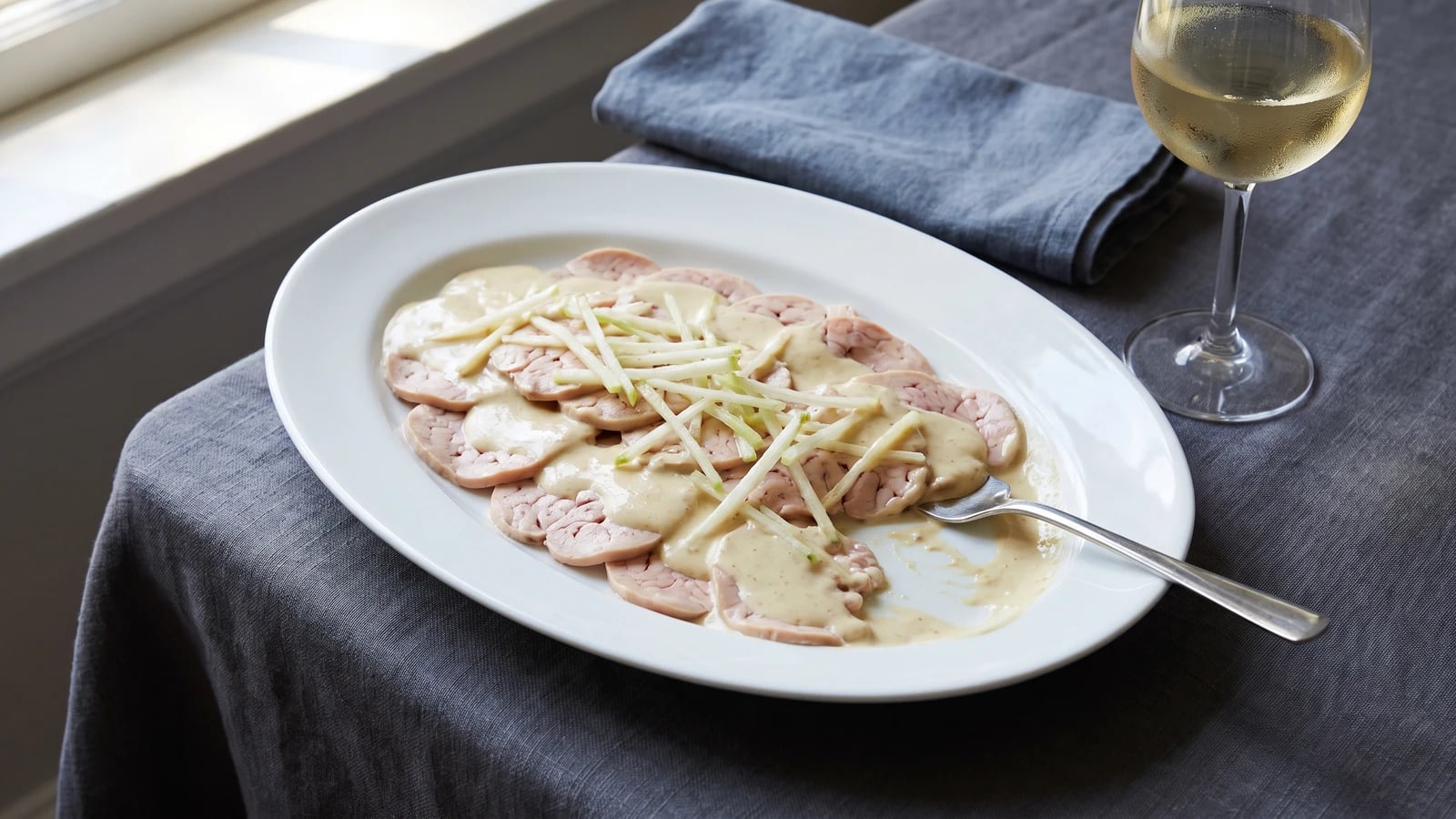
Cervelles à la Robert turns careful poaching and cold saucing into a lesson in texture: tender lambs’ brains, clean slices, lively mustard cream, and celery julienne with enough snap to wake the plate.
Cervelles à la Robert (poached brains with mustard cream and celery) teaches the quiet discipline of cold saucing. The one true thing is temperature: the brains must be cooked gently, then chilled until fully firm before a knife touches them. Warm brains smear; cold brains cut into tender, regular slices that can carry a proper mask of sauce.
The classical entry assumed a garde-manger, a cold-larder cook, working beside a saucier with mustard-and-cream sauce already waiting, enough brains to fill a service platter, and a fine tamis for the trimmings. There is no need for a stockpot that never goes cold or a salamander, because court-bouillon, not stock, does the poaching and the dish is served cold. At home, one nonreactive saucepan and a sturdy fine sieve do the work. The brigade quantities and separate stations are scaffolding and can go; the court-bouillon, the sieved remains, and the white celery julienne are the dish and must stay.
When it is right, the slices are pale and tender beneath an ivory sauce sharpened with Dijon, while the celery answers with a clean snap. Two brains make four generous starters, scaled for one cook, one stove, one evening. Poach at a tremble, then chill completely before slicing; that is the step that decides the plate.
Cervelles à la Robert belongs to Parisian cuisine bourgeoise and the classical cold hors-d’œuvre table, where economical offal received the same precision as costly cuts. The preparation carried household thrift into the grand kitchen: poaching made delicate brains sliceable, while the trimmings were sieved back into the sauce so nothing useful was lost. The name is sometimes mistaken for a hot brown mustard treatment, but this formula is unequivocally cold, with mustard softened by cream and the white heart of celery supplying its crisp counterpoint.
Quantity
2 (about 8 to 10 oz / 225 to 285 g total)
Quantity
8 cups (2 L / 2 kg), plus more as needed
Quantity
4 cups (1 L / 1 kg)
Quantity
1/3 cup (80 ml / 80 g)
Quantity
1 (about 4 oz / 115 g)
thinly sliced
Quantity
1 (about 2 oz / 60 g)
thinly sliced
Quantity
1
1 bay leaf, 2 parsley stems, and 1 thyme sprig
Quantity
1 teaspoon (5 ml / 3 g)
Quantity
2 teaspoons (10 ml / 12 g)
Quantity
1/2 cup (120 ml / 120 g)
Quantity
2 tablespoons (30 ml / 30 g)
Quantity
1/4 teaspoon (1.25 ml / 1.5 g)
Quantity
1/8 teaspoon (0.6 ml / 0.3 g)
Quantity
1 (about 2 oz / 55 g)
strings removed and cut julienne-fashion
| Ingredient | Quantity |
|---|---|
| fresh lambs’ or sheep’s brains | 2 (about 8 to 10 oz / 225 to 285 g total) |
| cold water for soaking | 8 cups (2 L / 2 kg), plus more as needed |
| water for the court-bouillon | 4 cups (1 L / 1 kg) |
| white wine vinegar | 1/3 cup (80 ml / 80 g) |
| small onionthinly sliced | 1 (about 4 oz / 115 g) |
| small carrotthinly sliced | 1 (about 2 oz / 60 g) |
| small bouquet garni1 bay leaf, 2 parsley stems, and 1 thyme sprig | 1 |
| black peppercorns | 1 teaspoon (5 ml / 3 g) |
| fine sea salt for the court-bouillon | 2 teaspoons (10 ml / 12 g) |
| chilled heavy cream | 1/2 cup (120 ml / 120 g) |
| Dijon mustard | 2 tablespoons (30 ml / 30 g) |
| fine sea salt for the sauce | 1/4 teaspoon (1.25 ml / 1.5 g) |
| ground white pepper | 1/8 teaspoon (0.6 ml / 0.3 g) |
| large pale inner celery ribstrings removed and cut julienne-fashion | 1 (about 2 oz / 55 g) |
Put the brains in the cold soaking water and refrigerate for 1 hour, changing the water once when it grows cloudy. Working under fresh cold water, gently lift away the thin outer membrane, clotted blood, and obvious vessels without separating the lobes. If the surface begins to fray, stop pulling and trim only what releases easily; poaching will firm the rest, while rough handling cannot be taken back.
Combine the court-bouillon water, vinegar, onion, carrot, bouquet garni, peppercorns, and salt in a nonreactive saucepan. Court-bouillon is a short aromatic poaching liquor, and its acidity firms the delicate surface while the vegetables remove any flat mineral character. Bring it to a boil, lower it to a quiet simmer, and cook uncovered for 20 minutes. Strain it, discard the aromatics, and return the clear liquor to the saucepan.
Bring the strained court-bouillon back to the barest simmer and lower in the brains. Keep the surface at a gentle tremble for 12 to 15 minutes, turning the brains once with a spoon, until they are opaque, lightly firm, and reach 160°F / 71°C at the thickest part. A hard boil tears the lobes. If the liquor begins rolling and a brain splits, lower the heat at once and finish it in the covered hot liquor; any broken portion can join the sauce later. Ça se rattrape. Take the pan off the heat and leave the brains in the liquor for 10 minutes.
Lift the brains carefully from the liquor and drain them on a shallow plate. Once they are no longer hot, cover and refrigerate for at least 2 hours, until cold and firm throughout. Do not mistake merely cool for ready: the chill sets their fragile texture and makes regular slicing possible.
With a thin, sharp knife, cut the chilled brains crosswise into regular slices about 1/4 inch / 6 mm thick. Arrange the best slices in overlapping rows on a chilled hors-d’œuvre dish. Collect every uneven end, crumb, and torn slice, then rub these remains through a fine sieve with the back of a spoon to make a smooth purée. If the slices smear or buckle, return everything to the cold for 30 minutes; if one breaks, add it to the purée and carry on.
Reserve 2 tablespoons of the chilled cream. Whisk the remainder only until it falls from the whisk in a loose ribbon, then fold in the Dijon mustard, sauce salt, and white pepper. Fold the sieved brain purée into this mustard-and-cream sauce until it is smooth and thick enough to coat a spoon. If it turns grainy from overwhipping, work in the reserved unwhipped cream a teaspoon at a time; if it is loose, chill it for 10 minutes. Cut the white celery into julienne-fashion, meaning fine matchstick rods about 1/16 inch / 1.5 mm wide, dry them thoroughly, and fold them into the sauce.
Masquer, or coat completely, the arranged brain slices with the mustard-cream sauce, spreading it gently so the slices remain in place and the celery stays distinct. Chill the finished dish for 20 minutes, then let it stand out of the cold for 10 minutes before serving. It should be cool, tender, and lively with mustard, not numb from the refrigerator. À table!
1 serving (about 110g)
Culinary guides, cultural storytelling, and the editorial depth that makes cooking meaningful.
Discover Culinary ExplorerChef Juliette
Tiny éperlans, lightly floured and fried until their tails stand crisp, arrive in a generous heap on a napkin with fried parsley and grooved lemon, a weeknight lesson in heat and restraint.

Chef Juliette
Brandade de Morue turns salt cod, warm olive oil, and milk into a pale, silky emulsion: keep everything warm and add the oil slowly, then crown the generous dome with butter-fried bread.

Chef Juliette
Salt cod worked warm with cream, one patient spoonful at a time, until the rough flakes become a glossy Nîmes paste, domed generously and ringed with butter-fried croutons for the table.

Chef Juliette
Wine-poached char packed in its earthenware crock beneath butter gold: a make-ahead first course that turns careful cooling, thorough boning, and one unbroken seal into quiet abundance.