
Chef Juliette
Smelt (Éperlans)
Tiny éperlans, lightly floured and fried until their tails stand crisp, arrive in a generous heap on a napkin with fried parsley and grooved lemon, a weeknight lesson in heat and restraint.
A cooking platform built around craft, culture, and the stories behind what we eat.
Created by Chef Juliette
Based on No. 326, Caviare and Blinis, from Le Guide Culinaire (1907) by Auguste Escoffier
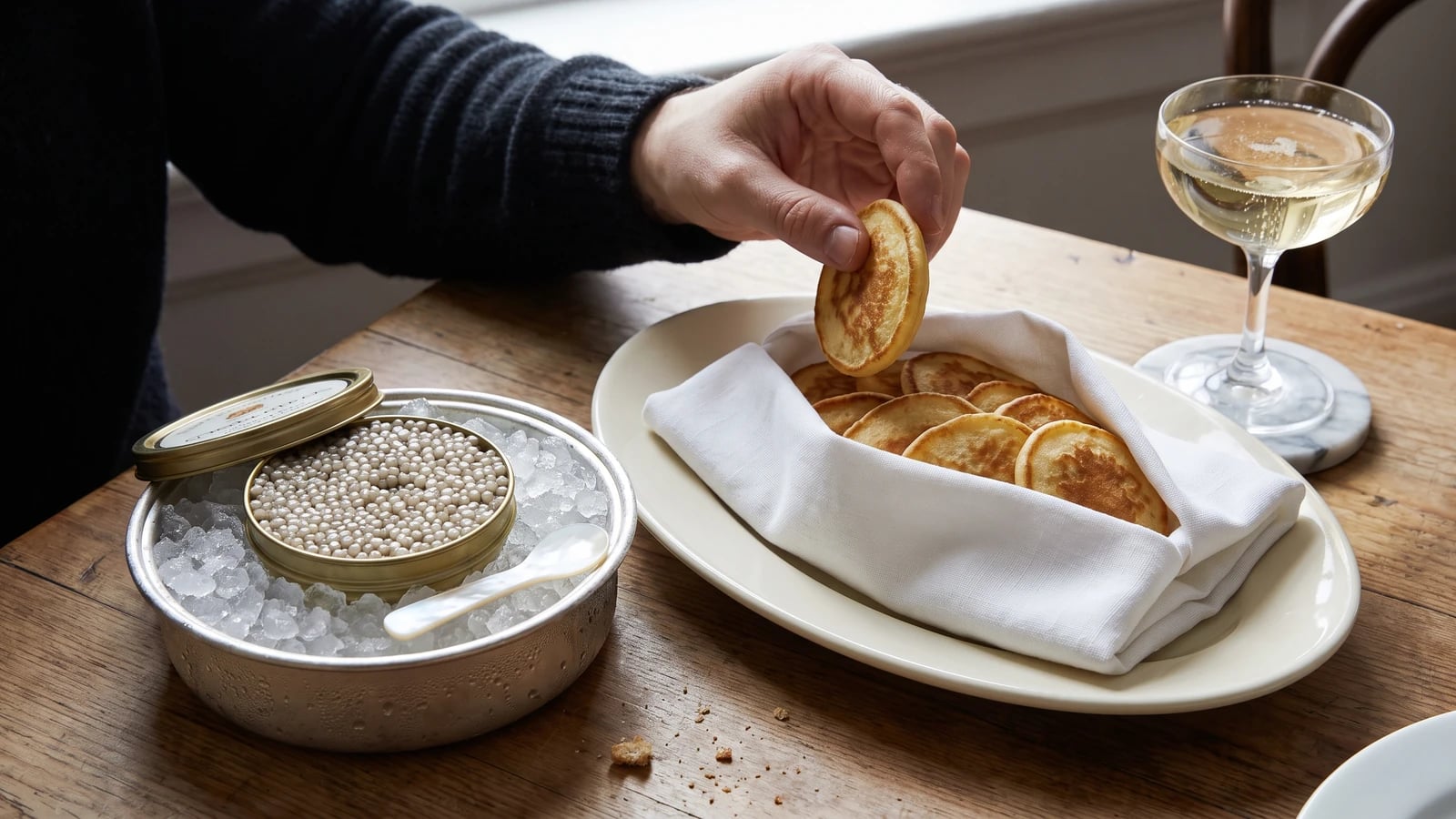
Caviar et blinis is a lesson in contrast: cold, saline pearls against hot, tender yeast cakes, with no onion to shout over either. Ferment gently, cook quickly, and serve them at once.
Caviar et blinis (caviare with yeast blinis) teaches one true thing: service is part of the cooking. The caviare must remain cold enough for every grain to hold its delicate pop, while the blinis arrive hot, tender, and faintly buttered. Let either wait for the other and the dish loses its reason for being.
The original formula assumed a brigade quantity, a reliably warm corner for fermentation, several little omelet pans, and enough hands to cook while someone else carried the caviare to the table. Here the proportions are reduced to exactly one quarter, fresh compressed yeast has an active dry equivalent for shops that don't carry it, and one broad skillet replaces the rank of little pans. A whisper of butter supplies the seasoned cooking surface hidden inside the instruction to cook them like pancakes. One cook, one stove, one evening.
Multiple pans and a formal procession are scaffolding. The two fermentations, the lightly handled batter, and the meeting of cold caviare with hot blinis are the dish itself. Before the first spoonful of batter touches the pan, seat your guests, settle the caviare over ice, and warm the serving platter. That timing matters most.
Caviar with blinis belongs first to the Russian feast table, then entered the French classical repertoire through Parisian grand kitchens and service à la russe, Russian-style course service. The all-wheat, yeast-raised blini used here is the French grand-kitchen interpretation of a family of Russian pancakes that may also contain buckwheat. Finely chopped onion became a common accompaniment elsewhere, but this preparation rejects it plainly because fresh, delicate caviare needs no competing condiment.
Quantity
1/2 cup (120 ml / 113 g)
kept very cold
Quantity
About 4 cups (950 ml / 600 g)
for serving
Quantity
1/4 ounce (7 g), or 3/4 teaspoon (3 ml / 2.3 g) active dry yeast
Quantity
1 cup minus 1 tablespoon (225 ml / 113 g)
for the first paste
Quantity
1/2 cup plus 1 tablespoon (140 ml / 145 g)
lukewarm, for the first paste
Quantity
Scant 1/2 cup (115 ml / 57 g)
for the second mixing
Quantity
1/4 cup plus 2 teaspoons (70 ml / 72 g)
tepid, for the second mixing
Quantity
1
separated
Quantity
1/8 teaspoon (0.6 ml / 0.8 g)
Quantity
2 tablespoons (30 ml / 28 g)
melted, for the skillet
| Ingredient | Quantity |
|---|---|
| fresh-grain sturgeon caviarekept very cold | 1/2 cup (120 ml / 113 g) |
| cracked icefor serving | About 4 cups (950 ml / 600 g) |
| fresh compressed yeast | 1/4 ounce (7 g), or 3/4 teaspoon (3 ml / 2.3 g) active dry yeast |
| sifted all-purpose flourfor the first paste | 1 cup minus 1 tablespoon (225 ml / 113 g) |
| whole milklukewarm, for the first paste | 1/2 cup plus 1 tablespoon (140 ml / 145 g) |
| sifted all-purpose flourfor the second mixing | Scant 1/2 cup (115 ml / 57 g) |
| whole milktepid, for the second mixing | 1/4 cup plus 2 teaspoons (70 ml / 72 g) |
| large eggseparated | 1 |
| fine salt | 1/8 teaspoon (0.6 ml / 0.8 g) |
| unsalted buttermelted, for the skillet | 2 tablespoons (30 ml / 28 g) |
Warm the first measure of milk to about 100°F (38°C), pleasantly warm against your wrist but never hot. Crumble in the fresh yeast and stir until dispersed; if using active dry yeast, leave it for five minutes until a light creamy froth appears. Add the first measure of sifted flour and stir only until you have a smooth, loose paste. Don't beat it into elasticity.
Cover the bowl and leave the paste for two hours in a warm, still place, ideally around 75 to 80°F (24 to 27°C). A switched-off oven with its light on can serve, but check that it remains merely warm. The paste is ready when it has expanded, smells gently yeasty, and wears bubbles across its surface. If it is sluggish, give it another twenty to thirty minutes in a warmer place rather than forcing it with heat.
Stir the remaining flour, egg yolk, salt, and tepid milk into the fermented paste just until evenly combined. Whisk the egg white in a clean bowl to soft, flexible peaks, then fold it through the batter in three additions with a spatula. Use broad, gentle strokes and stop as soon as no white streaks remain. Cover and ferment for another thirty minutes. If you have mixed too firmly and the batter looks elastic, stop handling it and allow the full rest; ça se rattrape, because rest relaxes the batter and the yeast supplies another lift.
While the batter completes its second fermentation, mound the cracked ice in a shallow serving bowl. Nestle the closed caviare tin or a small chilled bowl securely into the ice and set out a mother-of-pearl, horn, or other nonreactive spoon. Open the caviare only when the skillet is nearly ready. Don't stir or season it, and don't put onion or lemon beside it; the intact grains and their salinity are the whole finish.
Warm a platter and line it with a clean folded linen napkin. Heat a 12-inch (30 cm) nonstick or well-seasoned skillet over medium heat, then brush it with the thinnest film of melted butter. Drop in a teaspoon of batter. It should begin bubbling promptly and turn pale gold underneath without racing to brown. If it darkens before bubbles appear, lower the heat, wipe the skillet, butter it lightly again, and retest.
Spoon the batter into the skillet in portions of about 1 1/2 tablespoons (22 ml), leaving room for each blini to spread into a round about 3 inches (7.5 cm) wide. Cook for 45 to 60 seconds, until bubbles open across the top and the edge looks set, then turn and cook the second side for 20 to 30 seconds. The blinis should be lightly golden, tender, and springy, never crisp. Brush the skillet sparingly with more butter between batches. Transfer each batch to the warm napkin and fold it loosely over them; a tight wrapping traps moisture and makes their surfaces damp.
Carry the caviare over ice and the napkin-wrapped blinis to the table together. Let each guest spoon caviare onto a blini immediately before eating, so the pancake remains hot and the grains remain cold and distinct. No onion, no lemon, no cream. Cooking well is not cooking fancy. À table!
1 serving (about 125g)
Culinary guides, cultural storytelling, and the editorial depth that makes cooking meaningful.
Discover Culinary ExplorerChef Juliette
Tiny éperlans, lightly floured and fried until their tails stand crisp, arrive in a generous heap on a napkin with fried parsley and grooved lemon, a weeknight lesson in heat and restraint.

Chef Juliette
Brandade de Morue turns salt cod, warm olive oil, and milk into a pale, silky emulsion: keep everything warm and add the oil slowly, then crown the generous dome with butter-fried bread.

Chef Juliette
Salt cod worked warm with cream, one patient spoonful at a time, until the rough flakes become a glossy Nîmes paste, domed generously and ringed with butter-fried croutons for the table.

Chef Juliette
Wine-poached char packed in its earthenware crock beneath butter gold: a make-ahead first course that turns careful cooling, thorough boning, and one unbroken seal into quiet abundance.