
Chef Juliette
Smelt (Éperlans)
Tiny éperlans, lightly floured and fried until their tails stand crisp, arrive in a generous heap on a napkin with fried parsley and grooved lemon, a weeknight lesson in heat and restraint.
A cooking platform built around craft, culture, and the stories behind what we eat.
Created by Chef Juliette
Based on No. 322, Crayfish Toast, from Le Guide Culinaire (1907) by Auguste Escoffier
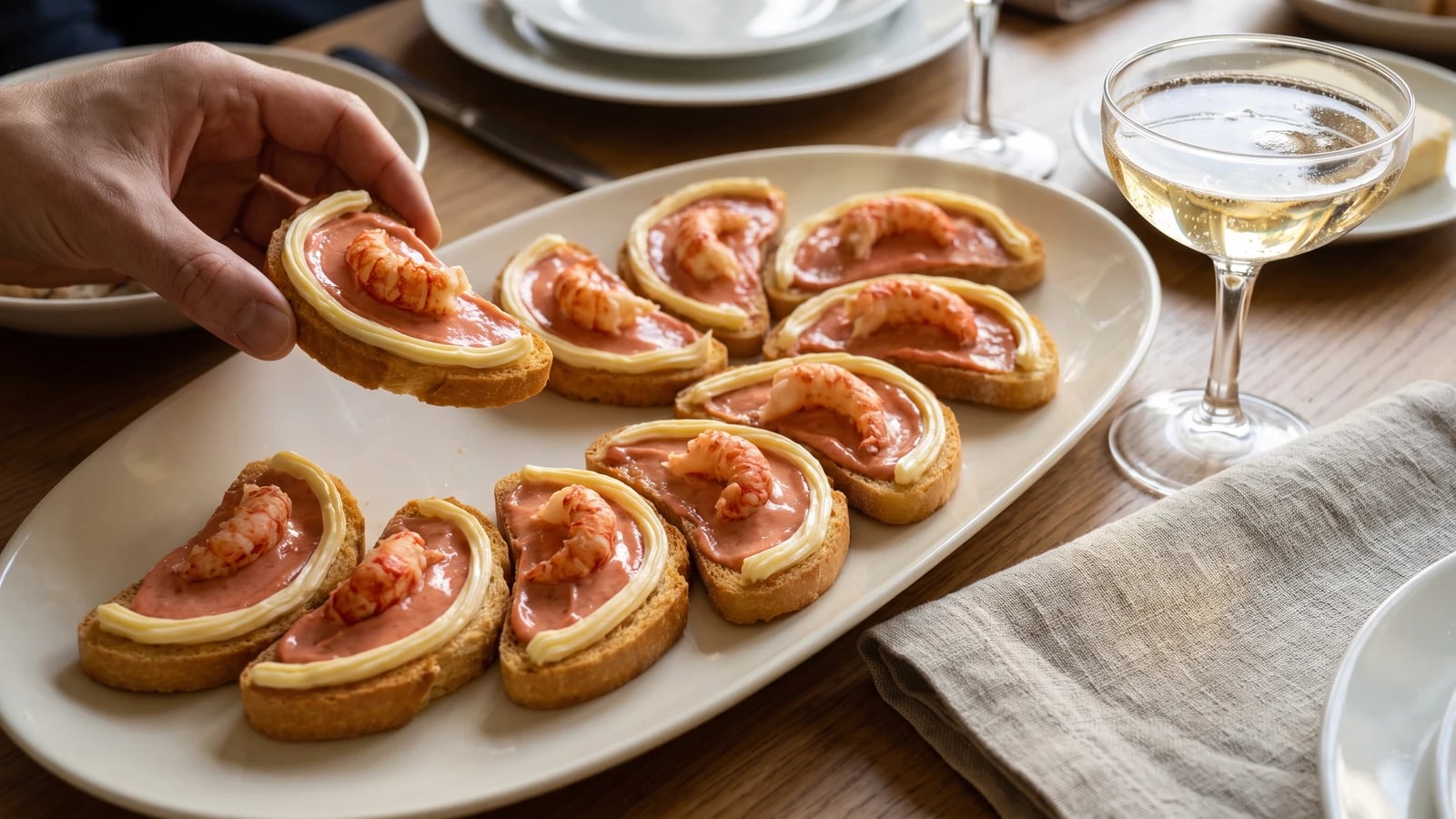
Rosy crayfish butter, crisp crescent toast, and a tail split neatly down the middle: this small canapé teaches the classical art of making one ingredient provide both its flavor and its ornament.
Croûtes d’Écrevisses (crayfish toasts) teach a very French economy: the shell must season the butter and the tail must finish the toast. Save every shell before you touch the bread. When the crescent is right, you get crisp toast under rose-colored butter, a clean ivory cord at the edge, and two coral tail halves nested in the curve.
The original assumed a saucier on staff with beurre d’écrevisses (crayfish butter) already in the larder, a stockpot never off the fire, and a salamander waiting to color toast. This preparation needs no stock, so leave that pot alone; extract one small batch of beurre d’écrevisses from the same eight shellfish and let your oven do the salamander’s work. The ready larder component and brigade quantity are scaffolding. The crescent, the rose butter, the piped border, and the split tail are the dish, and all four stay. That is the honest scale: one cook, one stove, one evening.
Keep the shell butter at a quiet sizzle and toast the bread until it is dry through, not dark. Too much heat muddies the butter, while too little leaves the crescent soft beneath its topping. The extraction is the one step that matters most: coax the shells into the butter without browning it.
Croûtes d’écrevisses belong to the French classical hors-d’œuvre table, especially the composed cold starters served in Parisian dining rooms, rather than to one provincial household tradition. Their flavor recalls the freshwater crayfish cooking of the Bugey around Nantua and the neighboring Lyonnais table, but the crescent shape and piped border mark this as service craft, not a bouchon specialty. Its clever economy is easily missed: the shells color and perfume the butter while the tail becomes the ornament, so one crayfish supplies the whole bite.
Quantity
8 whole (about 12 oz / 340 g total)
well chilled
Quantity
1/2 cup (120 ml / 113 g)
kept cold
Quantity
1/4 cup (60 ml / 57 g)
softened
Quantity
8 slices, each 1/2 inch / 1.25 cm thick (about 8 oz / 225 g total)
Quantity
1/8 teaspoon (0.6 ml / 0.8 g)
| Ingredient | Quantity |
|---|---|
| whole cooked crayfishwell chilled | 8 whole (about 12 oz / 340 g total) |
| unsalted butter for beurre d’écrevisseskept cold | 1/2 cup (120 ml / 113 g) |
| unsalted butter for pipingsoftened | 1/4 cup (60 ml / 57 g) |
| pain de mie | 8 slices, each 1/2 inch / 1.25 cm thick (about 8 oz / 225 g total) |
| fine sea salt (optional) | 1/8 teaspoon (0.6 ml / 0.8 g) |
Twist the tail from each chilled crayfish and peel it carefully, keeping the meat whole. Remove the dark vein if present, then split each tail cleanly in two lengthwise with a thin, sharp knife. Keep each matching pair together, cover, and return the tail halves to the refrigerator. Pat the tail shells, bodies, and claws dry, wrap them in a sturdy bag and a folded towel, then crack them firmly with a rolling pin. Expose the interiors without grinding the shells to powder, since fine grit is difficult to strain out.
Hold back 1 tablespoon of the cold butter. Melt the remainder in a small heavy saucepan over low heat, add the cracked shells, and cook for 6 to 8 minutes at the faintest sizzle, pressing and turning them with a wooden spoon. The butter should become rosy and smell distinctly of crayfish, but its milk solids must remain pale. If the foam races or tan flecks appear, lift the pan from the heat and whisk in the reserved cold butter immediately; ça se rattrape if you stop before anything burns. Rest off the heat for 5 minutes, then strain through a fine sieve lined with damp cheesecloth, pressing firmly without grinding. Whisk in the reserved butter now if it was not needed earlier, then chill for 15 to 20 minutes, just until opaque and spreadable.
Heat the oven to 350°F (180°C). Stamp a 3 1/4-inch (8 cm) round from each bread slice. Shift the cutter about 1 1/4 inches (3 cm) into each round and cut again, removing the inner piece to leave a broad crescent. Arrange the crescents on an ungreased baking sheet and toast for 8 to 10 minutes, turning once, until pale gold, crisp at the edges, and dry through the center. Cool completely on a rack. Color is useful, but deep browning would bully the delicate crayfish butter.
Work the softened butter with a small spatula until it reaches beurre pommade, butter with the smooth consistency of an ointment. It should hold a ridge without cracking or looking melted. Transfer it to a piping bag fitted with a 1/8-inch (3 mm) plain tip. If it slumps, chill the bag for 5 minutes and work it briefly between your hands; if it is too firm to pipe, let it stand for a few minutes longer.
Taste the beurre d’écrevisses and add only enough fine salt to sharpen its flavor, remembering that cooked crayfish may already be seasoned. Spread an even layer over the entire upper surface of each cooled crescent, carrying it neatly to both curved edges. Pipe a slender, continuous cord of beurre pommade around the perimeter. Keep the line fine and even; this is a border, not a wall.
Place the two matching halves of one crayfish tail lengthwise in the middle of each crescent, close together and with their thickest sides innermost, exactly as the preparation requires. Press only enough to secure them in the beurre d’écrevisses without flattening the piped border. Serve within 30 minutes at cool room temperature. If the finished toasts have been chilled, give them 10 minutes out of the refrigerator so the butter yields beneath the teeth. À table!
1 serving (about 105g)
Culinary guides, cultural storytelling, and the editorial depth that makes cooking meaningful.
Discover Culinary ExplorerChef Juliette
Tiny éperlans, lightly floured and fried until their tails stand crisp, arrive in a generous heap on a napkin with fried parsley and grooved lemon, a weeknight lesson in heat and restraint.

Chef Juliette
Brandade de Morue turns salt cod, warm olive oil, and milk into a pale, silky emulsion: keep everything warm and add the oil slowly, then crown the generous dome with butter-fried bread.

Chef Juliette
Salt cod worked warm with cream, one patient spoonful at a time, until the rough flakes become a glossy Nîmes paste, domed generously and ringed with butter-fried croutons for the table.

Chef Juliette
Wine-poached char packed in its earthenware crock beneath butter gold: a make-ahead first course that turns careful cooling, thorough boning, and one unbroken seal into quiet abundance.