
Chef Juliette
Smelt (Éperlans)
Tiny éperlans, lightly floured and fried until their tails stand crisp, arrive in a generous heap on a napkin with fried parsley and grooved lemon, a weeknight lesson in heat and restraint.
A cooking platform built around craft, culture, and the stories behind what we eat.
Created by Chef Juliette
Based on No. 319, Shrimp Toast, from Le Guide Culinaire (1907) by Auguste Escoffier
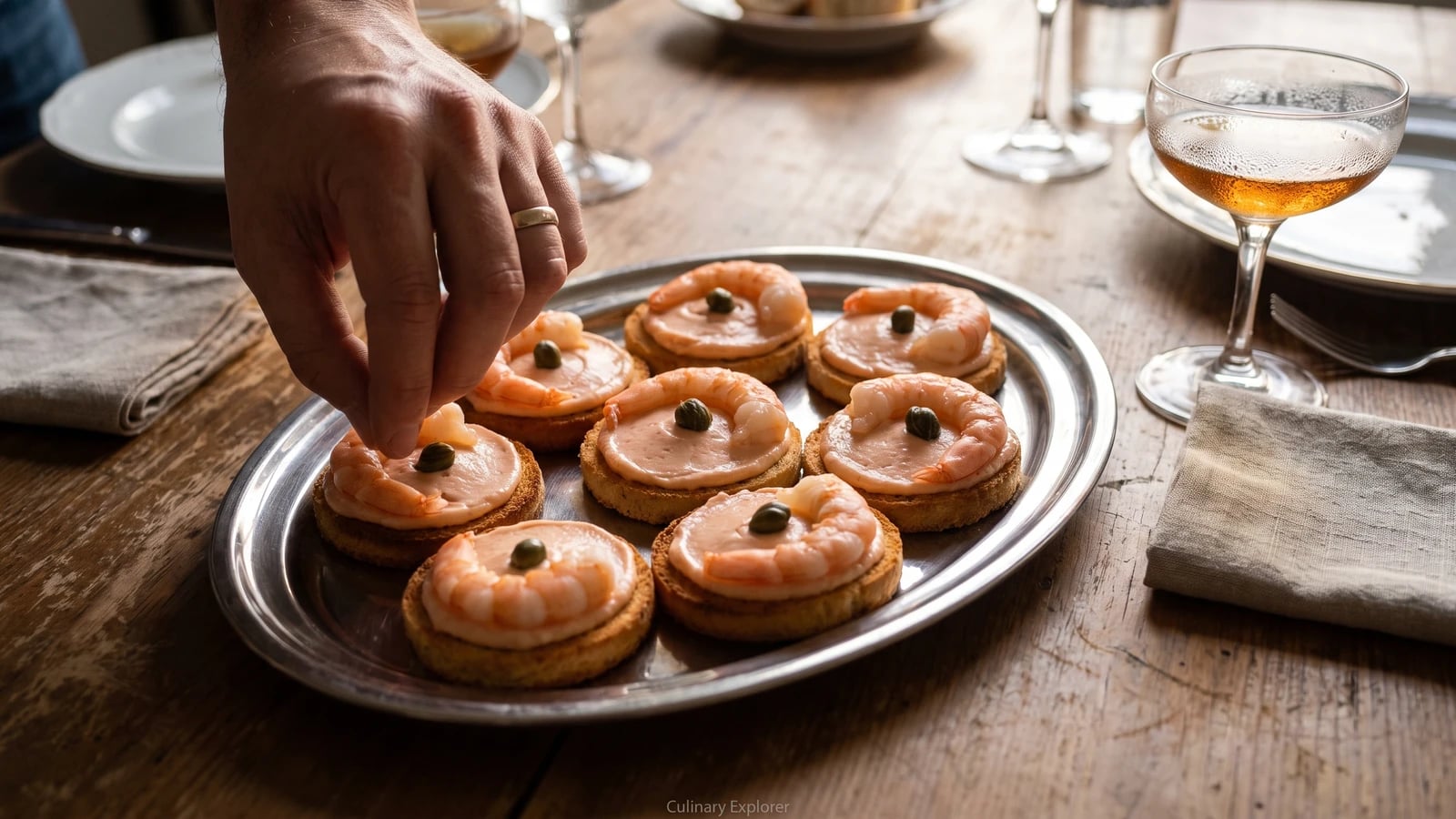
Canapés aux crevettes turn one disciplined arrangement into a complete bite: crisp round toast, cool shrimp butter, a border of tender tails, and one briny caper holding the center.
Canapés aux crevettes (shrimp toast) teach the discipline of the canapé: bread, spread, garnish, and seasoning must arrive together in one clean bite. Before you touch a pan, know this: the toast must be crisp and completely cool before the shrimp butter meets it. Warm bread melts the butter into the crumb, and the whole careful arrangement goes soft.
The original entry assumed a garde-manger, the cold station, with cooked tiny shrimp and beurre de crevettes already waiting, a salamander ready to toast whole trays, and several hands assembling brigade quantities. Your honest equivalent is eight bread rounds toasted together in a home oven, shrimp butter worked in one bowl, and a small tray assembled by one cook. It needs neither a saucier nor a stockpot kept on the fire. The separate station and tray-sized production are scaffolding, so they go; the round toast, shrimp butter, border of shelled tails, and single caper are the dish, so every one stays. One cook, one stove, one evening.
When it lands properly, the toast gives beneath the teeth, the cool beurre de crevettes tastes deeply of shrimp and real butter, and the caper cuts through both with one bright, salty point. Cool the toast completely before spreading the beurre de crevettes. That pause is the one step that decides whether these remain crisp.
Canapés aux crevettes belong to the Parisian hors-d'oeuvre table and the wider French classical garde-manger, where small breads were cut into precise shapes and dressed for service while still crisp. Canapé is also the French word for a sofa, because the garnish sits upon its bread base; here the name is unusually literal, with shrimp butter supporting a formal ring of tails. This is a cool assembled canapé, not fried shrimp paste on bread, and its geometry ensures that butter, shrimp, and caper meet in every bite.
Quantity
8 slices, each about ½ inch (1.25 cm) thick
Quantity
1½ cups (360 ml / 200 g)
dried well, with 48 reserved whole and the remainder finely chopped
Quantity
⅓ cup (80 ml / 75 g)
softened but still cool
Quantity
8
rinsed and dried
| Ingredient | Quantity |
|---|---|
| firm white pain de mie or sandwich bread | 8 slices, each about ½ inch (1.25 cm) thick |
| very small cooked peeled shrimpdried well, with 48 reserved whole and the remainder finely chopped | 1½ cups (360 ml / 200 g) |
| unsalted buttersoftened but still cool | ⅓ cup (80 ml / 75 g) |
| small capersrinsed and dried | 8 |
Choose the 48 neatest shrimp tail meats for the borders, six for each canapé. Lay all the shrimp between clean towels and blot until the cloth comes away dry, then keep the reserved tails whole and chop the remainder as finely as possible. Moisture makes the butter loose and encourages the garnish to slide, so take this drying seriously.
Mash the chopped shrimp beneath the flat of a knife until it becomes a coarse paste. Beat the softened butter with a wooden spoon until smooth, then work in the shrimp paste in three additions. Press the mixture through a fine-mesh sieve and beat it once more; this is beurre de crevettes, shrimp butter, and it should be smooth, cool, and firm enough to hold the mark of the spoon. If it turns shiny or oily, the butter has become too warm. Chill the bowl for 5 minutes, then beat again until it gathers. Ça se rattrape.
Heat the oven to 375°F (190°C) with a rack in the center. Cut one 2¼-inch (6 cm) round from each bread slice and arrange the rounds on a bare sheet pan. Toast for 5 minutes, turn them, and continue for 3 to 5 minutes, until dry through and evenly pale gold. The home oven replaces the salamander and handles all eight without scorching their edges. Transfer the rounds to a rack and leave them for at least 10 minutes, until no warmth remains.
Divide the beurre de crevettes evenly among the cold toast rounds and spread it in a level layer almost to the edge. Work gently so the butter sits on the bread rather than being driven into its crumb. If a round still feels warm or the butter begins to melt, stop and set the tray in the cold for 5 minutes, then restore the surface with the knife. Never sacrifice the crisp toast merely to save a few minutes.
Arrange six whole shrimp tails around the edge of each round, following the circle so they form a continuous border. Set one caper at the exact center and press every garnish only firmly enough to anchor it in the butter. Serve at once, or hold the finished canapés in a cool place for no more than 30 minutes. The arrangement may be formal, but the pleasure is immediate. À table!
1 serving (about 125g)
Culinary guides, cultural storytelling, and the editorial depth that makes cooking meaningful.
Discover Culinary ExplorerChef Juliette
Tiny éperlans, lightly floured and fried until their tails stand crisp, arrive in a generous heap on a napkin with fried parsley and grooved lemon, a weeknight lesson in heat and restraint.

Chef Juliette
Brandade de Morue turns salt cod, warm olive oil, and milk into a pale, silky emulsion: keep everything warm and add the oil slowly, then crown the generous dome with butter-fried bread.

Chef Juliette
Salt cod worked warm with cream, one patient spoonful at a time, until the rough flakes become a glossy Nîmes paste, domed generously and ringed with butter-fried croutons for the table.

Chef Juliette
Wine-poached char packed in its earthenware crock beneath butter gold: a make-ahead first course that turns careful cooling, thorough boning, and one unbroken seal into quiet abundance.