
Chef Juliette
Smelt (Éperlans)
Tiny éperlans, lightly floured and fried until their tails stand crisp, arrive in a generous heap on a napkin with fried parsley and grooved lemon, a weeknight lesson in heat and restraint.
A cooking platform built around craft, culture, and the stories behind what we eat.
Created by Chef Juliette
Based on No. 317, Anchovy Toast, from Le Guide Culinaire (1907) by Auguste Escoffier
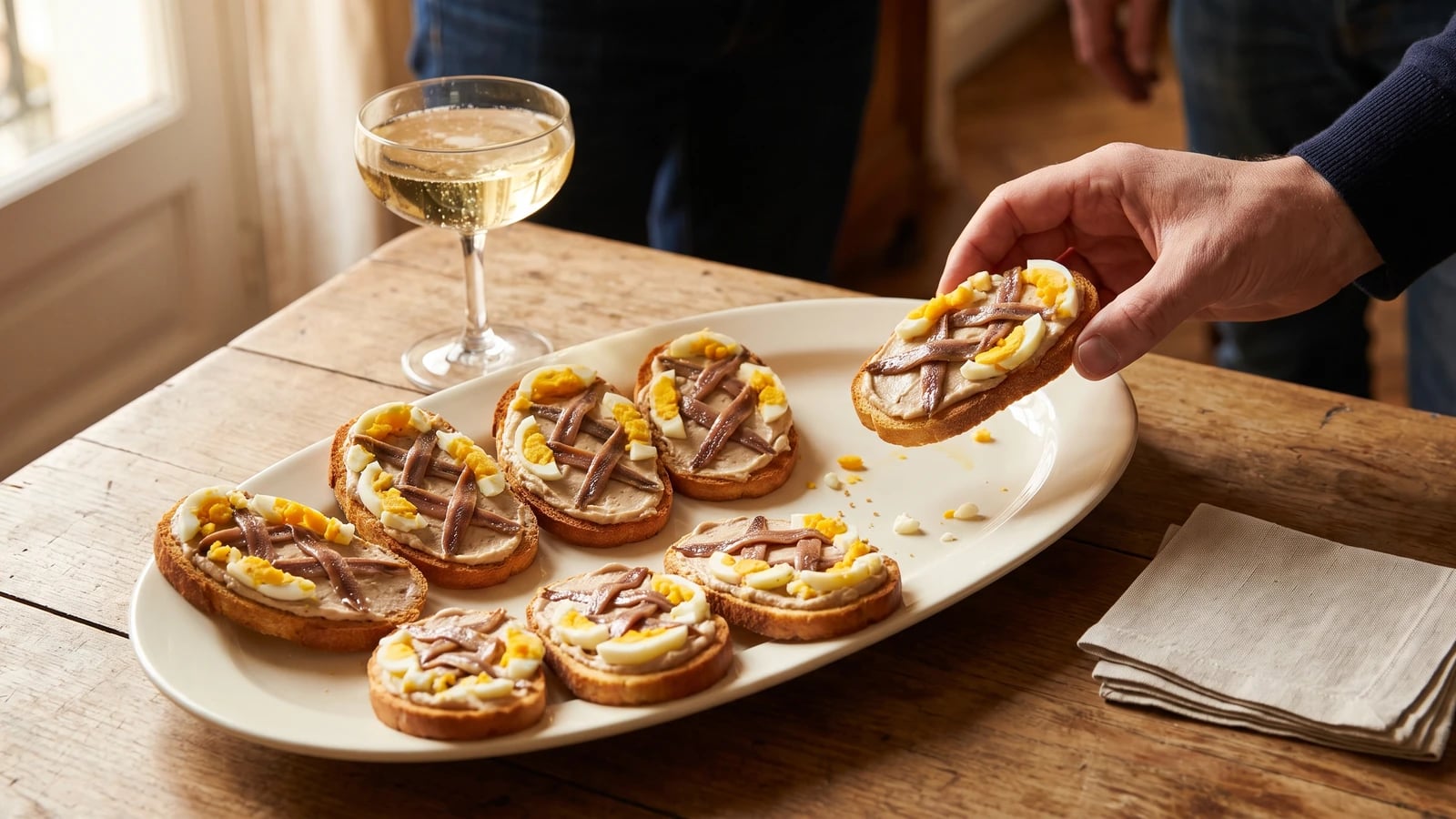
Canapés aux anchois teach precision at a glance: crisp oval toasts, smooth beurre d'anchois, neat fillet lattices, and alternating rings of white and yolk that make formal geometry feel entirely alive.
Canapés aux anchois (anchovy toasts) teach the discipline of the cold hors-d'oeuvre: every layer must be thin, distinct, and immediately legible. Crisp bread carries a smooth beurre d'anchois (anchovy butter), dark fillets make their little lattice, and chopped egg white and yolk alternate around the rim. The one true thing is proportion. Too much of any part turns a composed first bite into a mouthful of salt and butter.
The original entry assumed a garde-manger with anchovy butter ready, a commis cutting identical ovals, and a salamander to toast them on command. Here it becomes eight canapés for four guests, with a paper template, a serrated knife, a fork, and a moderate oven. Those specialized tools and extra hands were brigade scaffolding and may go. The oval toast, beurre d'anchois, fillet lattice, and alternating egg border are the dish and must stay. One cook, one stove, one evening.
When they are right, the bread snaps cleanly, the butter yields without greasiness, and the white, gold, and bronze garnish reads before the anchovy reaches your tongue. Toast the ovals until completely crisp, then cool them completely before spreading. That is the step that decides the dish.
Canapés aux anchois belong to the classical French hors-d'oeuvre table, particularly the formal dining rooms and bourgeois tables of Paris, rather than to a single provincial larder. Canapé is also the French word for a sofa, an apt name for a small garnish seated upon its fitted piece of bread. The alternating egg border comes from a tradition in which orderly cold garnishes displayed the cook's precision, but here the egg also softens the anchovy's salt and richness.
Quantity
8 slices, about 10 ounces (280 g) total
cut 1/2 inch (1.25 cm) thick
Quantity
2
Quantity
3 tablespoons (45 ml / 43 g)
softened but still cool
Quantity
24 fillets, about 1/2 cup (120 ml / 120 g) drained
blotted dry and divided, 8 for the butter and 16 for the lattices
| Ingredient | Quantity |
|---|---|
| firm pain de mie or white sandwich loafcut 1/2 inch (1.25 cm) thick | 8 slices, about 10 ounces (280 g) total |
| large eggs | 2 |
| unsalted buttersoftened but still cool | 3 tablespoons (45 ml / 43 g) |
| oil-packed anchovy filletsblotted dry and divided, 8 for the butter and 16 for the lattices | 24 fillets, about 1/2 cup (120 ml / 120 g) drained |
Set the eggs in a small saucepan and cover them with cold water by 1 inch (2.5 cm). Bring just to a boil, cover, remove from the heat, and leave for 10 minutes. Transfer them to cold water until completely cool, then peel. Separate the whites from the yolks and chop each very finely on its own board space, keeping the colours clean and distinct. Cover and set aside.
Heat the oven to 375°F (190°C). Cut a paper oval about 3 by 2 inches (7.5 by 5 cm), set it on each bread slice, and cut around it with a small serrated knife. Arrange the eight ovals on a baking sheet and toast for 8 to 12 minutes, turning once, until evenly pale gold and dry through the centre. Cool them completely on a rack. Test one at the narrow end: if it bends rather than breaking crisply, return the batch to the oven for 2 to 3 minutes. Ça se rattrape, but only before the butter goes on.
Mash 8 anchovy fillets to a perfectly smooth paste with a mortar and pestle, or rub them through a fine sieve using the back of a spoon. Beat the paste into the softened butter until the beurre d'anchois is even in colour, smooth, and spreadable. Do not melt the butter. If it becomes shiny or releases oil, chill it for 5 minutes and beat again until it holds softly on the spoon.
Split each of the remaining 16 anchovy fillets lengthwise into two narrow strips. Trim the strips to fit within the ovals, leaving a narrow border for the egg. Keep them covered while you work so their surfaces remain supple rather than drying into stiff little ropes.
Spread each cooled toast with about 2 teaspoons of beurre d'anchois, carrying it in a thin, even layer to the edge. Lay two anchovy strips in one direction and two across them in the other, forming a small diamond lattice in the centre. Keep the pressure light so the fillets sit visibly on the butter instead of sinking into it.
Using separate teaspoons, place a short arc of chopped white around the exposed rim, then an arc of yolk, continuing in alternating colours all the way around each oval. Press just enough to secure the egg to the beurre d'anchois. If the butter begins to shine and the colours slide together, chill the tray for 5 minutes, lift away the muddled egg with the point of a knife, and rebuild the border.
Leave the finished canapés in a cool room for 10 minutes so the butter settles around the garnish without becoming hard. Arrange them on a platter and serve within 30 minutes, while the toast is crisp and the beurre d'anchois yields at the first bite. À table!
1 serving (about 130g)
Culinary guides, cultural storytelling, and the editorial depth that makes cooking meaningful.
Discover Culinary ExplorerChef Juliette
Tiny éperlans, lightly floured and fried until their tails stand crisp, arrive in a generous heap on a napkin with fried parsley and grooved lemon, a weeknight lesson in heat and restraint.

Chef Juliette
Brandade de Morue turns salt cod, warm olive oil, and milk into a pale, silky emulsion: keep everything warm and add the oil slowly, then crown the generous dome with butter-fried bread.

Chef Juliette
Salt cod worked warm with cream, one patient spoonful at a time, until the rough flakes become a glossy Nîmes paste, domed generously and ringed with butter-fried croutons for the table.

Chef Juliette
Wine-poached char packed in its earthenware crock beneath butter gold: a make-ahead first course that turns careful cooling, thorough boning, and one unbroken seal into quiet abundance.