
Chef Juliette
Smelt (Éperlans)
Tiny éperlans, lightly floured and fried until their tails stand crisp, arrive in a generous heap on a napkin with fried parsley and grooved lemon, a weeknight lesson in heat and restraint.
A cooking platform built around craft, culture, and the stories behind what we eat.
Created by Chef Juliette
Based on No. 298, Tunny Cream, from Le Guide Culinaire (1907) by Auguste Escoffier
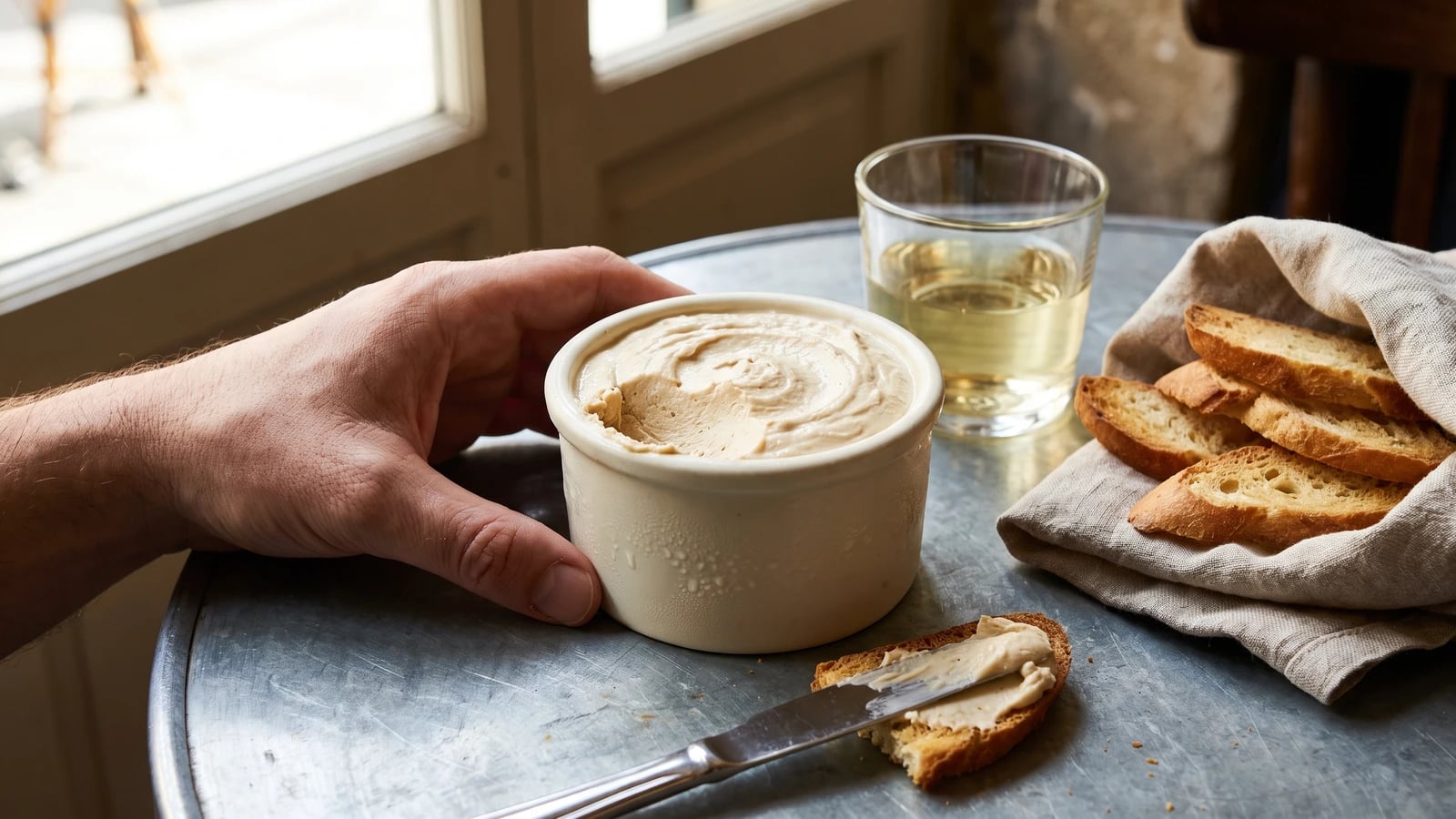
Oil-packed tuna, soft butter, and whisked cream become a cool, silken hors d'oeuvre for toast. Crème de thon teaches the cold emulsion: match temperatures, pound finely, then fold gently.
Crème de thon (tunny cream) teaches the cold emulsion in its smallest, clearest form. Before you touch a pan, know the one thing that decides it: the butter must be thoroughly soft but never melted, because it binds the pounded fish now and firms the spread when it chills. Cold butter leaves specks; melted butter makes a greasy cream. We don't apologize for butter, but we do respect its temperature.
The brigade kitchen assumed a commis at a heavy mortar, a fine tamis (drum sieve), and the companion smoked-salmon formula close at hand. Your honest equivalents are a mini processor, a fine-mesh sieve, and the finish written plainly into the method. The source's four ounces of tunny already make the right small bowl for six, so it needs no false enlargement. Only the tools and the cross-referenced finish are made explicit. One cook, one stove, one evening, though this time the stove may keep quiet.
Pounding and sieving are the dish; elaborate piping and molded buffet shapes are brigade scaffolding and can go. Work the softened butter completely into the smooth tuna paste before the whisked cream enters. Get that emulsion right, and everything afterward is gentle folding and a rest in the cold.
Crème de thon belongs to the Parisian classical repertoire of cold hors d'oeuvres, where the garde-manger, the cold-kitchen station, turned preserved fish into smooth creams for toast, small pastry cases, and buffet dishes. Its method traveled easily to the home apéritif because tunny in oil keeps well and the preparation asks for no cooking, only pounding, sieving, and chilling. Tunny is the English name used in the source for tuna, and the butter-and-cream finish marks this as a classical French fish cream, not a Provençal olive-oil spread.
Quantity
½ cup packed (4 oz / 113 g)
drained but not pressed dry
Quantity
¼ cup (2 oz / 57 g)
thoroughly softened but not melted
Quantity
2 tablespoons (30 ml / 30 g)
very cold
Quantity
16
for serving
| Ingredient | Quantity |
|---|---|
| oil-packed tunny or tunadrained but not pressed dry | ½ cup packed (4 oz / 113 g) |
| unsalted butterthoroughly softened but not melted | ¼ cup (2 oz / 57 g) |
| heavy creamvery cold | 2 tablespoons (30 ml / 30 g) |
| thin baguette toasts (optional)for serving | 16 |
About 45 minutes before mixing, set the butter in a medium bowl. It is ready when a spatula passes through without resistance and the surface remains matte, not shiny or liquid. Keep the cream cold. Drain the tunny for 10 minutes, then blot away loose surface oil without squeezing the fish dry; the oil held inside belongs to the ingredient, but a puddle would fight the butter.
Whisk the cold cream in a small chilled bowl until it thickens and holds a soft peak whose tip folds over. Stop there. Stiffly whipped cream is difficult to incorporate and leaves the finished crème de thon coarse rather than silken. Return it to the cold while you prepare the fish.
Process the drained tunny for 1 minute, scrape down the bowl, then process again until it becomes a close, uniform paste with no distinct flakes. Press it firmly through the fine-mesh sieve with a flexible scraper. The processor replaces the mortar, and the sieve replaces the tamis; both jobs matter. Stop after the processor and you have pleasant tuna rillettes, but not crème de thon.
Beat the softened butter until it looks like thick cream, then work in the sieved tunny a spoonful at a time. Beat each addition completely smooth before adding the next. If hard butter beads appear, wrap the outside of the bowl in a warm, damp towel for 10 seconds and beat again. If the mixture turns shiny and oily, chill it for 5 minutes, then resume beating. Ça se rattrape. The finished base should be cohesive, matte, and supple.
Fold one-third of the whisked cream into the tunny mixture to loosen it, then add the remainder in two gentle additions. Turn the bowl and sweep the spatula from bottom to top until no white streaks remain. Do not whisk vigorously now; the cream is here to lighten the emulsion, not to be beaten out of it.
Spoon the crème de thon loosely into a shallow crock, leaving natural ridges rather than piping it. Cover directly against the surface and chill for at least 1 hour, until the butter has given it a cool, spreadable body. Let it stand for 10 minutes before serving with thin baguette toasts. Set down the crock and let everyone help themselves. À table!
1 serving (about 33g)
Culinary guides, cultural storytelling, and the editorial depth that makes cooking meaningful.
Discover Culinary ExplorerChef Juliette
Tiny éperlans, lightly floured and fried until their tails stand crisp, arrive in a generous heap on a napkin with fried parsley and grooved lemon, a weeknight lesson in heat and restraint.

Chef Juliette
Brandade de Morue turns salt cod, warm olive oil, and milk into a pale, silky emulsion: keep everything warm and add the oil slowly, then crown the generous dome with butter-fried bread.

Chef Juliette
Salt cod worked warm with cream, one patient spoonful at a time, until the rough flakes become a glossy Nîmes paste, domed generously and ringed with butter-fried croutons for the table.

Chef Juliette
Wine-poached char packed in its earthenware crock beneath butter gold: a make-ahead first course that turns careful cooling, thorough boning, and one unbroken seal into quiet abundance.