
Chef Juliette
Smelt (Éperlans)
Tiny éperlans, lightly floured and fried until their tails stand crisp, arrive in a generous heap on a napkin with fried parsley and grooved lemon, a weeknight lesson in heat and restraint.
A cooking platform built around craft, culture, and the stories behind what we eat.
Created by Chef Juliette
Based on No. 297, Smoked Salmon Cream, from Le Guide Culinaire (1907) by Auguste Escoffier
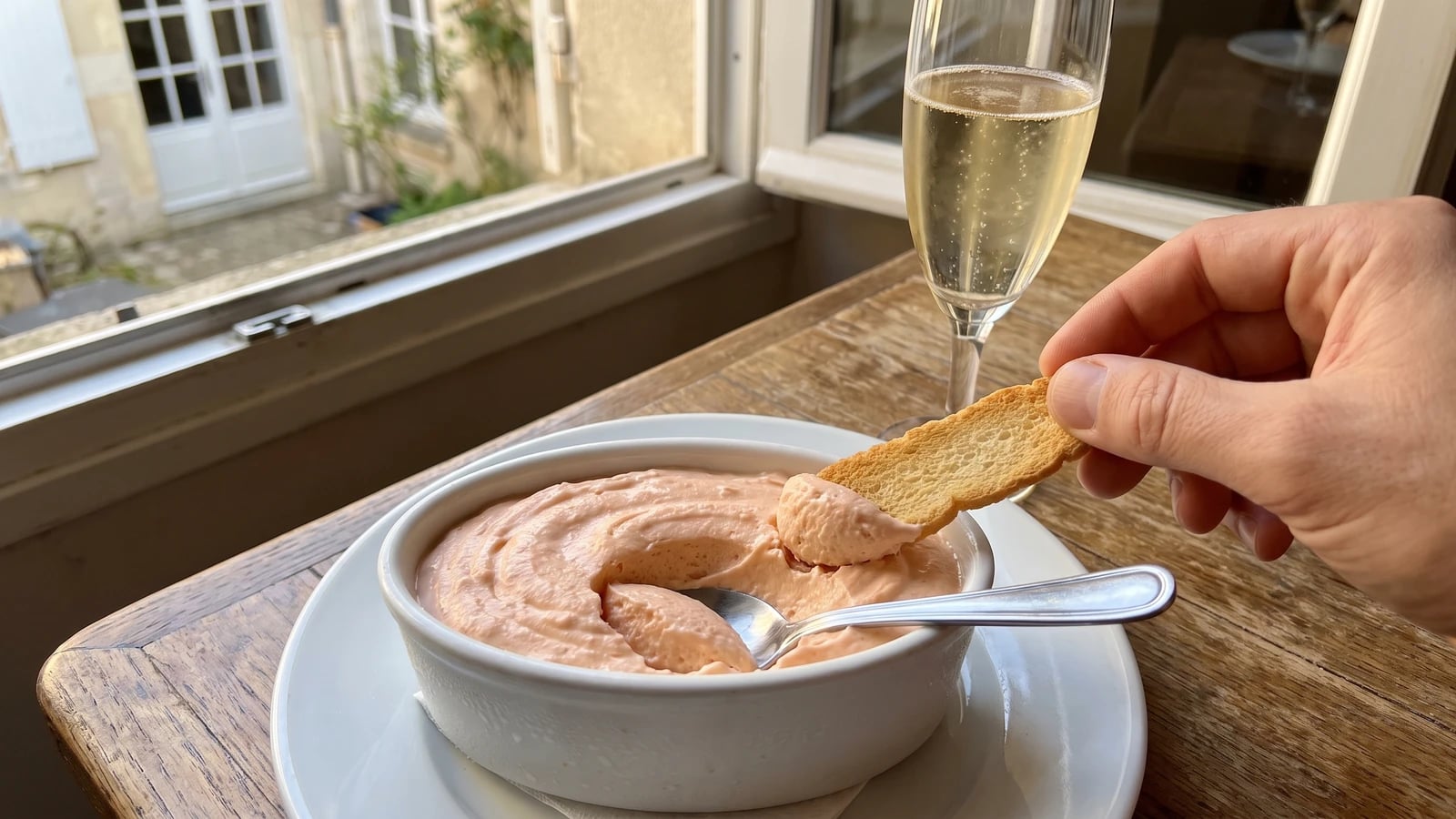
Crème de saumon fumé is a lesson in texture: smoked salmon, butter, and cream worked perfectly smooth, then lifted with softly whipped cream into a cool, silken spread for the first glass of the evening.
Crème de saumon fumé (smoked salmon cream) teaches the difference between richness and heaviness. The salmon, butter, and liquid cream make a smooth émulsion froide, a cold emulsion, but the final crème fouettée, softly whipped cream, gives it lift. Treat that last cream as air, not another liquid ingredient.
The original preparation assumed a garde-manger with a mortar, a broad tamis, and another pair of hands to pound and sieve. A small food processor and a fine-mesh sieve are the honest home equivalents. The lengthy hand-pounding and oversized equipment are brigade scaffolding, so they can go; passing the paste through the sieve and folding in exactly three tablespoons of crème fouettée are the dish, so they stay. The original proportions already make a modest home bowl, and they remain unchanged. One cook, one stove, one evening, with the stove spared entirely.
The finished cream should be pale coral, cool, and satiny, with enough body to hold the curve of a spoon without becoming dense. The final fold decides it: stop as soon as the white streaks disappear, before the air you made is pressed out.
Crème de saumon fumé belongs to the garde-manger of Parisian classical kitchens, where smoked fish was worked into smooth creams for the cold hors-d'œuvre table. It traveled naturally to the home apéritif because it could be prepared ahead and served generously with thin toast. It is not rillettes de saumon: rillettes preserve visible flakes, while this preparation is defined by the sieve and the lift of crème fouettée.
Quantity
4 ounces (113 g)
finely chopped
Quantity
3 tablespoons (45 ml / 45 g)
35 to 40 percent fat
Quantity
4 tablespoons (60 ml / 57 g)
softened but not greasy
Quantity
3 tablespoons (45 ml / about 23 g), measured after whipping; begin with 1/4 cup (60 ml / 60 g) cold liquid cream for workable whisking
whipped only to soft folds
| Ingredient | Quantity |
|---|---|
| cold-smoked salmonfinely chopped | 4 ounces (113 g) |
| heavy whipping cream for the salmon base35 to 40 percent fat | 3 tablespoons (45 ml / 45 g) |
| unsalted buttersoftened but not greasy | 4 tablespoons (60 ml / 57 g) |
| softly whipped heavy creamwhipped only to soft folds | 3 tablespoons (45 ml / about 23 g), measured after whipping; begin with 1/4 cup (60 ml / 60 g) cold liquid cream for workable whisking |
Cut the butter into small pieces and let it soften until a finger presses into it easily, but its surface still looks matte. Keep the salmon and both measures of cream cold. Butter that is hard leaves pale flecks; butter that has begun to shine makes the mixture greasy. If it becomes oily, chill it for five minutes rather than trying to work around it.
Put the chopped smoked salmon in a small food processor and pulse, scraping the bowl often, until it gathers into a fine, cohesive paste. Do not let the machine run continuously, because friction warms the salmon and smears out its fat. If using a mortar, pound small portions until perfectly smooth, then combine them.
Add the 3 tablespoons of liquid cream one teaspoon at a time, pulsing after each addition until it disappears completely into the salmon. Add the softened butter in six small portions, working each one in before the next. The finished émulsion froide should look satin-smooth and hold together without an oily rim. If it turns loose or greasy, stop immediately, scrape it into a bowl, and chill it for eight to ten minutes before pulsing again in short bursts. Ça se rattrape.
Set a fine-mesh sieve over a cold bowl and press the salmon mixture through with a flexible scraper or the back of a sturdy spoon. Work across the mesh methodically, then scrape every bit of smooth paste from the underside. Discard the few fibrous scraps left behind. This pass through the sieve is not ceremony: it removes the threads that pounding alone cannot, giving the cream its silken finish.
From the 1/4 cup of cold cream, reserve 1 tablespoon in case the whisked cream needs loosening. Whisk the remaining cream in the chilled narrow bowl until it forms soft folds that slump gently from the whisk. Measure exactly 3 tablespoons of the finished crème fouettée. If it becomes grainy, stir in the reserved liquid cream a few drops at a time until smooth, then whisk briefly. Fold one-third into the salmon base to loosen it, then fold in the remainder with broad turns of the spatula. Stop the moment no white streaks remain.
Spoon the cream into a small serving dish, leaving generous natural curves rather than packing it flat. Cover and chill for at least one hour so the butter firms and the flavors settle together. Take it from the cold ten minutes before serving, just long enough to become spreadable while remaining cool. Serve with thin, crisp toast. À table!
1 serving (about 40g)
Culinary guides, cultural storytelling, and the editorial depth that makes cooking meaningful.
Discover Culinary ExplorerChef Juliette
Tiny éperlans, lightly floured and fried until their tails stand crisp, arrive in a generous heap on a napkin with fried parsley and grooved lemon, a weeknight lesson in heat and restraint.

Chef Juliette
Brandade de Morue turns salt cod, warm olive oil, and milk into a pale, silky emulsion: keep everything warm and add the oil slowly, then crown the generous dome with butter-fried bread.

Chef Juliette
Salt cod worked warm with cream, one patient spoonful at a time, until the rough flakes become a glossy Nîmes paste, domed generously and ringed with butter-fried croutons for the table.

Chef Juliette
Wine-poached char packed in its earthenware crock beneath butter gold: a make-ahead first course that turns careful cooling, thorough boning, and one unbroken seal into quiet abundance.