
Chef Juliette
Bavaroise
Bavaroise turns the ribbon stage into a drink: yolks and sugar, boiling tea and milk, and Kirsch whisked into a light crown of foam. Keep the whisk moving, and the café comes home.
A cooking platform built around craft, culture, and the stories behind what we eat.
Created by Chef Juliette
Based on No. 2947, Iced Punch, from Le Guide Culinaire (1907) by Auguste Escoffier
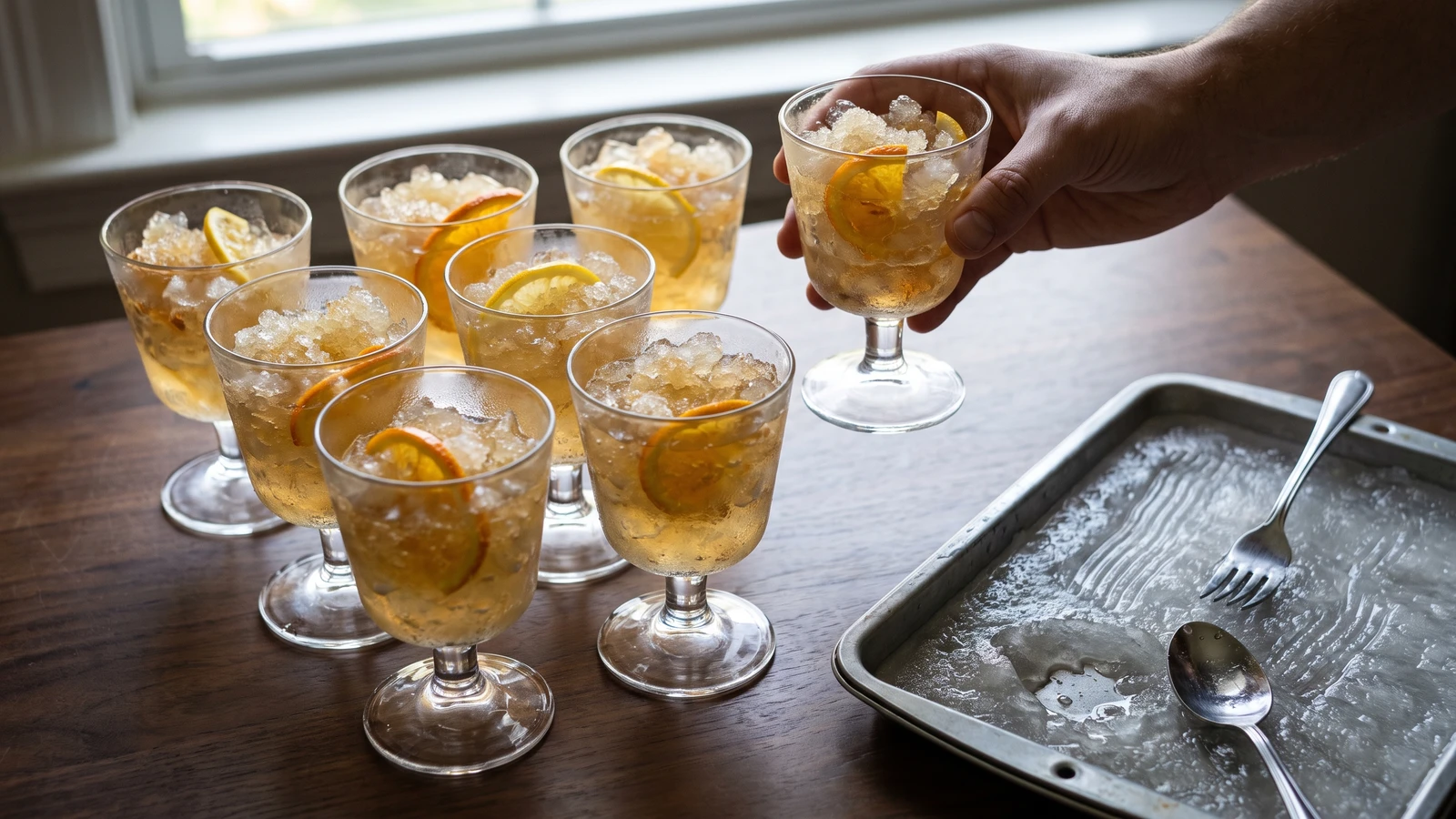
Tea, citrus, wine, and rum become a crystalline Punch Glacé à la Marquise, flamed while hot, corrected to 15° on the syrup scale, then scraped into bright, loose granité.
Punch Glacé à la Marquise (iced Marquise punch) teaches that a granité is governed before it freezes. Its texture is decided by density: hold the punch at 15° on the syrup scale and it rakes into bright, loose crystals; miss that mark and you get either a hard block or a wet drift. Granité means a coarse scraped ice, and the coarseness is deliberate.
The source begins with Marquise Punch already prepared, and so does this version; that finished component remains whole because its method belongs to its own entry. The grand kitchen also assumed a syrup hydrometer, an ice worker, and room to freeze a punch-bowl quantity. Here, 1.2 litres makes eight generous glasses, a shallow metal pan replaces the ice room, and a fork does the worker's scraping. The half ounce of tea, raw-peeled citrus, warmed rum, ten-minute infusion, and flame all stay, because those steps are the dish; only the brigade volume and constant attendance are scaffolding.
Because the source calls only for “some” rum, this home batch fixes it at 120 ml, enough to flame in a controlled layer without burying the wine and tea. Cool the punch completely, then bring it to exactly 15° on the syrup scale before it enters the freezer. That reading is the dish.
Punch glacé à la Marquise belongs to the formal Parisian table, within the French repertoire of frozen punches served in small glasses between substantial courses or at the close of a meal. It carries hot wine punch into the office des glaces, the ice kitchen, where tea was infused, citrus added, rum flamed, and the finished mixture corrected on the syrup scale before freezing. Despite the name punch, the classical preparation is not a drink poured over ice; the punch becomes the ice, deliberately crystalline rather than churned smooth like a sorbet.
Quantity
5 cups (1.2 L / approximately 1.25 kg)
prepared according to its own entry
Quantity
2 tablespoons plus 1 teaspoon (35 ml / 14 g)
Quantity
1 medium (about 200 g)
peeled à vif and sliced 5 mm thick
Quantity
1 medium (about 120 g)
peeled à vif and sliced 5 mm thick
Quantity
1/2 cup (120 ml / approximately 110 g)
Quantity
Up to 1/2 cup (120 ml / 100 g)
for correcting a low syrup reading
Quantity
Up to 1 cup (240 ml / 240 g)
for correcting the syrup reading
| Ingredient | Quantity |
|---|---|
| Marquise Punchprepared according to its own entry | 5 cups (1.2 L / approximately 1.25 kg) |
| loose-leaf unflavored black tea | 2 tablespoons plus 1 teaspoon (35 ml / 14 g) |
| orangepeeled à vif and sliced 5 mm thick | 1 medium (about 200 g) |
| lemonpeeled à vif and sliced 5 mm thick | 1 medium (about 120 g) |
| amber or dark rum, 40 to 50% alcohol | 1/2 cup (120 ml / approximately 110 g) |
| fine granulated sugar (optional)for correcting a low syrup reading | Up to 1/2 cup (120 ml / 100 g) |
| chilled water (optional)for correcting the syrup reading | Up to 1 cup (240 ml / 240 g) |
Pour the prepared Marquise Punch into a 2-quart (2 L) stainless-steel saucepan and heat it gently to about 175°F (80°C), hot but not boiling. Take the pan off the burner immediately. Boiling would drive away the wine's perfume before the tea and citrus have joined it.
Add the black tea, cover the saucepan, and infuse for exactly 10 minutes. The measured half ounce gives the punch its tannic backbone, but a longer infusion turns that backbone bitter. If the clock runs away from you, strain at once and do not press the leaves; pressing extracts the harshest part.
Pass the punch through a fine-mesh strainer into a clean, wide saucepan. Add the orange and lemon slices, both peeled à vif, meaning cut down to the bare flesh with every strip of bitter white pith removed. Keep the slices intact and distribute them across the surface.
Warm the rum separately to about 120°F (50°C), never to a boil. Turn off the burner, move the punch to a cleared heatproof surface, keep its lid beside you, and pour the warm rum gently across the surface without stirring. Flamber, to set the rum alight, with a long lighter and let the flame subside on its own; if it continues beyond 30 seconds, cover the pan. Never pour rum directly from the bottle near a flame, and never lean over the pan. If it does not catch, do not keep adding alcohol. The punch can continue, and its flavour remains sound.
Let the punch cool completely with the citrus in it, then chill it to 68°F (20°C). Measure the clear liquid with a syrup hydrometer and bring it to exactly 15° Baumé, approximately a specific gravity of 1.115. If the reading is below 15°, the granité will freeze hard: dissolve 2 tablespoons (25 g) sugar in 1 tablespoon (15 ml) water, cool the concentrated syrup, add it gradually, and remeasure. If the reading is above 15°, add chilled water 1 tablespoon (15 ml) at a time and remeasure. Ça se rattrape. Do not boil the punch down to correct it, because that sacrifices the alcohol and citrus aroma.
Pour the punch and citrus slices into a shallow metal pan, arranging most of the slices near the edges. Freeze for 45 minutes, then rake the forming ice from the sides toward the centre with a fork. Continue freezing and raking every 30 minutes until the whole mixture forms loose, coarse crystals, about 4 to 5 hours. This repeated scraping is what makes a granité rather than a solid block. If it hardens before you can rake it, leave the pan at room temperature for 5 minutes, break it up, and check the density again before refreezing.
Chill eight small stemmed glasses. Rake the granité once more so the crystals fall loosely, then spoon it generously into the glasses, placing a thin flamed citrus slice against the side of each. Serve at once with small spoons. À table!
1 serving (about 200g)
Culinary guides, cultural storytelling, and the editorial depth that makes cooking meaningful.
Discover Culinary ExplorerChef Juliette
Bavaroise turns the ribbon stage into a drink: yolks and sugar, boiling tea and milk, and Kirsch whisked into a light crown of foam. Keep the whisk moving, and the café comes home.

Chef Juliette
Bischoff turns Champagne, tilleul, citrus, and brandy into pale-gold granité, coarse enough to sparkle under the spoon. The scraping makes the texture, and the timer becomes your smallest member of the brigade.

Chef Juliette
Café glacé is coffee taught by texture: dark, sweet, vanilla-softened, and churned only until it moves like loose snow. Stop before ice cream, pour into cold cups, and take it outside.
Chef Juliette
Zest brings perfume, juice brings acid, and three cool hours join them: a clear, lively French limonade finished with seltzer for the picnic table in the shade.