
Chef Juliette
Bavaroise
Bavaroise turns the ribbon stage into a drink: yolks and sugar, boiling tea and milk, and Kirsch whisked into a light crown of foam. Keep the whisk moving, and the café comes home.
A cooking platform built around craft, culture, and the stories behind what we eat.
Created by Chef Juliette
Based on No. 2944, Punch with Kirsch, from Le Guide Culinaire (1907) by Auguste Escoffier
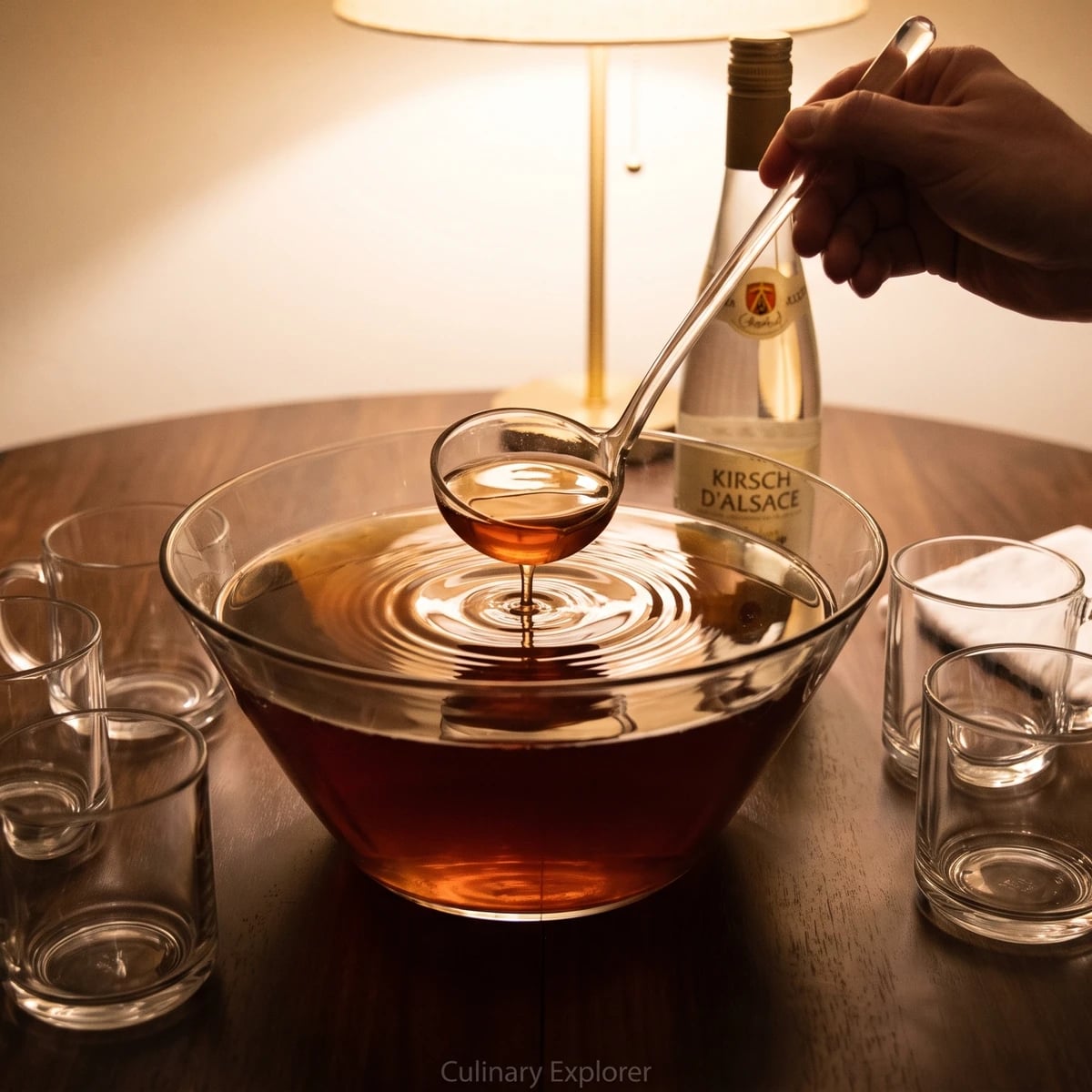
Punch au kirsch is clear amber, cherry-scented and celebratory, with strong tea holding dry eau-de-vie in balance. Dissolve the sugar first, then the bowl is ready for its brief blue flame.
Punch au kirsch (hot Kirsch punch) teaches one exact order: the sugar must disappear into the hot tea before the spirit enters. Kirsch is a dry eau-de-vie, not a sweet liqueur, and sugar that meets it too late can remain gritty at the bottom of the bowl.
The book's formula filled a professional service bowl and assumed a silver spoon, a roomful of guests, and spare hands to manage a live flame. Here its proportions are halved exactly for six small glasses. A two-litre stainless steel bowl replaces the uncertain salad bowl, and a long stainless spoon replaces silver. The silver was nonreactive scaffolding. The ten-minute infusion, the sugar-first sequence, and the Kirsch flame are the dish. One cook, one stove, one evening.
When it is right, the punch is clear amber and richly sweet, with brisk tea beneath the clean scent of cherries. The one step that matters most is simple: strain the boiling-hot infusion over the sugar and stir until the bowl feels perfectly smooth before the Kirsch comes near it.
Punch au kirsch belongs to the French banquet and holiday table, while its defining spirit points east to Alsace and Franche-Comté, where cherries are distilled into dry, clear eau-de-vie and Fougerolles is especially associated with kirsch. Punch reached French dining rooms through maritime trade, then classical service fixed this version around strong tea, loaf sugar, and a brief flame. Kirsch is not a sweet cherry liqueur, a useful correction: the sugar in the bowl supplies the sweetness the spirit does not.
Quantity
2 cups (475 ml / 475 g)
freshly boiled
Quantity
about 3 tablespoons (45 ml / 7 g)
Quantity
8 oz by weight (227 g; granulated volume equivalent: 1 cup plus 2 tablespoons / 270 ml)
broken into small lumps if necessary
Quantity
1½ cups (355 ml / approximately 335 g)
at room temperature
| Ingredient | Quantity |
|---|---|
| waterfreshly boiled | 2 cups (475 ml / 475 g) |
| loose unflavoured black tea | about 3 tablespoons (45 ml / 7 g) |
| white loaf sugar or plain white sugar cubesbroken into small lumps if necessary | 8 oz by weight (227 g; granulated volume equivalent: 1 cup plus 2 tablespoons / 270 ml) |
| dry Kirsch eau-de-vie, 40 to 45% ABVat room temperature | 1½ cups (355 ml / approximately 335 g) |
Bring the water to a full boil, take it off the heat, and pour it over the loose tea in a heatproof pot or saucepan. Cover and infuse for the full ten minutes. This is deliberately stronger than breakfast tea: the sugar and Kirsch need its tannic backbone, so don't shorten the infusion because the colour looks dark.
Put the loaf sugar or sugar cubes into the flameproof punch bowl. Strain the hot tea directly over them, then stir continuously with the long stainless spoon until every crystal has dissolved and the spoon finds no grit along the bottom. Do not add the Kirsch while grains remain. If the tea cools first, ça se rattrape: set the bowl over a saucepan of barely simmering water, without letting its base touch the water, and keep stirring until the liquid is completely clear.
Clear the table around the bowl, turn off every nearby burner, and place a flat metal lid or rimmed baking sheet within reach. Pour the measured Kirsch into the sweet hot tea and stir once. Cap the bottle immediately and move it well away from the bowl. Never warm the Kirsch separately and never pour from the bottle once any flame is present.
Flamber, setting the surface alight, by touching a long match or long-reach lighter to the far edge of the punch and withdrawing your hand at once. The flame should be low and blue, and it can be difficult to see in a bright room. Let it burn for 10 to 15 seconds, without moving the bowl, then slide the lid or baking sheet over it until the flame is fully extinguished. Do not blow on it or ladle while it burns. If it does not catch on the first attempt, don't add more spirit or keep striking matches. Serve it unflamed; the flavour is already complete.
Warm six heatproof punch glasses with hot tap water, then empty and dry them. Once you have confirmed that the flame is completely out, stir the punch gently and ladle it into the glasses. The source moves directly from flame to service, but at home the bowl is smothered first because one cook cannot safely manage a live flame and six glasses at once. Serve immediately. À table!
1 serving (about 165g)
Culinary guides, cultural storytelling, and the editorial depth that makes cooking meaningful.
Discover Culinary Explorer
Chef Juliette
Bavaroise turns the ribbon stage into a drink: yolks and sugar, boiling tea and milk, and Kirsch whisked into a light crown of foam. Keep the whisk moving, and the café comes home.

Chef Juliette
Bischoff turns Champagne, tilleul, citrus, and brandy into pale-gold granité, coarse enough to sparkle under the spoon. The scraping makes the texture, and the timer becomes your smallest member of the brigade.

Chef Juliette
Café glacé is coffee taught by texture: dark, sweet, vanilla-softened, and churned only until it moves like loose snow. Stop before ice cream, pour into cold cups, and take it outside.

Chef Juliette
Zest brings perfume, juice brings acid, and three cool hours join them: a clear, lively French limonade finished with seltzer for the picnic table in the shade.