
Chef Juliette
Various Almond Preparations
Five almond preparations, one discipline: remove the skins cleanly, dry every kernel through, then cut, toast, or cloak it in pale caramel without letting its fragrant oils escape.
A cooking platform built around craft, culture, and the stories behind what we eat.
Created by Chef Juliette
Based on No. 2931, Marquises, from Le Guide Culinaire (1907) by Auguste Escoffier
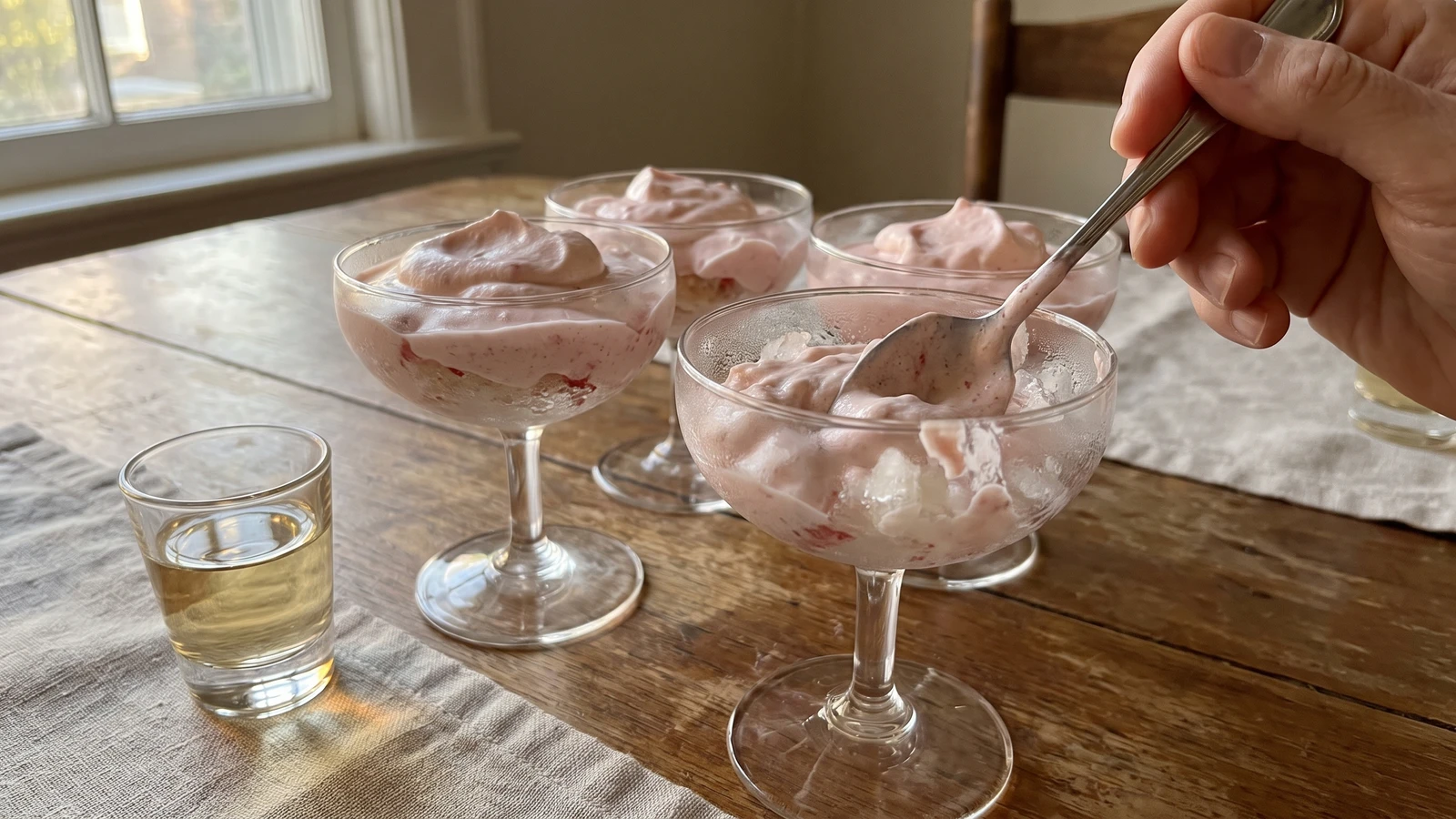
Kirsch sherbet frozen finer and firmer than granité, then folded at the glass with fruit Chantilly: a cold dessert whose pleasure lies in the last-minute contrast of crystals, cream, and ripe fruit.
Marquises aux fraises ou à l’ananas (firm kirsch sherbet folded with fruit Chantilly) teach a precise lesson about frozen desserts: texture can be assembled at the last second. The one true thing to know before warming the syrup is this: the final fold is the dish. Combine the sherbet and cream too early and you get a pleasant pink or golden ice, but lose the contrast that makes a Marquise.
The original recipe assumed a pastry station with a salt-and-ice freezing pot, a saccharometer reading 17°, and a hand waiting for the dining room’s call. At home, a gram scale fixes the syrup at the same useful concentration, a shallow metal pan replaces the freezing pot, and four chilled glasses replace brigade service. This version reduces the quantity, not the intention: two parts kirsch sherbet to one part fruit Chantilly, folded only when each glass is served. The equipment was scaffolding. That ratio and the last-minute fold are the dish. One cook, one stove, one evening.
When it is right, fine translucent crystals remain distinct among cold ribbons of fruit and cream. Freeze the sherbet beyond the loose texture of granité, whip the Chantilly until it stands firmly, and stop the final fold after two or three turns. Restraint matters most at the glass.
Marquises belong to the classical French repertoire of entremets glacés served from the pastry station into the grand Parisian dining room, not to a regional farmhouse tradition. Their defining practice was service itself: a kirsch sherbet frozen beyond granité texture, then combined only when called for with very stiff Chantilly carrying strawberry or pineapple purée. The chocolate marquise found elsewhere is a separate preparation; here the plural name belongs to this family of fruit-and-kirsch frozen desserts.
Quantity
1½ cups (355 ml / 355 g)
Quantity
¾ cup (180 ml / 150 g)
Quantity
¼ cup (60 ml / 57 g)
Quantity
⅓ cup (80 ml / 80 g)
very cold
Quantity
⅓ cup (80 ml / 80 g)
very cold
Quantity
2 teaspoons (10 ml / 5 g)
Quantity
⅛ teaspoon (0.6 ml / 0.6 g)
Quantity
1 tablespoon (15 ml / 15 g)
very cold, for rescuing overwhipped Chantilly
| Ingredient | Quantity |
|---|---|
| water | 1½ cups (355 ml / 355 g) |
| granulated sugar | ¾ cup (180 ml / 150 g) |
| dry kirsch | ¼ cup (60 ml / 57 g) |
| strained strawberry or pineapple puréevery cold | ⅓ cup (80 ml / 80 g) |
| heavy creamvery cold | ⅓ cup (80 ml / 80 g) |
| confectioners’ sugar | 2 teaspoons (10 ml / 5 g) |
| pure vanilla extract | ⅛ teaspoon (0.6 ml / 0.6 g) |
| additional heavy cream (optional)very cold, for rescuing overwhipped Chantilly | 1 tablespoon (15 ml / 15 g) |
Combine the water and granulated sugar in a small saucepan. Warm over medium-low heat, stirring gently, just until every crystal dissolves and the syrup turns perfectly clear. Let it reach the first quiet simmer, then remove it at once; reducing it would change the balance established by the old 17° saccharometer reading. Cool completely, first on the counter and then in the cold.
Stir the kirsch into the cold syrup, then pour the mixture into a prechilled shallow metal pan, keeping it no deeper than 2 cm. Freeze for about 45 minutes, until the edges are solid and the middle is slushy. Rake the frozen edges inward with a fork, return the pan to the freezer, and rake again every 30 minutes until the sherbet forms fine, firm crystals that hold a scoop instead of slumping, about 3 to 4 hours in all. Carry the freezing a little farther than granité, as the original directs. If it becomes a solid slab, leave it at room temperature for 3 to 5 minutes and rake from the surface; if it remains loose, spread it more thinly and move it to the coldest part of the freezer. Ça se rattrape.
Purée ripe strawberries or pineapple until completely smooth, pass the fruit through a fine sieve, and measure exactly ⅓ cup. Chill it until thoroughly cold. The strawberry version is called Marquises aux fraises; the pineapple version is Marquises à l’ananas. Keep the fruits separate and let the designation follow the purée.
Chill a small bowl and whisk, then beat the heavy cream with the confectioners’ sugar and vanilla until it forms very stiff peaks and the whisk leaves ridges that remain upright. Stop before the cream turns grainy. If it does begin to curdle, stop immediately and whisk in the optional cold cream one teaspoon at a time until smooth. Fold the cold fruit purée through in two additions, using broad turns so the Chantilly keeps its body. You should have about 1 cup of firm fruit Chantilly; hold it in the cold for no more than 30 minutes.
Rake the kirsch sherbet once more to loosen its crystals. Place about ½ cup of sherbet in each chilled glass and add about ¼ cup of fruit Chantilly, preserving the original two-to-one proportion. With a cold dessert spoon, cut down through the two and lift only two or three times. Stop while ribbons of cream, fruit, and translucent ice remain visible; mixing until uniform erases the texture the whole preparation was built to preserve. Serve immediately. À table!
1 serving (about 185g)
Culinary guides, cultural storytelling, and the editorial depth that makes cooking meaningful.
Discover Culinary ExplorerChef Juliette
Five almond preparations, one discipline: remove the skins cleanly, dry every kernel through, then cut, toast, or cloak it in pale caramel without letting its fragrant oils escape.

Chef Juliette
A pastry pantry lesson in one tray: filberts warmed only until their red skins release, rubbed clean, cooled, and chopped into a fragrant mise-en-place for cakes, creams, pralines, and petits fours.

Chef Juliette
The smallest pâtisserie discipline decides whether a cake leaves its mould intact: clarified butter in every corner, followed by the lightest veil of dry flour or fécule.

Chef Juliette
Four whites, one spotless bowl, and a patient change of speed: whisk gently until loosened, then briskly to glossy stiffness, with powdered sugar waiting if the foam begins to granulate.