
Chef Juliette
Various Almond Preparations
Five almond preparations, one discipline: remove the skins cleanly, dry every kernel through, then cut, toast, or cloak it in pale caramel without letting its fragrant oils escape.
A cooking platform built around craft, culture, and the stories behind what we eat.
Created by Chef Juliette
Based on No. 2929, Sorbet à la Sicilienne, from Le Guide Culinaire (1907) by Auguste Escoffier
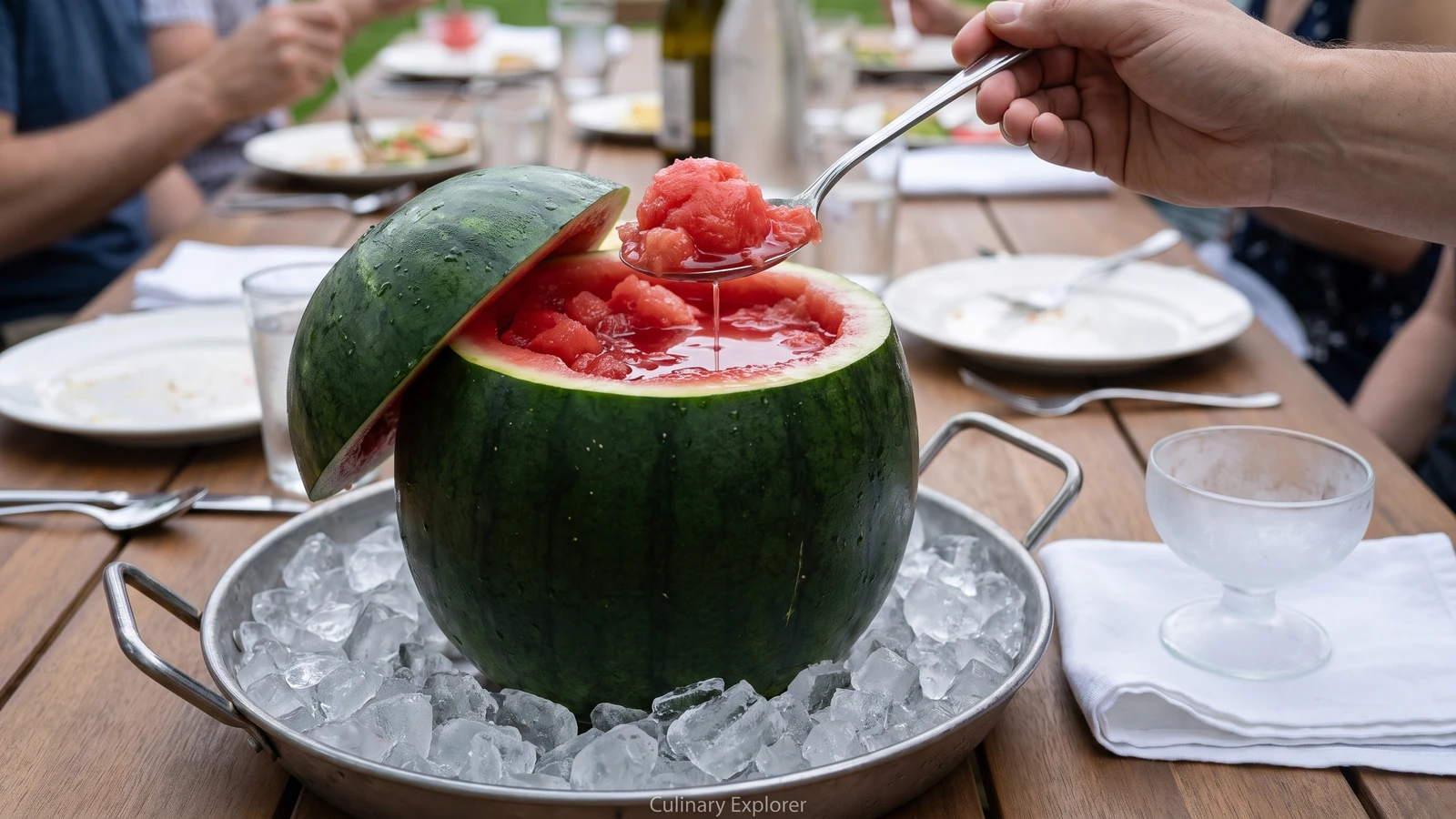
A green watermelon, chilled through and opened before service, holds ruby pulp loosened in its own shell and scented with maraschino. No churning, no syrup, just cold fruit served from the rind.
Sorbet à la Sicilienne (watermelon chilled in its shell with maraschino) teaches one true thing: cold can be a technique, not merely a temperature. There is no churned ice here. The whole green melon becomes its own bowl, its ruby pulp loosened but never removed, brightened with maraschino, and carried to the table on ice. The chill is the recipe.
The original formula assumed professional cold storage, hands to fracture or carve a block of ice, silver service, and someone ready to spoon the melon before the diners. At home, use one small seeded watermelon for four, a stainless-steel spoon in place of silver, and a shallow platter of crushed ice instead of a sculpted block. The carved ice was service scaffolding and can go. The three-hour whole-fruit chill, the one-hour rest after the maraschino, and the flesh left inside its shell are the dish, and they stay. One cook, one refrigerator, one summer table.
Before you touch the knife, give the whole fruit its full three hours in the cold. A melon opened too soon never catches up at the center; once cold, work gently enough to keep the pulp in generous pieces and the rind watertight. That first deep chill decides everything.
Within the French classical repertory, Sorbet à la Sicilienne belongs to the grand-service table, where chilled fruit could arrive in its own shell and be portioned before the diners into sorbet glasses. It moves watermelon from the fruit course into sorbet service by borrowing the ice bed and glassware, though the flesh itself is never churned or frozen. The Sicilian title should not be mistaken for a formula for granita; the method is French tableside service, with maraschino supplying the only perfume.
Quantity
1, about 5 lb (2.3 kg)
Quantity
1/4 cup (60 ml / 65 g)
Quantity
8 cups (1.9 L / about 1 kg)
for presentation
| Ingredient | Quantity |
|---|---|
| small seeded, dark-green-skinned watermelon | 1, about 5 lb (2.3 kg) |
| clear maraschino liqueur | 1/4 cup (60 ml / 65 g) |
| crushed icefor presentation | 8 cups (1.9 L / about 1 kg) |
Wash and dry the whole watermelon, then refrigerate it for three full hours. Keep it on a low, cold shelf rather than in the freezer; the flesh must become thoroughly cold without freezing, which would make it watery once cut. During the final hour, place four sherbet glasses or coupes in the refrigerator.
One hour before serving, steady the cold melon on a folded towel and cut a neat cap, about 4 inches (10 cm) across, from the top. Angle the knife slightly inward so the cap cannot fall through the opening, then reserve it. Set the melon upright in a snug bowl while you work; a rolling watermelon and a sharp knife have no business negotiating with one another.
Use a long-handled stainless-steel spoon to remove every visible seed. Slide the spoon between the ruby flesh and the pale inner rind, detaching the pulp all around without lifting it from the fruit, then divide it inside the shell into generous, irregular spoonfuls. Work gently and never scrape through the rind. If you puncture it, ça se rattrape: leave the melon in its snug bowl, collect any escaped juice, and divide that juice among the glasses when you serve.
Sprinkle the maraschino evenly over the loosened pulp, letting it run between the pieces without stirring them to a mash. Replace the cap and return the whole fruit to the refrigerator for exactly one hour. If the melon releases plenty of juice, keep it. That cold, maraschino-scented liquor belongs in the glasses with the fruit.
Just before serving, mound the crushed ice in a shallow rimmed platter and press a hollow into its center. Nest the capped watermelon upright in the ice, using a small bowl or support ring beneath it if necessary. Crushed ice is the honest home equivalent of the original fractured or carved block: it holds the melon securely and preserves the deep chill without turning service into sculpture.
Carry the melon to the table on its ice bed, lift off the cap, and spoon the pulp before the diners into the chilled sherbet glasses. Give each serving generous pieces of watermelon and some of the clear pink juice gathered at the bottom of the shell. Serve immediately, while fruit, glass, and spoon are all properly cold. À table!
1 serving (about 330g)
Culinary guides, cultural storytelling, and the editorial depth that makes cooking meaningful.
Discover Culinary ExplorerChef Juliette
Five almond preparations, one discipline: remove the skins cleanly, dry every kernel through, then cut, toast, or cloak it in pale caramel without letting its fragrant oils escape.

Chef Juliette
A pastry pantry lesson in one tray: filberts warmed only until their red skins release, rubbed clean, cooled, and chopped into a fragrant mise-en-place for cakes, creams, pralines, and petits fours.

Chef Juliette
The smallest pâtisserie discipline decides whether a cake leaves its mould intact: clarified butter in every corner, followed by the lightest veil of dry flour or fécule.

Chef Juliette
Four whites, one spotless bowl, and a patient change of speed: whisk gently until loosened, then briskly to glossy stiffness, with powdered sugar waiting if the foam begins to granulate.