
Chef Juliette
Various Almond Preparations
Five almond preparations, one discipline: remove the skins cleanly, dry every kernel through, then cut, toast, or cloak it in pale caramel without letting its fragrant oils escape.
A cooking platform built around craft, culture, and the stories behind what we eat.
Created by Chef Juliette
Based on No. 2921, Marie-Rose Pudding, from Le Guide Culinaire (1907) by Auguste Escoffier
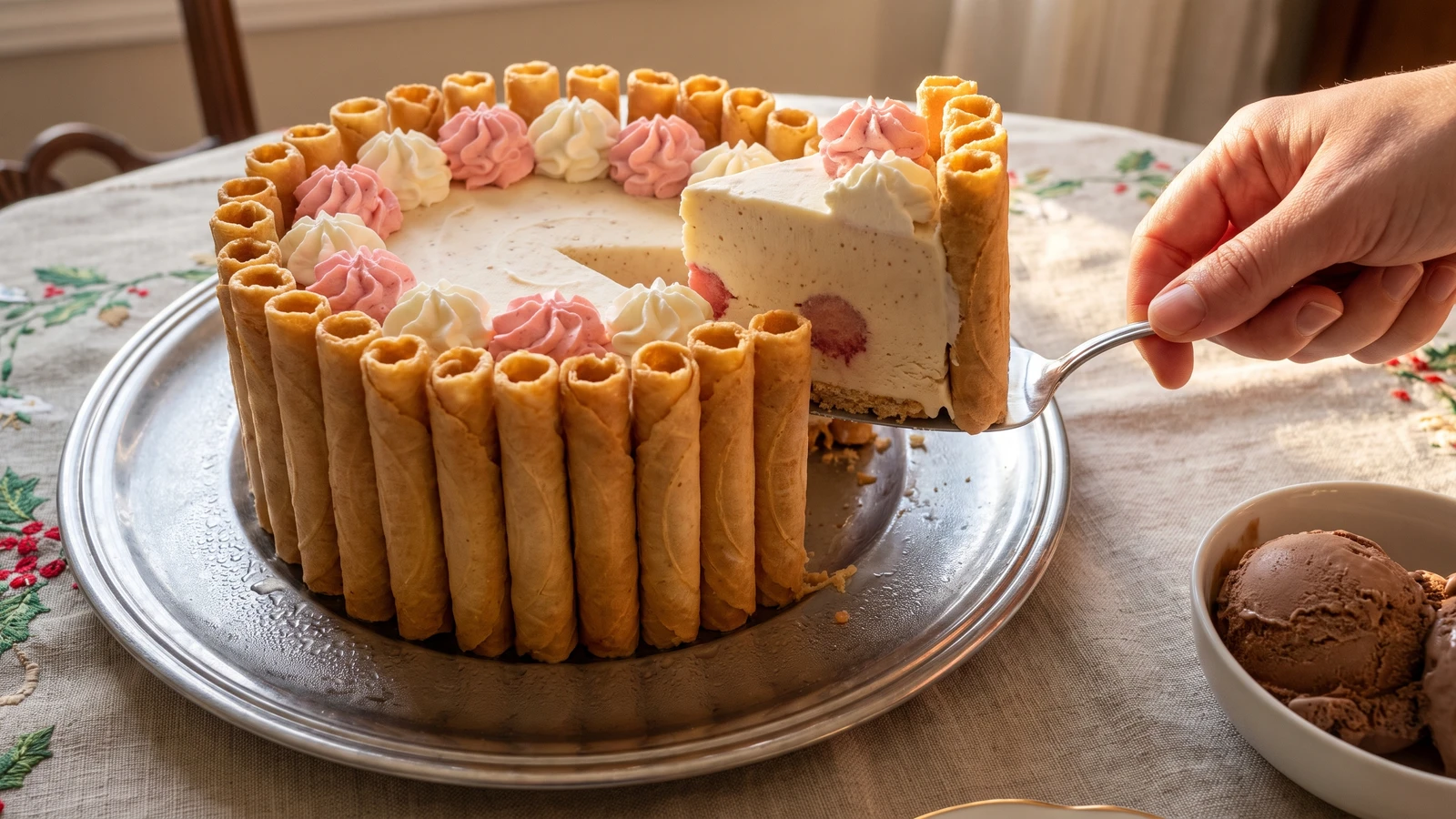
Crisp gaufrettes filled with hard strawberry ice form the pink wall around a vanilla-praline bombe, crowned in two-tone Chantilly and served with chocolate ice cream alongside.
Pouding Marie-Rose (Marie-Rose frozen pudding) teaches the cold pastry rule: temperature is structure. A Gaufrette, a special rolled wafer, stays crisp only when the strawberry ice piped inside it is nearly hard. Let the ice go slack and the wafer drinks it, then the wall gives. Before you touch the syrup pan, clear the freezer shelf and chill every tool that will meet the ice.
The original needed no saucier, stockpot, or salamander. It assumed the equivalent extravagance of a pastry brigade able to reach for prepared strawberry ice, a vanilla pralined Bombe-preparation, two colors of Chantilly, and chocolate ice cream from separate stations. At home, use a dense purchased strawberry sorbet and good chocolate ice cream, then make the pralined pâte à bombe yourself. Making three separate frozen bases was brigade scaffolding and can go. The hard-filled wafer wall, the pralined centre, the two-tone cream, and the separate chocolate service are the dish and stay. One cook, one stove, one evening.
Turned out, the Marie-Rose stands like a little crown of golden wafers, pink strawberry hidden inside each tube, with a pale vanilla-praline heart and generous curls of pink and white cream above. The decisive act is piping that strawberry ice while it is hard enough to hold its shape. Guard that moment and the rest follows.
Pouding Marie-Rose belongs to the Parisian grand-kitchen family of entremets glacés, celebration sweets assembled from prepared ices, wafers, Bombe mixtures, and piped cream. Its construction moved naturally to domestic celebration tables once a home freezer and well-made prepared ices could supply what the pastry brigade once kept ready. Despite the word pudding, it is neither baked nor steamed; structurally it is a frozen charlotte, and the separately served chocolate ice cream is part of its intended contrast rather than a sauce.
Quantity
36 (about 6 ounces / 170 g)
Quantity
½ cup (120 ml / 125 g)
Quantity
3
for the vanilla pralined Bombe-preparation
Quantity
⅓ cup plus 1 tablespoon (95 ml / 80 g)
Quantity
2 tablespoons (30 ml / 30 g), plus up to 1 tablespoon (15 ml / 15 g) if needed
Quantity
⅓ cup (80 ml / 100 g)
Quantity
1 cup (240 ml / 240 g)
for the Bombe-preparation
Quantity
1 teaspoon (5 ml / 5 g)
for the Bombe-preparation
Quantity
¾ cup (180 ml / 180 g)
for the Chantilly
Quantity
2 tablespoons (30 ml / 16 g)
Quantity
½ teaspoon (2.5 ml / 2.5 g)
for the Chantilly
Quantity
1 drop
Quantity
1 pint (475 ml / 425 g)
held firm for separate service
| Ingredient | Quantity |
|---|---|
| hollow rolled Gaufrettes (special wafer tubes) | 36 (about 6 ounces / 170 g) |
| very firm strawberry ice or dense strawberry sorbet | ½ cup (120 ml / 125 g) |
| large egg yolksfor the vanilla pralined Bombe-preparation | 3 |
| superfine sugar | ⅓ cup plus 1 tablespoon (95 ml / 80 g) |
| water | 2 tablespoons (30 ml / 30 g), plus up to 1 tablespoon (15 ml / 15 g) if needed |
| smooth almond-hazelnut praliné paste | ⅓ cup (80 ml / 100 g) |
| cold heavy creamfor the Bombe-preparation | 1 cup (240 ml / 240 g) |
| pure vanilla extractfor the Bombe-preparation | 1 teaspoon (5 ml / 5 g) |
| cold heavy creamfor the Chantilly | ¾ cup (180 ml / 180 g) |
| confectioners' sugar | 2 tablespoons (30 ml / 16 g) |
| pure vanilla extractfor the Chantilly | ½ teaspoon (2.5 ml / 2.5 g) |
| pink gel food coloring | 1 drop |
| chocolate ice creamheld firm for separate service | 1 pint (475 ml / 425 g) |
Clear a level freezer shelf. Chill the charlotte mould, the plain piping tip, one piping bag, and a small tray for at least 20 minutes. Temperature is structure here: a cold mould buys you the few precise minutes needed to fill the Gaufrettes before the strawberry ice softens.
Stand the Gaufrettes upright against the inside wall of the cold mould, open ends facing upward and the tubes touching snugly. Use as many as the mould requires, breaking none to force a gap; one trimmed length may close the final narrow space. The wafers are the architecture, not a decoration, so keep them straight and tightly packed.
Let the strawberry ice stand only until it can be pushed through the piping bag, about 2 to 4 minutes. It must remain very stiff, mounding without settling. Fit the chilled bag with an 8 mm plain tip, pack in the ice, insert the tip to the bottom of each Gaufrette, and pipe while slowly withdrawing so every tube fills without an air pocket. If the ice begins to shine, spread, or slump, stop and return the bag and mould to the freezer for 10 minutes. Ça se rattrape. Pressing on with slack ice softens the wafers and the wall gives. Freeze the filled mould for 20 minutes.
Whisk the egg yolks at medium speed in a heatproof bowl. Put the sugar and 2 tablespoons of water in a small saucepan, bring to a boil without stirring, and cook to 118°C (244°F). If crystals form before the syrup reaches temperature, cover the pan for 30 seconds so condensation washes down the sides; if grains remain, add the reserved spoonful of water and dissolve them gently before continuing. Stream the hot syrup down the side of the bowl while whisking, avoiding the beaters, then whip for 6 to 8 minutes until the pâte à bombe, the cooked yolk foam, is pale, thick, and no longer warm. Beat in the praliné paste and vanilla until completely smooth.
Whip the cold cream to medium peaks. Fold one-third into the pralined pâte à bombe to loosen it, then fold in the remainder with broad turns until no white streaks remain. The mixture should hold a soft ridge. If the base was still warm and the cream loosens, set the bowl over ice water and fold slowly until it regains body. Spoon the vanilla pralined Bombe-preparation into the centre of the Gaufrette wall in three additions, pressing gently with an offset spatula to remove hidden gaps without disturbing the wafers. Level the surface.
Cover the surface and freeze the mould on its level shelf for at least 5 hours, until the centre is firm from edge to edge. The source's three-hour refrigerator hold does not translate to an ordinary home refrigerator, which is not cold enough to set this architecture. Five hours in a domestic freezer is the honest equivalent, scaled for one cook and a 1-liter mould.
Reserve 1 tablespoon of the cold cream, then whip the remainder with the confectioners' sugar and vanilla until the Chantilly, sweetened whipped cream, holds firm piping ridges. Divide it evenly between two bowls and tint one half pale pink with the gel coloring, leaving the other white. Transfer each color to one side of a star-tipped piping bag, or use two small bags. If the Chantilly turns grainy, fold in the reserved cream a teaspoon at a time until smooth.
Lay a neatly folded white napkin on a chilled flat platter. Wrap the outside of the mould with a warm, barely damp towel for 5 seconds, invert it onto the napkin, and lift straight upward. If it resists, repeat for 3 seconds; prolonged warmth melts the strawberry cores and softens the wafers. Pipe alternating pink and white Chantilly rosettes generously over the top. Bring the chocolate ice cream separately in a chilled bowl, exactly as the dish intends. Let the Marie-Rose stand for 3 minutes, then cut with a warm, dry knife. À table!
1 serving (about 180g)
Culinary guides, cultural storytelling, and the editorial depth that makes cooking meaningful.
Discover Culinary ExplorerChef Juliette
Five almond preparations, one discipline: remove the skins cleanly, dry every kernel through, then cut, toast, or cloak it in pale caramel without letting its fragrant oils escape.

Chef Juliette
A pastry pantry lesson in one tray: filberts warmed only until their red skins release, rubbed clean, cooled, and chopped into a fragrant mise-en-place for cakes, creams, pralines, and petits fours.

Chef Juliette
The smallest pâtisserie discipline decides whether a cake leaves its mould intact: clarified butter in every corner, followed by the lightest veil of dry flour or fécule.

Chef Juliette
Four whites, one spotless bowl, and a patient change of speed: whisk gently until loosened, then briskly to glossy stiffness, with powdered sugar waiting if the foam begins to granulate.