
Chef Juliette
Preparation for Iced Fruit Mousses
Mousses glacées aux fruits teach the no-churn grammar of frozen dessert: one part cold syrup, one part pure fruit, two parts very stiff Chantilly, folded lightly and frozen before the air can fall.
A cooking platform built around craft, culture, and the stories behind what we eat.
Created by Chef Juliette
Based on No. 2918, Parfait (Generic Recipe), from Le Guide Culinaire (1907) by Auguste Escoffier
Parfait turns syrup-cooked yolks, whipped cream, and rum into a pale frozen mousse with a close, silken crumb. Cool the yolk base completely before folding, and the dessert keeps every bit of its lift.
Parfait (a frozen yolk-and-cream dessert) teaches a rule every cold mousse obeys: warm custard and whipped cream cannot be hurried together. The yolks must cook gently in syrup, then be whisked over ice until the mixture and the bowl are truly cold. Fold sooner and the cream slackens, taking the parfait's lightness with it.
The original formula assumed thirty yolks, a strong arm at the whisk, dedicated parfait moulds, and a freezer packed with ice and salt. For one cook, one stove, one evening, six yolks, an electric hand mixer, an ice bath, and a small metal mould do the same work. Only the scale and freezing time change, because a home freezer works more slowly. The brigade quantity was scaffolding; the syrup-cooked yolks, straining, cold whisking, and stiff cream are the dish and must stay.
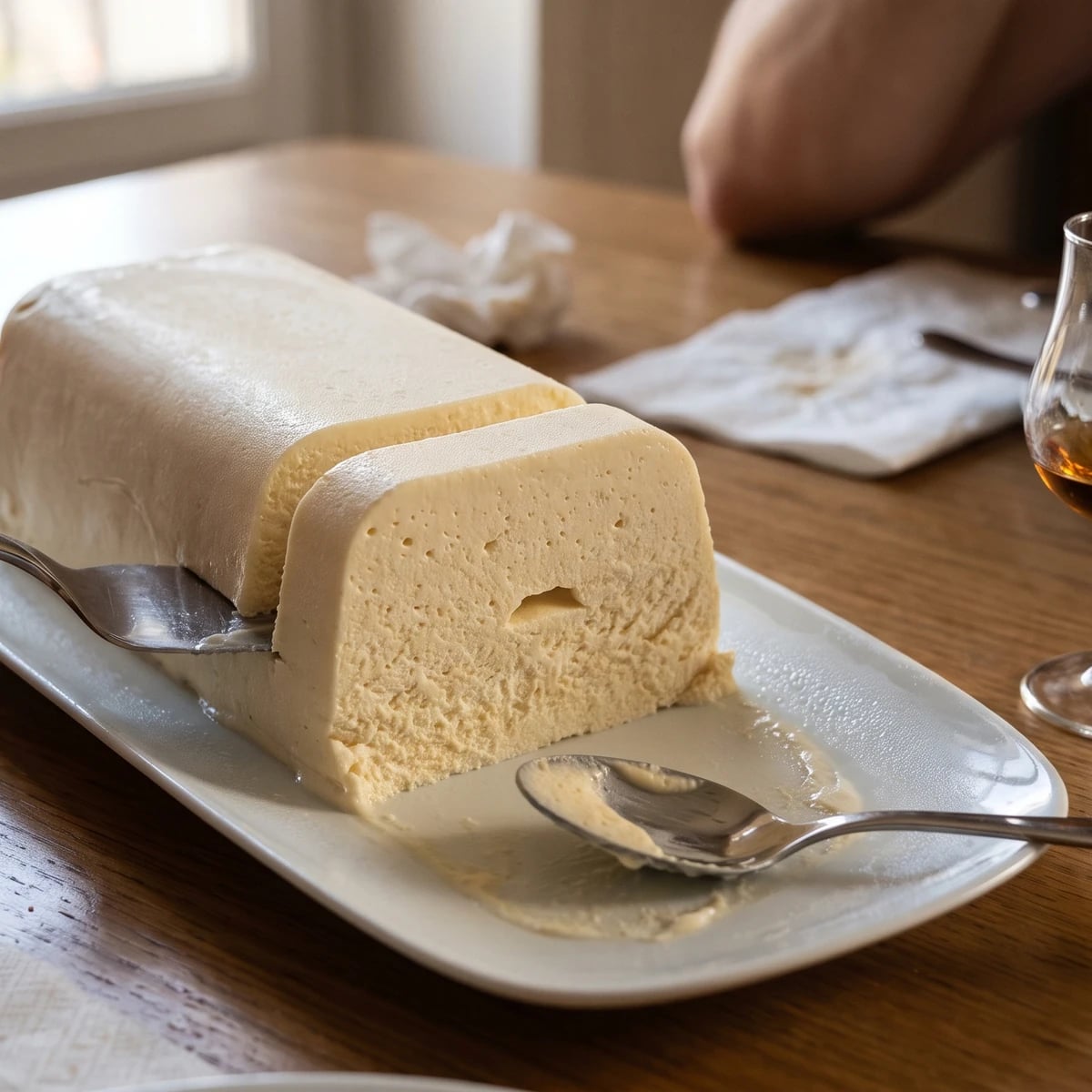
When it is right, the parfait is ivory-pale and finely aerated, firm enough to slice but softer than ordinary ice cream, with rum warming the finish. Before you fold, touch the bowl: it must feel cold, not merely cool.
Parfait belongs to the Parisian confectioner's and grand-kitchen repertory of moulded ices, where the name first belonged specifically to parfait au café. As the preparation settled into the canon, parfait became the common name for a single-flavour, unclothed ice from the same family as a bombe, and vanilla, chocolate, and pralined versions followed naturally. The French parfait is therefore a frozen yolk-and-cream preparation, not the layered dessert in a glass that the shared name often suggests.
Quantity
⅔ cup (160 ml / 135 g)
Quantity
½ cup plus 1 tablespoon (135 ml / 135 g)
Quantity
6 (about 7 tablespoons / 105 ml / 108 g)
Quantity
1⅓ cups plus 1 tablespoon (335 ml / 333 g)
very cold
Quantity
1½ tablespoons (22.5 ml / 21 g)
Quantity
(No. 916), no amount enters the parfait
| Ingredient | Quantity |
|---|---|
| granulated sugar | ⅔ cup (160 ml / 135 g) |
| cold water | ½ cup plus 1 tablespoon (135 ml / 135 g) |
| large egg yolks | 6 (about 7 tablespoons / 105 ml / 108 g) |
| heavy cream, at least 35% fatvery cold | 1⅓ cups plus 1 tablespoon (335 ml / 333 g) |
| dark rum, or brandy | 1½ tablespoons (22.5 ml / 21 g) |
| Reference only, not an ingredient: Another Method of Preparing Aspics de Filets de Soles (optional) | (No. 916), no amount enters the parfait |
Keep the book's cross-reference to Another Method of Preparing Aspics de Filets de Soles (No. 916) separate. It is a finished savoury preparation with its own formula and does not enter this dessert. The glossary term pralined belongs to the parfait flavour family, not to this rum preparation.
Combine the sugar and water in a small saucepan. Stir over low heat only until every crystal dissolves, bring the clear syrup to one quiet simmer, then remove it immediately. The equal weights of sugar and water give the home equivalent of syrup at roughly 28° Baumé, which describes density, not temperature. Cool the syrup completely in a jug set over ice, stirring occasionally.
Combine the yolks and all the cold syrup in a heavy saucepan. Whisk until even, then cook over the lowest heat, stirring continuously with a flexible spatula and reaching into every corner. Cook as for a crème anglaise (pouring custard) until the mixture turns pale, thickens slightly, and coats the back of a spoon, about 7 to 10 minutes or 80 to 82°C (176 to 180°F). Never let it simmer. If the first fine curds appear, lift the pan from the heat, set its base over ice, and whisk hard before straining. Ça se rattrape when caught at the first grain; firm scrambled curds mean the base must be begun again.
Strain the cooked yolk mixture immediately through a fine sieve into a clean metal bowl. Nest the bowl in a larger bowl of ice and cold water, then whisk continuously, by hand or with an electric mixer, until the base is thick, airy, and no warmer than 10°C (50°F). It should fall from the whisk in a pale ribbon, and the bowl should feel cold beneath your palm. If it is still warm, simply keep whisking over ice. Do not reach for the cream yet; this is the step that decides the parfait.
Whip the very cold cream in a chilled bowl until it holds stiff, upright peaks while remaining smooth and satin-finished. Stop as soon as it stands. If it begins to look slightly grainy, add a spoonful of the cold yolk base and fold gently until smooth. Ça se rattrape. Once distinct butter grains separate, however, the cream has gone too far.
Stir the rum into the cold yolk base. Fold in one-third of the whipped cream firmly to lighten it, then add the remainder in two additions, turning the mixture from the bottom with broad, deliberate strokes. Stop when no white pockets remain. Do not whisk now, because the air held by the cream is what gives the frozen parfait its fine, tender structure.
Spoon the mixture into a 900 ml metal mould or eight 120 ml metal cups. Smooth the top, tap each mould once to dislodge large air pockets, and cover closely. Freeze the large mould for at least 6 hours, or the individual moulds for 3 to 4 hours, until firm throughout. Leave the preparation still as it freezes; a parfait is not churned.
Dip the mould in barely warm water for 3 to 5 seconds, dry it, and invert it onto a chilled platter. If it clings, wrap the mould briefly in a warm damp cloth and try again rather than pulling at the parfait. Cut with a knife dipped in warm water and wiped dry between slices. Serve at once, pale, cold, and cleanly sliced. À table!
1 serving (about 78g)
Culinary guides, cultural storytelling, and the editorial depth that makes cooking meaningful.
Discover Culinary Explorer
Chef Juliette
Mousses glacées aux fruits teach the no-churn grammar of frozen dessert: one part cold syrup, one part pure fruit, two parts very stiff Chantilly, folded lightly and frozen before the air can fall.

Chef Juliette
A stone-cold crème anglaise, real cream, and patient whisking over ice become a pale, airy frozen mousse, proof that temperature, not force, is what lets this classical dessert hold its lift.

Chef Juliette
Mousse glacée teaches the cold dessert canon in one bowl: cook a smooth crème anglaise, fold it with softly whipped cream, choose your perfume, and freeze it without churning.

Chef Juliette
Pouding glacé is a frozen entremet, not ice cream: vanilla crème anglaise collée, folded with whipped cream and set in a mold. Master its custard and a whole family of no-churn desserts follows.