
Chef Juliette
Bombe Aboukir
Bombe Aboukir sets a pale pistachio ice shell around pralined pâte à bombe, cool, nutty, and cleanly sliceable, with chopped pistachios held in a centre as light as frozen mousse.
A cooking platform built around craft, culture, and the stories behind what we eat.
Created by Chef Juliette
Based on No. 2905, Bombe Sultane, from Le Guide Culinaire (1907) by Auguste Escoffier
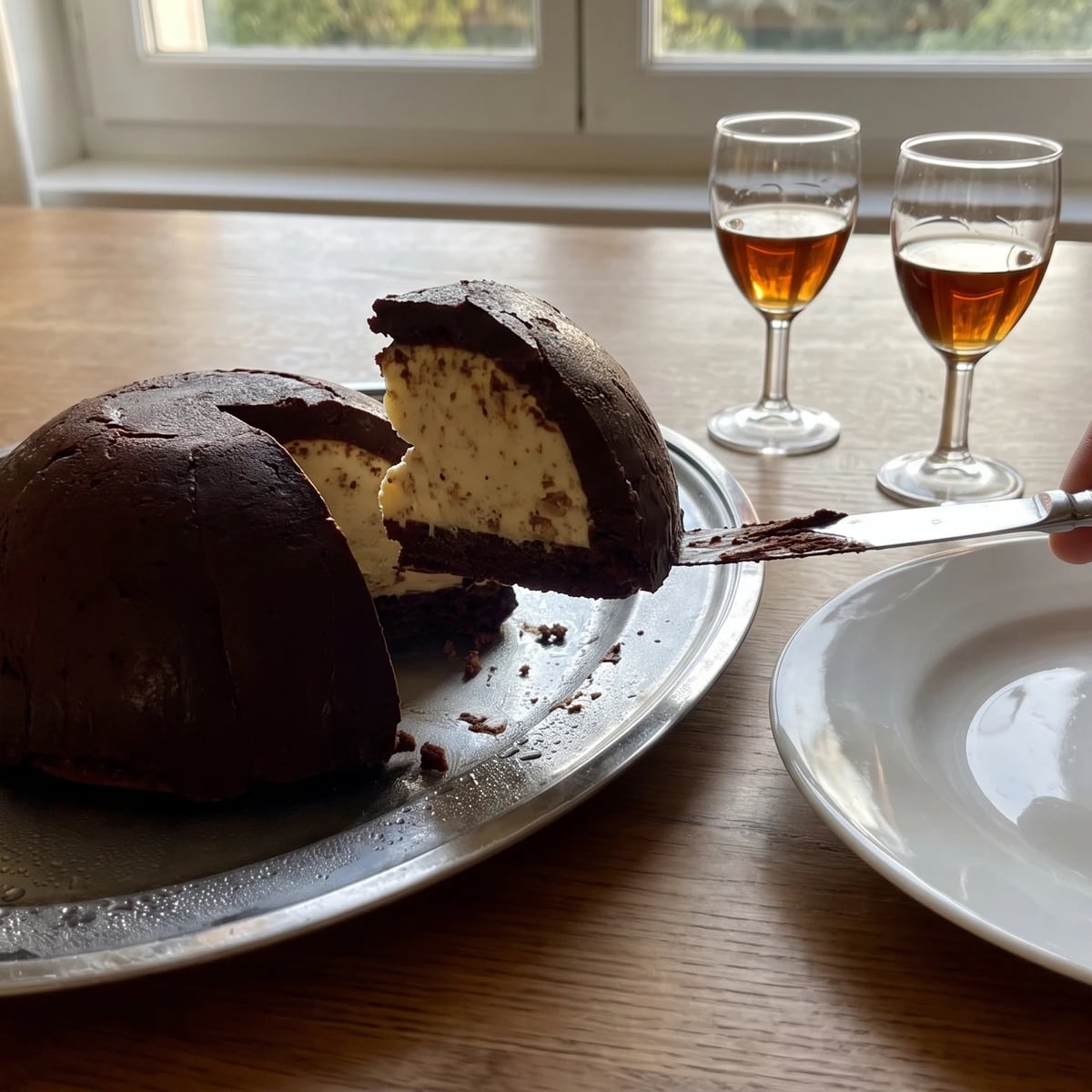
Dark chocolate ice around a light praline pâte à bombe centre, where pounded Pralin goes in last so the frozen mousse keeps its lift and the shell cuts cleanly.
Bombe Sultane (chocolate ice with a praline frozen-mousse centre) teaches the architecture of a classical frozen dessert: a firm shell around a lighter heart. The one true thing to know before touching a pan is this: the pounded Pralin goes in last, only after the cream has been folded through. Stir it early and its weight knocks the air from the centre.
The original entry gives architecture rather than quantities because the grand kitchen already had chocolate ice, Pralin, and Bombe-preparation waiting in separate departments, with a glacier tending moulds in tubs of salted ice. Here both frozen mixtures are made in small batches sized for one 1-litre mould. A domestic ice-cream machine and freezer replace the freezing chest, while a chilled stainless-steel bowl replaces the dedicated bombe mould. Those extra hands and tubs were scaffolding. The chocolate lining, the pâte à bombe, a whipped yolk-and-hot-syrup base, and the final fold of Pralin are the dish and must stay.
One cook, one stove, one evening. The freezer does the waiting. Fold the Pralin only when the cream is completely incorporated, then stop as soon as its amber flecks run through the mousse.
Bombe Sultane belongs to the Parisian grand-kitchen dessert repertoire, where frozen bombes paired a churned outer glace with a softer, cream-enriched Bombe-preparation at the centre. Sultane is a fanciful service title rather than a regional claim, and its chocolate-and-Pralin composition follows the confectionery vocabulary of the formal French table. The unlikely cross-reference to a sole aspic concerns only clothing the mould, the shared practice of building an even outer layer before adding the centre; no fish or jelly enters the dessert.
Quantity
1 cup (240 ml / 245 g)
Quantity
1/2 cup (120 ml / 120 g)
for the chocolate ice
Quantity
1/3 cup (80 ml / 65 g)
for the chocolate ice
Quantity
3
for the chocolate ice
Quantity
2/3 cup (160 ml / 100 g)
finely chopped
Quantity
1/4 cup (60 ml / 22 g)
Quantity
1/8 teaspoon (0.6 ml / 0.7 g)
Quantity
1/3 cup (80 ml / 50 g)
Quantity
1/4 cup (60 ml / 50 g)
for the Pralin
Quantity
1 tablespoon (15 ml / 15 g)
for the Pralin
Quantity
6 tablespoons (90 ml / 75 g)
for the pâte à bombe
Quantity
2 tablespoons (30 ml / 30 g)
for the pâte à bombe
Quantity
3
for the pâte à bombe
Quantity
3/4 cup (180 ml / 180 g)
for the pâte à bombe
Quantity
1 technique reference (No. 916)
consulted for clothing the mould only; no savory component enters the dessert
| Ingredient | Quantity |
|---|---|
| whole milk | 1 cup (240 ml / 245 g) |
| heavy cream, at least 35% fatfor the chocolate ice | 1/2 cup (120 ml / 120 g) |
| granulated sugarfor the chocolate ice | 1/3 cup (80 ml / 65 g) |
| large egg yolksfor the chocolate ice | 3 |
| dark chocolate, 64% to 70% cocoafinely chopped | 2/3 cup (160 ml / 100 g) |
| unsweetened cocoa powder | 1/4 cup (60 ml / 22 g) |
| fine salt | 1/8 teaspoon (0.6 ml / 0.7 g) |
| blanched whole almonds | 1/3 cup (80 ml / 50 g) |
| granulated sugarfor the Pralin | 1/4 cup (60 ml / 50 g) |
| waterfor the Pralin | 1 tablespoon (15 ml / 15 g) |
| granulated sugarfor the pâte à bombe | 6 tablespoons (90 ml / 75 g) |
| waterfor the pâte à bombe | 2 tablespoons (30 ml / 30 g) |
| large egg yolksfor the pâte à bombe | 3 |
| cold heavy cream, at least 35% fatfor the pâte à bombe | 3/4 cup (180 ml / 180 g) |
| Another Method of Preparing Aspics de Filets de Solesconsulted for clothing the mould only; no savory component enters the dessert | 1 technique reference (No. 916) |
Freeze the bowl of the ice-cream machine according to its instructions, if required. Set a 1-litre metal bombe mould or deep stainless-steel bowl in the freezer for at least 30 minutes, clear a level space around it, and prepare an ice bath large enough to hold the saucepan. Frozen desserts reward organization because every warm pause costs texture.
Heat the milk, the 1/2 cup cream, half the chocolate-ice sugar, and the salt until small bubbles gather around the pan. Whisk the 3 yolks with the remaining sugar, then pour in one-third of the hot milk while whisking. Return everything to the pan and stir constantly over gentle heat until the crème anglaise coats the spoon and reaches 82°C to 84°C (180°F to 183°F). Do not boil it. If fine grains appear, lift the pan immediately, blend briefly, and strain into the cold bowl. Ça se rattrape. A custard that smells of cooked egg has gone too far and must be remade.
Sift the cocoa into the hot custard and whisk until smooth, then pour it over the chopped chocolate. Wait one minute and stir from the centre outward until the mixture forms a dark, glossy emulsion. Strain it into a clean bowl, set it over the ice bath, and stir until thoroughly cold. Churn until dense and softly mounded, usually 20 to 25 minutes. It should spread without flowing.
Clothe the mould, using the coating principle preserved in Another Method of Preparing Aspics de Filets de Soles (No. 916). Press the soft chocolate ice over the bottom and sides of the frozen mould in an even layer about 1.5 cm thick, leaving a hollow centre and reserving about 3/4 cup for the final base. Use the back of a cold spoon to smooth the lining, then freeze it for 45 minutes. Hold the mould toward a light to find thin patches. If one appears, press on more chocolate ice and refreeze for 15 minutes; ça se rattrape.
While the shell freezes, spread the almonds on a tray and toast them at 175°C (350°F) until golden through the centre, about 8 minutes. Put the Pralin sugar and water in a small pale saucepan, dissolve the sugar over gentle heat, then boil without stirring until the caramel turns a deep amber. If crystals gather at the edge, cover the pan for 30 seconds so condensation washes them down. Add the warm almonds, turn them through the caramel, and scrape the mixture onto a silicone mat to cool completely.
Break the cold almond caramel into pieces and pound it in a mortar, or pulse it in a food processor, until it resembles coarse golden sand with a few pinhead-sized pieces. Stop before the almonds release enough oil to form a paste. If it begins clumping, spread it on a cold plate and finish chopping it with a knife. The centre wants the dry texture of pounded Pralin, not nut butter.
Put the pâte à bombe sugar and water in a small saucepan and boil without stirring to 118°C (244°F). Meanwhile, whisk the remaining 3 yolks until pale and thick. With the mixer running at medium speed, pour the hot syrup in a fine stream down the inside of the bowl, never onto the whisk, then beat at high speed until the mixture triples in volume and the bowl feels cool. If a little syrup hardens into threads on the bowl, remove the threads and keep whipping; the smooth mixture beneath is sound.
Whip the cold 3/4 cup cream to soft peaks. Fold one-quarter into the pâte à bombe to loosen it, then fold in the rest with broad turns until no white streaks remain. Only now add the pounded Pralin, folding four or five times, just enough to distribute it. This order decides the dish. Add the Pralin before the cream is through and the centre goes flat. If the mixture softens because the pâte à bombe was still warm, set the bowl over ice for five minutes and fold gently once more, never whisking.
Spoon the pralined Bombe-preparation into the chocolate-lined mould, pressing lightly so no empty pockets remain, and stop 1 cm below the rim. Freeze for 20 minutes. Soften the reserved chocolate ice just until spreadable, seal it across the exposed centre, and smooth the base level with the rim. Cover tightly and freeze for at least 4 hours, preferably overnight, until completely firm.
Chill the serving platter. Dip the mould in warm water for 5 seconds, dry it, invert it onto the platter, and lift straight upward. If it holds, wrap the mould briefly in a warm towel and try again; never keep soaking, or the chocolate shell will melt before the centre releases. If the surface softens, return the bombe to the freezer for 15 minutes. Cut with a thin knife dipped in hot water and wiped dry between slices. À table!
1 serving (about 125g)
Culinary guides, cultural storytelling, and the editorial depth that makes cooking meaningful.
Discover Culinary Explorer
Chef Juliette
Bombe Aboukir sets a pale pistachio ice shell around pralined pâte à bombe, cool, nutty, and cleanly sliceable, with chopped pistachios held in a centre as light as frozen mousse.

Chef Juliette
A thin dark chocolate chemise gives way to golden apricot pâte à bombe, a frozen dinner-party dessert whose elegance depends on spreading the shell evenly before it firms.

Chef Juliette
Apricot ice holds a Kirsch-scented pâte à bombe and ribbons of stewed fruit, frozen into a gleaming dome whose clean layers depend on cold components and thoroughly drained apricots.

Chef Juliette
Strawberry ice forms a bright, clean shell around a satin Kirsch pâte à bombe, a frozen dessert that teaches precise layering, restrained alcohol, and the patience to let each layer set.