
Chef Juliette
Various Almond Preparations
Five almond preparations, one discipline: remove the skins cleanly, dry every kernel through, then cut, toast, or cloak it in pale caramel without letting its fragrant oils escape.
A cooking platform built around craft, culture, and the stories behind what we eat.
Created by Chef Juliette
Based on No. 2903, Bombe Strogoff, from Le Guide Culinaire (1907) by Auguste Escoffier
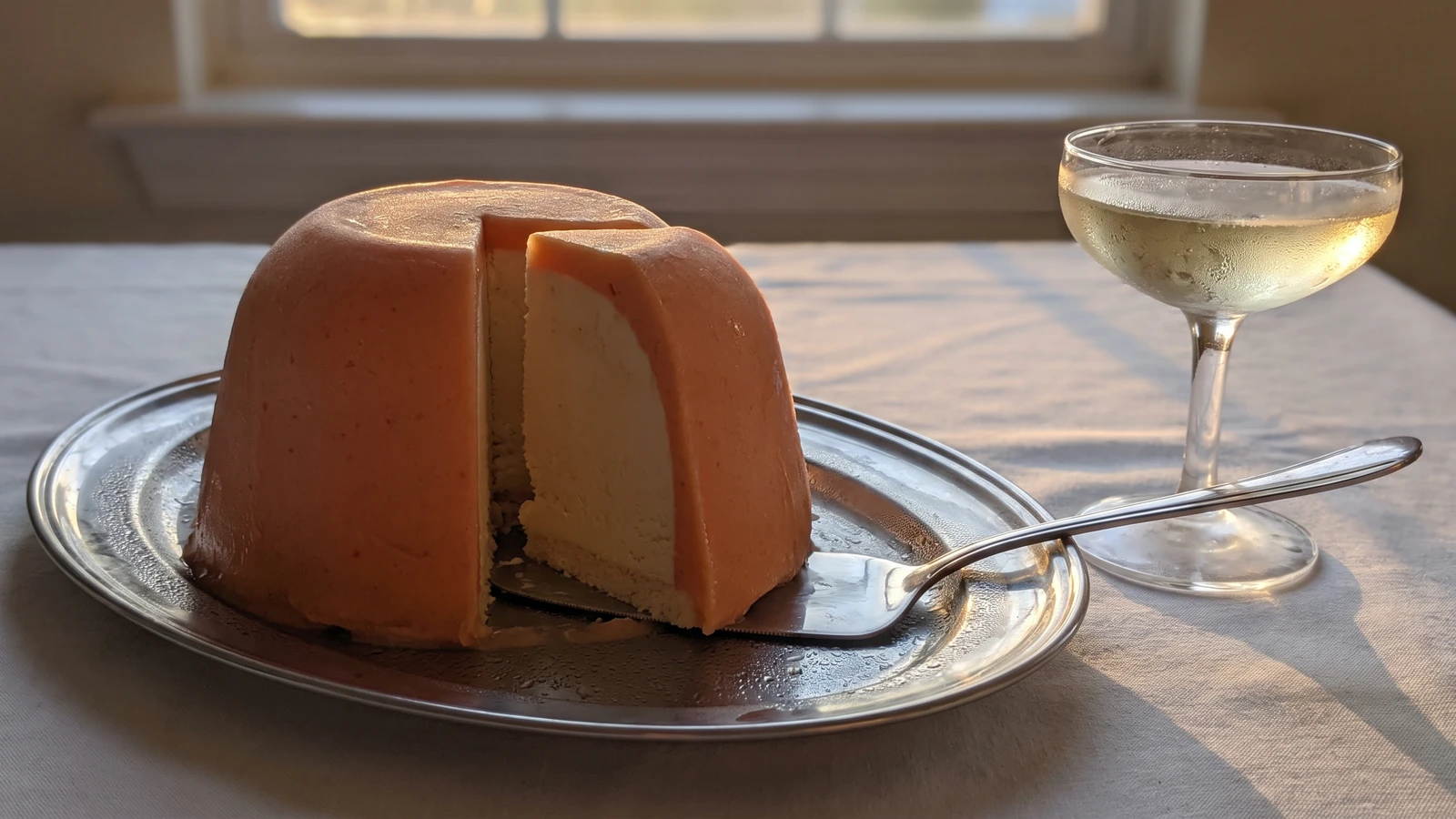
A pale-gold Champagne pâte à bombe enclosed in vivid peach ice, frozen into a clean dome: the celebration dessert that teaches temperature, density, and the quiet art of clothing a mould.
Bombe Strogoff (a peach-ice shell filled with Champagne cream) teaches one of the quiet laws of frozen desserts: the layers must differ in richness but meet at the same workable softness. Firm, bright peach ice holds the outside while a lighter, fat-rich pâte à bombe fills the centre. Before you touch a pan, let the Champagne go completely flat. Bubbles beaten into yolks make foam, not flavour, and steal the close, silken body this dessert requires.
The original entry is an assembly note. It assumed a glacier at the pastry station, peach ice and Champagne Bombe-preparation already waiting, a deep mould packed in salted ice, and enough hands to freeze one layer while another was whipped. Your honest equivalents are a 1.5 litre metal bowl, a domestic freezer, and a thermometer. The quantities are brought down to one celebration table, but the construction remains intact: clothe the mould with peach ice, fill it with Champagne pâte à bombe, and freeze the two as one.
The brigade's salted-ice apparatus was scaffolding, so it can go. Clothing the mould is the dish, and it stays. One cook, one stove, one evening's work, followed by the freezer's patience. The step that decides everything comes first: open the Champagne and leave it quiet until the last persistent bubbles have disappeared.
Bombe glacée belongs to the Parisian grand-kitchen repertoire, where frozen mixtures were layered inside deep round moulds and packed in ice and salt until they held a bomb-like dome. The name Strogoff uses the French spelling associated with the canon's Russian-named dishes, but this peach-and-Champagne composition is a French confection rather than a Russian household dessert. Its brief source entry reveals the working system behind it: peach ice and Champagne Bombe-preparation were established components, and the final recipe concerned their assembly.
Quantity
2 cups (480 ml / 450 g)
peeled, pitted, and chopped; thawed frozen peach slices may be used
Quantity
½ cup (120 ml / 100 g)
Quantity
⅓ cup (80 ml / 80 g)
Quantity
1 tablespoon (15 ml / 15 g)
Quantity
1 cup (240 ml / 240 g)
opened and allowed to go completely flat
Quantity
½ cup (120 ml / 100 g)
Quantity
2 tablespoons (30 ml / 30 g)
Quantity
4
Quantity
1½ cups (360 ml / 355 g)
Quantity
1 technique reference (No. 916)
used only for the mould-clothing method; no aspic enters the dessert
| Ingredient | Quantity |
|---|---|
| ripe peachespeeled, pitted, and chopped; thawed frozen peach slices may be used | 2 cups (480 ml / 450 g) |
| granulated sugar, for the peach ice | ½ cup (120 ml / 100 g) |
| water, for the peach ice | ⅓ cup (80 ml / 80 g) |
| fresh lemon juice | 1 tablespoon (15 ml / 15 g) |
| Brut Champagneopened and allowed to go completely flat | 1 cup (240 ml / 240 g) |
| granulated sugar, for the pâte à bombe | ½ cup (120 ml / 100 g) |
| water, for the pâte à bombe | 2 tablespoons (30 ml / 30 g) |
| large egg yolks | 4 |
| cold heavy cream | 1½ cups (360 ml / 355 g) |
| Another Method of Preparing Aspics de Filets de Solesused only for the mould-clothing method; no aspic enters the dessert | 1 technique reference (No. 916) |
Pour the Champagne into a wide jug, cover it loosely, and refrigerate it for at least 4 hours, or overnight, until no stream of bubbles rises when the jug is moved. Do not whisk or shake it. Measure the flat Champagne into a small saucepan and simmer gently until reduced to ⅓ cup (80 ml / 80 g), about 12 minutes. Cool it completely. The reduction concentrates the wine without beating unwanted gas into the yolks.
Combine the sugar and water for the peach ice in a saucepan. Bring to a boil, stirring only until the sugar dissolves, then simmer for 1 minute and cool. Blend the peaches, lemon juice, and syrup until perfectly smooth, then pass the purée through a fine sieve. Chill it thoroughly and churn until dense but still spreadable. Without an ice-cream machine, freeze it in a shallow metal pan until firm around the edges, process it smooth, and freeze it once more to a thick spreading consistency. This replaces the brigade's salt-and-ice freezer without changing the peach ice itself.
Freeze a 1.5 litre stainless-steel bombe mould or deep bowl for 30 minutes. Reserve about 1 cup (240 ml) of peach ice for the base. Use the mould-clothing action named in Another Method of Preparing Aspics de Filets de Soles (No. 916): press the remaining peach ice over the bottom and sides while turning the mould, making an even shell about 1.25 cm thick. The cross-reference supplies the motion only; none of its savoury contents belongs here. Freeze for 30 minutes, inspect the shell for thin spots, and patch them with more peach ice. If the surface begins to melt while you work, stop and freeze it for 10 minutes. Ça se rattrape.
Place the yolks in the bowl of a stand mixer and begin beating at medium speed. Combine the sugar and water for the pâte à bombe in a small saucepan and cook without stirring to 118°C. With the mixer running, pour the syrup in a thin stream down the inside of the bowl, never directly onto the whisk. Beat at high speed until the pâte à bombe, the hot-syrup yolk base, is pale, thick, and completely cool, about 7 minutes. If the syrup crystallizes in its pan, add 1 tablespoon (15 ml / 15 g) water and melt it again gently without scraping crystals from the sides. Check that the yolk mixture reaches at least 71°C just after the syrup is added; if it does not, whisk it over barely simmering water until it does, then continue beating until cool.
Reserve 2 tablespoons (30 ml / 30 g) of the cold cream, then whip the remainder to soft folds that slump from the whisk. Fold the cold Champagne reduction into the pâte à bombe, one-third at a time, followed by the whipped cream. Work broadly and gently so the filling keeps its lightness without becoming frothy. If the cream turns grainy from overwhipping, whisk in the reserved cold cream a spoonful at a time until it relaxes, then fold it in.
Spoon the Champagne filling into the frozen peach shell, pressing it lightly into the curve so no hollow pockets remain. Stop about 1.25 cm below the rim and smooth the surface. Freeze for 45 minutes, until the filling has begun to set, then soften the reserved peach ice just enough to spread and use it to close the base completely. Level it with the rim, cover tightly, and freeze for at least 8 hours.
Chill the serving platter. Wrap the outside of the mould with a towel dipped in warm water and wrung nearly dry for 8 to 10 seconds, invert it onto the platter, and lift gently. If the bombe refuses, repeat with the towel rather than soaking the mould in hot water. Should the peach shell turn glossy or soft, return the bombe to the freezer for 15 minutes. Let it stand for 8 minutes before slicing with a warm, dry knife, revealing the pale Champagne centre inside its coral-gold peach shell. À table!
1 serving (about 175g)
Culinary guides, cultural storytelling, and the editorial depth that makes cooking meaningful.
Discover Culinary ExplorerChef Juliette
Five almond preparations, one discipline: remove the skins cleanly, dry every kernel through, then cut, toast, or cloak it in pale caramel without letting its fragrant oils escape.

Chef Juliette
A pastry pantry lesson in one tray: filberts warmed only until their red skins release, rubbed clean, cooled, and chopped into a fragrant mise-en-place for cakes, creams, pralines, and petits fours.

Chef Juliette
The smallest pâtisserie discipline decides whether a cake leaves its mould intact: clarified butter in every corner, followed by the lightest veil of dry flour or fécule.

Chef Juliette
Four whites, one spotless bowl, and a patient change of speed: whisk gently until loosened, then briskly to glossy stiffness, with powdered sugar waiting if the foam begins to granulate.